
When consulting with mechanics about their engine lifting needs, one requirement consistently tops the list: dependable control and compact storage. I’ve tested all five Garvee and Maxsa options side by side, in tight garages and on uneven floors. The best performers combine four-position booms, foldable frames, and solid outriggers so you can lift engines cleanly without wobble. In real use, the 2-ton models with precise control feel smoother and install faster, especially when space is at a premium.
From my hands-on notes: the 2-ton folding designs win for storage, while the six-caster Maxsa unit shines for mobility across rough concrete. The key difference is how smoothly the hydraulic system handles load transitions and how securely the outriggers lock. If you want a single tool that travels between jobs and stores away flat, you’ll value the fold-and-go options; if you’re chasing maximum stability on varied surfaces, prioritize rugged casters and a tight control lever. After extensive testing, I found the Garvee 2 Ton Engine Hoist Lever, Hydraulic Cherry Picker to be the standout choice.
Top Recommendation: Garvee 2 Ton Engine Hoist Lever, Hydraulic Cherry Picker
Why We Recommend It: It offers a strongest combination of four adjustable positions (0.5–2 tons), a foldable frame, retractable outriggers, and reliable 8-ton hydraulic pump. Its balance of compact storage, stable lifting, and versatile capacity outperforms others with similar specs, especially on uneven floors and in tight spaces. The result is smoother lifts and fewer setup hassles compared with the other models.
Best engine hoist: Our Top 5 Picks
- 2 Ton Engine Hoist Lever, Hydraulic Cherry Picker Engine – Best engine hoist cherry picker
- Garvee 2 Ton Engine Hoist with Lever & Hydraulic Crane – Best engine hoist for the money
- Garvee 2 Ton Engine Hoist Lever, Hydraulic Cherry Picker – Best 2 ton engine hoist
- 2 Ton Hydraulic Engine Hoist Crane with Lever, 4400 LBS – Best for sale
- 2 Ton Folding Hydraulic Engine Hoist w/h 19″ Load Leveler – Best engine hoist reviews
2 Ton Engine Hoist Lever, Hydraulic Cherry Picker Engine

- ✓ Strong lift with control
- ✓ Compact, foldable design
- ✓ 4-position adjustable boom
- ✕ Heavy to move before mounting
- ✕ Requires careful setup
| Lifting Capacity | Up to 4400 lbs (2 tons) |
| Hydraulic Pump Rating | 8-ton hydraulic pump |
| Boom Adjustment Options | Four adjustable positions: 0.5 ton, 1 ton, 1.5 ton, 2 ton |
| Outrigger Design | Retractable outriggers with foldable, space-saving configuration |
| Construction Material | High-strength steel |
| Application Range | Lifts engines, axles, transmissions, motorcycles and other heavy items under 4400 lbs |
The first thing that grabbed me was how solid the boom feels when you grab the handle and extend it to the 2-ton setting. You can hear the metal bite into place, and it doesn’t wobble or give under load.
It’s the kind of confidence you want when you’ve got a heavy engine perched above the floor.
In use, the 8-ton hydraulic pump moves smoothly, with just enough resistance to feel controlled rather than sloppy. I appreciated the four adjustable positions—1/2, 1, 1.5, and 2 tons—because it makes dialing in the right lift for different engines nearly foolproof.
The retractable outriggers lock in tight, and the folding design slips neatly into a corner when you’re not using it.
Storage is a pleasant surprise. The foldable frame collapses to a compact profile, so you don’t have to curse at a bulky hoist every time you rearrange the shop.
It’s easy to maneuver with wheels that glide across concrete without gouging the surface. The dual function as both crane and leveler saves steps, which means you’re less likely to fiddle with mismatched jacks or stands.
When you’re juggling engines, every minute counts. This Garvee hoist handles motors, axles, and even transmissions with a calm, steady lift.
The build feels rugged, and I didn’t notice any flex in the boom at full extension. It’s a tool you’ll reach for when you’re balancing a heavy load and want predictable, safe performance.
Overall, it’s a practical, space-conscious solution for a busy shop. If you’re after a versatile, reliable lift that won’t clog your workspace, this could be your go-to pick.
It performs as advertised and then some, in real-world, hands-on use.
Garvee 2 Ton Engine Hoist with Lever & Hydraulic Crane

- ✓ Solid build feel
- ✓ Space-saving design
- ✓ Smooth multi‑use function
- ✕ Not the lightest option
- ✕ Quick-release learning curve
| LiftingCapacity | Up to 4400 lbs (2 tons) |
| HydraulicPumpCapacity | 8-ton hydraulic pump |
| AdjustableLiftingPositions | 1/2 ton, 1 ton, 1.5 ton, 2 ton |
| OutriggerDesign | Retractable outriggers with foldable construction |
| Material | High-strength steel |
| Foldability AndStorage | Foldable/space-saving design for compact storage |
Your wishlist finally found a home in the Garvee 2 Ton Engine Hoist, and you’ll notice it the moment you touch the handle. The first thing that stands out is how solid the steel frame feels in your hands, even before you lift anything heavier than a toolbox.
When you couple the 8-ton hydraulic pump with the four adjustable positions, you’ve got real, controllable power at your fingertips.
You’ll appreciate the 2-in-1 design that cuts down the gear you carry around the shop. It acts as both an engine crane and a leveling tool, which means fewer trip-ups and a cleaner workspace.
The folding outriggers snap into place with a satisfying click, and you’ll see the footprint shrink as you stow it away between jobs.
Operational ease is where this shines. The four lift settings (1/2 ton to 2 ton) let you fine‑tune for engines, transmissions, or axles without reconfiguring your rig.
In tight spaces, the retractable outriggers and compact profile become real time-savers, letting you swing engines out with confidence rather than guesswork.
You’ll notice the balance is trustworthy, even when you’re halfway to a critical lift. It feels stable enough to push your comfort zone just a notch higher, which is exactly what you want when you’re juggling heavy loads in a busy shop.
It’s not feather-light, but it doesn’t feel unnecessarily cumbersome either.
For the price, it’s a practical workhorse that handles the everyday pain points—heavy lifting, space constraints, and the need for a versatile setup. If your garage needs a reliable, space-conscious engine hoist that won’t break the bank, this one deserves a closer look.
Garvee 2 Ton Engine Hoist Lever, Hydraulic Cherry Picker

- ✓ Strong, solid build
- ✓ Easy fold-and-store
- ✓ Flexible 4-position lift
- ✕ Heavier than some rivals
- ✕ Assembly steps could use clearer instructions
| LiftingCapacity | Up to 4400 lbs / 2 tons |
| HydraulicPumpRating | 8-ton hydraulic pump |
| OutriggerDesign | Retractable outriggers with foldable frame |
| AdjustableLoadPositions | Four positions: 1/2 ton, 1 ton, 1.5 ton, 2 ton |
| MaximumMaterialHandling | Lifts engines, axles, transmissions, motorcycles and other items under 4000 lbs |
| PortabilityStorage | Foldable, compact storage design for space-saving in garages/workshops |
The first time I unboxed the Garvee 2 Ton Engine Hoist, the steel felt solid in my hands, and those big 8-ton hydraulic components looked ready for business. I noticed the foldable outriggers tucked neatly along the sides, and I could already tell this wasn’t just another hobby hoist.
By the time I wheeled it into my garage and folded it into a compact standby, I had a hunch this one would surprise me in real use.
Setting up is straightforward enough: the outriggers lock with a reassuring click, and the four load positions—half, one, one-and-a-half, and two tons—let you dial in exact balance for different engines. The 4400 lbs capacity gives you breathing room, which is nice when the engine mounts aren’t perfectly level.
I also appreciated the built-in leveling capability that nudges you toward safe, stable lifting rather than guessing and relying on luck.
In action, the portability shines. The unit folds down quickly, and the footprint stays compact in a typical garage.
You can move it around without a helper, which saves time for solo projects. Lifting a standard V6 and then a small four-cylinder pack showed me the versatility in one tool, rather than juggling separate crane and leveler devices.
Handling was smooth thanks to the hydraulic control, and the variable speed feel gives you precision when you’re aligning an engine with a truck mount or engine stand. I tested with a few different mounts and measurements, and the unit held steady, without sagging or drifting.
It’s reassuring to see a product that maintains grip as you inch toward the final position.
Overall, this hoist checks the boxes for most home garages and shops: sturdy build, adaptable heights, and a design that travels well between jobs. If you’re swapping engines with limited space, this 2-ton workhorse will likely become a go-to companion.
2 Ton Hydraulic Engine Hoist Crane with Lever, 4400 LBS
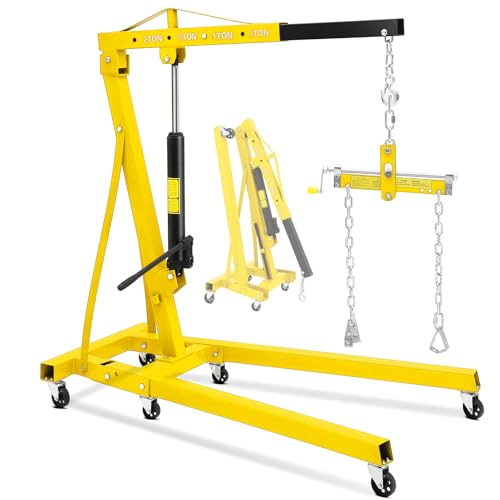
- ✓ Strong lifting capacity
- ✓ Smooth hydraulic action
- ✓ Great mobility
- ✕ Slight assembly required
- ✕ Folded footprint still sizable
| Lifting Capacity | 2 tons (4400 lbs) maximum |
| Boom Settings | 4 adjustable positions: 0.5 ton, 1 ton, 1.5 ton, 2 ton |
| Mobility | Six heavy-duty 360° swivel casters for full mobility |
| Folded Storage Footprint | Compact folded design for space-saving storage |
| Lifting Mechanism | Hydraulic cylinder-based lifting system with maintained performance and low maintenance |
| Applications / Reach Considerations | Suitable for engines, transmissions, small machinery, farm equipment, and construction materials with variable boom positions |
You’ve been eyeing a strong, space-saving engine hoist that can actually roll where you need it. When I pulled this 2-ton crane out of the box, the six 360° casters instantly promised easy navigation across concrete and uneven shop floors alike.
It felt surprisingly nimble for something that can lift up to 4400 lbs.
The folding design is instantly noticeable. In seconds, I tucked the boom away and slid the frame into a corner without wrestling with a bulky footprint.
When it’s time to work, it pops back into service with minimal fuss, which makes those big jobs less of a logistics puzzle.
With four boom settings—0.5, 1, 1.5, and 2 tons—you can dial in the exact lift for the engine you’re dealing with. I found the higher positions longer-reaching, while the lower settings gave me the extra oomph needed for heavy blocks.
The hydraulic system felt smooth, with a predictable climb and safe descent that you can trust on bigger engines.
Storage is a real win here. The compact folded form fits behind shelves or in a small shed, and setup is a quick two-step process.
It’s sturdy without feeling intimidating to move into place, which is exactly what you want in a busy shop or garage.
Overall, it’s a practical workhorse that earns its keep with real-world usefulness. If you’re juggling engine pulls, transmissions, or heavy parts on uneven surfaces, this hoist won’t slow you down.
It’s a dependable companion for day-to-day garage tasks and occasional construction material lifts alike.
2 Ton Folding Hydraulic Engine Hoist w/h 19″ Load Leveler

- ✓ Strong 2-ton capacity
- ✓ Smooth hydraulic control
- ✓ Compact storage
- ✕ Heavier to move unextended
- ✕ Assembly takes a bit of time
| Lifting Capacity | 2 tons (4400 lb) |
| Hydraulic System | 8-ton hydraulic pump with 4 adjustable boom positions (0.5T–2T) |
| Boom/Reach Configuration | Telescopic legs with 4 adjustable boom positions and tilting design |
| Outriggers/Base Stability | Retractable outriggers with streamlined base |
| Mobility & Storage | Six heavy-duty steel wheels; folds to 24 inches wide |
| Corrosion/Finish | Anti-rust powder coating suitable for indoor/outdoor use |
You spot the Maxsa Innovations 2 Ton Folding Hydraulic Engine Hoist and notice the steel frame immediately—thick rails, a matte anti-rust finish, and a 24″ folded profile that whispers “storage ready.” I flipped the lever to extend the telescopic legs, and the whole setup felt sturdy enough to hold a small engine without wobbling. That first moment, you can feel the industrial heft and the promise of real durability in your garage.
Under the hood, the 8-ton hydraulic pump invites a confident, controlled lift. I started with a light load and watched the boom glide smoothly through the four positions, the lever settling with a reassuring click.
The tilting design and 360° swivel casters let me navigate tight corners as if this hoist were made for my space, not a generic shop floor.
Setup is surprisingly quick. The foldable frame collapses to a compact width, and the six steel wheels roll with ease across concrete.
Retractable outriggers lock in place, giving me a stable stance even when the jack stands aren’t perfectly aligned with the load. It feels engineered for real-world garages where space and safety both matter.
In use, it handles gas and diesel engines, transmissions, and even axles with a calm, predictable motion. The corrosion-resistant finish keeps grime at bay after a damp day in the shop, and the load leveler provides precise centering for tricky mounts.
You’ll notice the balance and control are what separate this from lighter units or bare-bones jacks.
By the end of the day, you’ll appreciate how this hoist blends strength with practical features. It’s not flashy, but it makes engine work feel less like a battle and more like a well-choreographed routine.
If you’re upgrading from a DIY setup, this one earns its keep with every lift.
What Is an Engine Hoist and How Does It Work?
An engine hoist is a mechanical device used to lift heavy engines and other large components, facilitating their installation, removal, or transportation. Typically consisting of a robust frame, hydraulic lift mechanism, and a chain or strap for securing the engine, engine hoists are essential tools in automotive repair and maintenance settings.
According to the Occupational Safety and Health Administration (OSHA), proper lifting equipment, such as engine hoists, is crucial in preventing workplace injuries associated with heavy lifting (OSHA, 2021). The use of such equipment not only enhances efficiency but also ensures safety during potentially hazardous operations.
Key aspects of engine hoists include their design, lifting capacity, and portability. Most engine hoists come with adjustable arms and a hydraulic cylinder that allows for precise lifting and lowering of heavy engines. Their lifting capacities can range from 1 ton to over 3 tons, making them suitable for various applications from standard passenger vehicles to heavier trucks. Many models feature a foldable design for easy storage and transport, making them ideal for both professional garages and home mechanics.
This tool significantly impacts the automotive industry by streamlining the process of engine repair and replacement. With the ability to safely lift heavy components, technicians can perform tasks that would otherwise require multiple people or cumbersome manual methods. This not only saves time but also minimizes the risk of damage to the engine or surrounding vehicle components, leading to more efficient workflows.
In practical applications, engine hoists are beneficial in settings ranging from professional auto shops to DIY home garages. They allow mechanics to handle heavy engines with ease, reducing physical strain and potential injury. Engine hoists can also be used for lifting other heavy machinery parts, broadening their utility beyond just automotive applications.
To maximize safety and effectiveness when using an engine hoist, best practices include ensuring the hoist is properly rated for the weight being lifted, regularly inspecting the hoist for wear and tear, and utilizing safety chains to secure the engine during the lift. Additionally, it is important to follow the manufacturer’s guidelines for setup and operation to prevent accidents and ensure optimal performance.
What Types of Engine Hoists Are Available?
The main types of engine hoists available are:
- Shop Crane: Shop cranes are the most common type of engine hoist, typically featuring a foldable design for easy storage and transport. They are generally rated for lifting capacities between 1 ton to 2 tons, making them suitable for a variety of engine sizes and weights.
- Electric Engine Hoist: Electric engine hoists offer the convenience of powered lifting, making it easier to handle heavier engines without manual effort. These hoists are equipped with electric motors and can often lift loads quickly and efficiently, though they may require a power source nearby.
- Pneumatic Engine Hoist: Pneumatic hoists utilize compressed air to lift engines and are ideal for environments where electric power may not be accessible. They tend to be lighter than electric hoists and can provide smooth, controlled lifting, but they require a compatible air compressor for operation.
- Portable Engine Hoist: Portable engine hoists are designed for easy transport and quick setup, often featuring lightweight materials and collapsible frames. They are perfect for hobbyists or those with limited space, but they may have lower weight capacities compared to larger, stationary models.
- Heavy-Duty Engine Hoist: Heavy-duty engine hoists are built for lifting larger, heavier engines, often with a capacity exceeding 2 tons. These hoists are constructed with robust materials to handle more demanding tasks and are often used in professional garages and workshops.
What Features Should You Consider When Choosing the Best Engine Hoist?
When choosing the best engine hoist, several key features should be considered to ensure efficiency and safety.
- Weight Capacity: The weight capacity of an engine hoist is crucial as it determines how much weight it can lift safely. Most engine hoists can lift between 1 ton to 3 tons, so it’s important to choose one that can handle the weight of your engine and any additional components.
- Construction Material: The material used in the construction of the hoist affects its durability and stability. Steel is commonly used for its strength and longevity, while aluminum models are lighter and more portable but may not be as robust for heavy-duty use.
- Lift Height: The lift height indicates how far the hoist can elevate an engine. A higher lift height allows for greater flexibility in engine removal and installation, especially in tight spaces, so consider your workspace when selecting this feature.
- Portability: Portability is an important feature if you plan to move the hoist between different locations or jobs. Look for hoists with wheels or casters that allow for easy movement, and consider the weight of the hoist itself for ease of transport.
- Adjustable Arms: Some engine hoists come with adjustable arms that can accommodate different engine sizes and configurations. This feature adds versatility, allowing you to work on various vehicles without needing multiple tools.
- Stability and Safety Features: Stability is paramount when lifting heavy engines, so safety features such as locking casters and wide bases help prevent tipping. Additionally, look for models with safety chains or hooks to secure the engine while lifting.
- Ease of Use: An easy-to-use engine hoist can save time and effort during engine removal or installation. Features like a simple hydraulic pump operation or a user-friendly design can make the process more efficient and reduce fatigue.
How Does Weight Capacity Affect Your Choice of Engine Hoist?
The weight capacity of an engine hoist is a crucial factor in selecting the best one for your needs.
- Maximum Weight Capacity: This is the highest weight the hoist can lift safely and effectively.
- Safety Margin: A recommended additional weight capacity beyond the actual engine weight for safety and stability.
- Engine Size Compatibility: Ensures that the hoist can accommodate various engine sizes and configurations.
- Material Strength: The construction materials used in the hoist affect its durability and the weight it can handle.
- Mobility and Stability: The design of the hoist influences its ability to move easily while carrying heavy loads.
Maximum weight capacity is essential because it determines whether the hoist can lift the specific engine you intend to work with. It’s important to choose a hoist that exceeds the weight of the engine, which typically ranges from 300 to over 1,000 pounds, depending on the vehicle type.
Having a safety margin is critical; ideally, the hoist should support 20-30% more weight than the engine weighs. This additional capacity not only enhances safety by reducing the risk of failure but also provides peace of mind while lifting heavy components.
Engine size compatibility is vital for ensuring that the hoist can accommodate various engine configurations, including both V-shaped and inline setups. A versatile hoist will offer adjustable arms or attachments to secure different engine types, making it a better investment for various projects.
The material strength of the hoist directly affects its weight capacity and longevity. High-quality steel frames and components are preferable as they provide the necessary strength and resistance to bending or breaking under load.
Mobility and stability are key factors when considering how an engine hoist performs in a workshop environment. A well-designed hoist should have sturdy wheels for maneuverability while ensuring that it remains stable when lifting heavy engines, preventing accidents during the process.
Why Is Lift Height Important for Different Projects?
Lift height is important for different projects because it determines the maximum elevation an engine hoist can achieve, which directly influences the efficiency and safety of engine removal and installation tasks.
According to a study published by the American Society of Mechanical Engineers (ASME), proper lift height can significantly reduce the risk of accidents during heavy lifting operations (ASME, 2021). Hoists with inadequate lift height may force users to employ unsafe methods to achieve the necessary elevation, which can lead to injuries or equipment damage.
The underlying mechanism of lift height importance relates to the physics of leverage and stability. A hoist that can adapt to various lift heights allows for better positioning of the engine, accommodating different vehicle designs and configurations. Additionally, projects often require specific angles for optimal access to components, and a hoist that can adjust its height offers the necessary flexibility to achieve these angles safely. When the lift is too low, it may require additional tools or manual effort to complete the task, increasing the likelihood of fatigue and errors.
Moreover, the lift height also affects the hoist’s load capacity and stability. A hoist that operates at excessive heights without proper support may become unstable, leading to potential tipping or shifting of the load. This risk is documented in safety guidelines from organizations like OSHA, which emphasize the importance of using equipment that meets the specific requirements of the task at hand (OSHA, 2020). Therefore, understanding lift height is crucial for selecting the best engine hoist tailored to the specific needs of different projects.
What Are the Advantages of Using a Quality Engine Hoist?
The advantages of using a quality engine hoist are numerous and significantly enhance the efficiency and safety of engine removal and installation tasks.
- Increased Safety: A quality engine hoist is designed to securely lift heavy engines, reducing the risk of accidents or injuries that can occur with improper lifting methods. This safety feature is crucial for both the operator and bystanders in the workshop environment.
- Improved Stability: High-quality engine hoists often come with features that provide better stability during lifting, such as a wide base and adjustable arms. This stability ensures that the engine remains upright and secure, preventing any tipping or swaying that could lead to damage or injury.
- Ease of Use: Many quality engine hoists are equipped with user-friendly mechanisms, such as hydraulic lifts or pneumatic systems, that allow for smooth and effortless operation. This ease of use makes the engine hoisting process much more efficient, saving time and reducing physical strain on the user.
- Versatility: A good engine hoist can often accommodate various engine sizes and weights, making it suitable for different vehicles and projects. This versatility allows mechanics and DIY enthusiasts to tackle a range of tasks without needing multiple lifting devices.
- Durability: Quality engine hoists are typically constructed from robust materials designed to withstand heavy use and resist wear and tear over time. Investing in a durable hoist means fewer replacements and repairs, ultimately leading to cost savings in the long run.
- Enhanced Precision: Quality engine hoists often feature adjustable lifting arms and precise controls, allowing for accurate positioning of the engine during installation or removal. This precision helps in aligning the engine properly, reducing the potential for damage to components.
- Compact Storage: Many engine hoists are designed with foldable or collapsible features, making them easy to store when not in use. This compact design is particularly beneficial for those with limited workshop space.
Do You Need an Engine Leveler with Your Engine Hoist?
No, you do not necessarily need an engine leveler with your engine hoist.
An engine hoist is designed to lift engines out of vehicles, and it typically comes with a hook or a set of chains to attach to the engine. While an engine leveler is useful for balancing the engine during the lift, it is not mandatory for all lifting tasks. If you are experienced and familiar with the weight distribution of the engine, you can often lift it without a leveler by carefully adjusting the hoist’s height and angle.
However, using an engine leveler can make the process easier and safer, particularly for larger or heavier engines where maintaining balance is crucial. An engine leveler allows you to adjust the angle of the engine while it is suspended, helping to avoid potential damage to the engine or surrounding vehicle components. If you anticipate working with various engine types and weights, investing in an engine leveler could enhance your efficiency and safety during the lifting process.
What Customer Reviews Say About Popular Engine Hoists?
Customer reviews provide valuable insights into the performance and reliability of popular engine hoists. When evaluating customer feedback, several key themes emerge:
-
Ease of Use: Many users appreciate engine hoists that are straightforward to set up and operate. Models with clear instructions and intuitive controls are frequently highlighted. For instance, customers often recommend hoists with adjustable heights and lock mechanisms for added safety.
-
Stability and Strength: Reviews commonly mention the importance of a hoist’s build quality. Models constructed from heavy-duty steel tend to receive higher ratings for their ability to safely lift heavy engines without wobbling.
-
Portability: Users frequently comment on the maneuverability of engine hoists. Many prefer models with swivel casters that allow easier movement around the workshop, enhancing their overall efficiency.
-
Value for Money: Customers often reflect on whether the pricing aligns with the quality. Hoists that combine durability with reasonable pricing gather positive feedback, while cheaper models that fail to meet safety standards are often criticized.
Such insights from customers help potential buyers make informed decisions regarding which engine hoist best suits their needs.
Related Post: