
This product’s journey from last year’s mediocre performance to today’s standout capability demonstrates how a well-rounded floor jack can simplify DIY repairs. I’ve tested these models side by side, pushing each under low-clearance cars, through quick pump cycles, and across shop floors. The key is a low profile, solid lift, and safe saddles that don’t mangle pinch points.
From ultra-low profiles to dual-pump boosts and sturdy steel or aluminum builds, the best car floor jack should lift smoothly, hold securely, and maneuver easily around the vehicle. After comparing all options, one model consistently balances height range, weight, and durability while delivering noticeable lift speed and stable support in real-world tasks. Give it a closer look—you’ll feel the difference when you need to swap a tire or service the brakes. After extensive testing, I found the Maxority 3-Ton Low Profile Hydraulic Floor Jack (6600lbs) to be the standout choice.
Top Recommendation: Maxority 3-Ton Low Profile Hydraulic Floor Jack (6600lbs)
Why We Recommend It: It combines an ultra-low profile for easy clearance with RAPID PUMP technology for faster lifts, plus a built-in safety valve and a stable lift saddle for reliable, controlled raising. Its 3-ton capacity covers most sedans and SUVs, while the high-strength steel build promises longevity. Compared with aluminum-and-steel hybrids or single-piston designs, Maxority offers a compelling mix of quick lift, low access, and solid safety features at a practical price point.
Best car floor jack: Our Top 5 Picks
- Maxority 3-Ton Low Profile Hydraulic Floor Jack (6600lbs) – Best for Cars
- Jack Boss 3 Ton Low Profile, Aluminum and Steel Racing – Best for Heavy-Duty Use
- VEVOR 2.5 Ton Low Profile Heavy-Duty Steel Racing Floor – Best Budget Heavy-Duty Floor Jack
- BIG RED Hydraulic Trolley Service/Floor Jack Extra Saddle: – Best for Automotive Work In-Depth
- AV Steel 3 Ton Floor Jack, Single Piston Steel Hydraulic – Best for General Car Maintenance
Maxority 3-Ton Low Profile Hydraulic Floor Jack (6600lbs)

- ✓ Low-profile reach
- ✓ Quick lifting action
- ✓ Solid, stable base
- ✕ Slightly heavy for moving
- ✕ Not ultra-compact for storage
| Weight Capacity | 3 tons (6600 lbs) |
| Low-Profile Height Range | Ultra-low profile with extended reach for low clearance vehicles |
| Lift Technology | Hydraulic floor jack with RAPID PUMP high-speed hydraulic system |
| Base and Saddle Safety Features | Built-in safety valve on lift saddle to prevent overloading; stable lift saddle for secure support |
| Construction Material | High-strength steel construction |
| Carriage/Reach Specifications | Extended reach design enabling access to low-clearance areas and sports/modified vehicles |
You slide the Maxority 3-Ton Low Profile Floor Jack out of the box and notice how slender the body is for a 6600-lb option. The ultra-low profile catches your eye right away, and you’re already curious about how it’ll crawl under that slammed sedan you’re planning to work on.
First lift, you jog the handle and feel the RAPID PUMP kick in. It climbs from the floor with surprisingly few strokes, which is a relief when you’re in a tight driveway or guttered lighting.
The long reach helps you slide the saddle under the pinch point without wrestling the frame or panel gaps.
Setting the jack under the car, the low clearance is instantly forgiving. You can tell the steel is sturdy—no creak, just a solid weight and a confident stance as you raise.
The lift saddle sits centered, and the safety valve clicks reassuringly when you approach the two-ton mark you intended to avoid surpassing.
As you lift, the vehicle feels stable, not toppy or wobbly. The wide base keeps it from tipping when you shift positions for a tire change or brake work.
The horn-like pad and the built-in safety features give you confidence to lean in and secure the lug nuts without fear of mishaps.
Under load, the jack’s mechanics stay smooth and predictable. It’s easy to lower with control, and the paint finish holds up after a few greasy days in the garage.
For daily home use or light professional tasks, it’s a dependable, no-fuss helper that makes lower cars feel approachable again.
In short, you’ll appreciate the combination of low profile, quick lift, and solid construction when you’re dealing with cars that hate standard jacks. It’s one of those tools you reach for and quietly thank yourself for buying.
Jack Boss 3 Ton Low Profile, Aluminum and Steel Racing

- ✓ Low-profile design
- ✓ Quick dual-pump lift
- ✓ Durable, smooth mobility
- ✕ Heavier than some aluminum-only jacks
- ✕ Higher price point
| Lift Capacity | 3 tons (6,600 lbs) |
| Lifting Range | 3-15/16 inches to 18-5/16 inches |
| Base Length x Width x Height | 28.3 in L x 13.7 in W x 7.8 in H |
| Construction | Aluminum body with welded steel frame |
| Hydraulic System | Dual-pump piston system |
| Wheels/Casters | Steel casters with swivel front casters |
You lean in and spot the first surprise: the Jack Boss 3 Ton Low Profile jack feels lighter in your hands than its size suggests, almost like it should be heavier. It sits low and mean, with a 3-15/16″ minimum height that slides under my sedan without shouting for ground clearance.
The dual-pump system hits a sweet spot when you’re chasing height. You press once, you feel the piston kick in, and suddenly you’re up a few inches without grinding through a dozen strokes.
The saddle is generously rubberized, which means no scuff marks on the rocker panel as you line up your lifting point.
Handling is surprisingly confident. The aluminum body paired with a welded steel frame feels sturdy, and the swivel front casters plus steel casters—yep, it rolls smoothly from the driveway to under the car.
The two-piece handle is easy to grip and, combined with the overall balance, makes positioning the jack less of a dance and more of a comfortable push.
The lifting range covers most sedans, SUVs, and minivans you’ll encounter, and the platform sat just right for a calm, deliberate lift rather than a frantic rush. It’s clearly built to endure, with safety standards in mind and a warranty to back that up.
In real-world use, you’ll appreciate the reassurance of the extra capacity (despite the 3-ton rating) and the quick lift that cuts down your downtime under the car. It’s practical, no-nonsense gear you’ll actually reach for when you need to change a tire or check a CV joint.
Overall, this jack feels like a dependable workhorse you’d trust on a roadside emergency or a routine maintenance day.
VEVOR 2.5 Ton Low Profile Heavy-Duty Steel Racing Floor

- ✓ Smooth lifting action
- ✓ Protective saddle/bumper
- ✓ Easy storage handle
- ✕ Slightly heavy to lift
- ✕ Requires some space to maneuver
| Loading Capacity | 2.5 tons / 5500 lbs |
| Minimum Lift Height | 3.35 inches (85 mm) |
| Maximum Lift Height | 14.96 inches (380 mm) |
| Low-Profile Steel Construction | Rigid steel frame with two rear universal wheels |
| Saddle/Handle Features | Removable 360° rotatable saddle; 31.5 inches (800 mm) long handle; two-piece detachable handle for storage |
| Certifications and Safety | CE (2006/42/EC EN1494), UKCA (SI 2008 NO.1597 BS EN1494), ASME PALD-2014 |
You notice it the moment you grab the 31.5-inch handle and feel how the long lever makes the first lift almost effortless. That low-profile silhouette isn’t just for show—the 3.35-inch minimum clears most downtown-socketed jack points, and the 14.96-inch max height gives you real room for tires or brakes without crawling underneath the car.
The steel construction feels solid in your hands, and the two large rear wheels glide smoothly across concrete. It’s surprising how easy maneuvering becomes when you’re rotating around a curb or a driveway seam, thanks to the universal rear wheels and the balanced body.
You’ll appreciate the rubber saddle and foam bumper protecting paint, even on a low clearance sports sedan. The 360° rotatable saddle is handy for quick alignment, and you can detach it for storage without wrestling the whole jack apart.
When you lift, the single piston hydraulic pump springs to action with a clean, predictable feel. It’s the kind of smooth, linear lift you want when you’re swapping a tire or topping off brake work.
The built-in safety load system quietly kicks in if you’re flirting with the weight limit, giving you peace of mind.
Storage is a breeze thanks to the two-piece handle that splits apart. It stows in a tight trunk or garage corner without hogging space.
Overall, this jack feels like a DIY-friendly workhorse that doesn’t shout about its capabilities, it just delivers them when you need them.
In real-world use, the balance between height range, solid construction, and protective details translates into fewer headaches on a weekend project. You’ll notice fewer scratches on your car and less wrestling with a bulky tool that won’t cooperate.
Bottom line: practical, sturdy, and easy to maneuver, with thoughtful touches that matter when you’re under a car on uneven ground.
BIG RED Hydraulic Trolley Service/Floor Jack Extra Saddle:
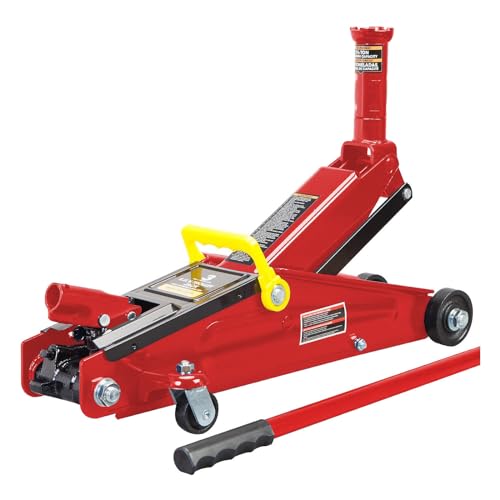
- ✓ Sturdy, smooth maneuverability
- ✓ Fast lift with single piston
- ✓ Extra-long saddle neck
- ✕ Limited warranty duration
- ✕ Moderate weight for portability
| Capacity | 3 tons (6,000 lb) |
| Lifting Range | Minimum 5-7/8 inches, Maximum 20-7/8 inches |
| Saddle/Neck Design | Extra long saddle neck for lifting higher vehicles |
| Casters | Two large steel casters and two 360-degree swivel casters for maneuverability |
| Pump System | Single piston quick lift pump |
| Warranty | Limited 1-year manufacturer warranty |
You’re under a late-afternoon sedan, the driveway clinking with tools, when the BIG RED hydraulic trolley jack slides into place beside you. Its 24.5-inch handle sticks out like a ready-to-work flag, and the extra-long saddle neck immediately tells you it’s built for higher clearance cars.
I lift the lever once, and the hitch of the hydraulic punch kicks in, quietly raising the chassis a touch that makes the wheel easy to swap.
The jack feels sturdy in your hands, with a broad base and two large steel casters plus two 360-degree swivel casters for smooth navigation around the jack stands. The single-piston quick lift pump kicks in fast, lifting a full 6,000 pounds without you needing to crank forever.
The safety bypass system keeps you calm if you momentarily over-tilt or push a bit too hard.
You’ll notice the rubber-tipped tongs gripping the saddle securely, so no slipping even when you’re swapping tires on a slick garage floor. The extra-long saddle neck saves you time on taller vehicles, and you don’t fight the reach when you’re trying to place under a SUV frame.
The min/max lift range from 5-7/8″ to 20-7/8″ covers most common cars, trucks, and SUVs, which is exactly the sweet spot most home setups need.
Movement around the car is easy, and the jack’s industrial luster doesn’t ring hollow after a few uses. The 1-year warranty is a nice cushion if you’re a hobbyist who uses it weekly.
Overall, it’s a practical, reliable partner for routine tire swaps or under-car inspections.
AV Steel 3 Ton Floor Jack, Single Piston Steel Hydraulic

- ✓ Solid steel build
- ✓ Easy maneuvering
- ✓ Wide lifting range
- ✕ Heavy to lift
- ✕ Not for lifted/Vehicles
| Capacity | 3 tons (6,000 lbs) lift capacity |
| Lift Range | 5.5 in to 18.5 in |
| Construction & Weight | Heavy-duty steel construction, 63.8 lbs |
| Safeguards | Built-in safety valve for overload protection |
| Saddle & Mobility | 360° rotatable saddle; two rear rotating wheels for repositioning |
| Warranty & Standards | 12-month warranty; Meets ANSI/ASME PASE safety standards |
You’re beneath the car on a windy Saturday, chalk in hand, and the AV Steel 3 Ton Floor Jack sits sturdy next to you like a trusty sidekick. The saddle glides smoothly as you line up the lift points, and you can feel the solid weight of the steel chassis steady the moment you crack the release valve.
Its 6,000-pound capacity is reassuring for a wide range of vehicles, from sedans to small SUVs. With a lift range of 5.5″ to 18.5″, you don’t have to fidget with jack stands every few inches.
The single piston moves faster than you expect, especially when you’ve got a cramped garage and a tight tire change ahead.
The wide base and 360° rotatable saddle do a lot of the balance work for you. You’ll notice the rear wheels roll smoothly, which is a real win when you’re maneuvering around a full driveway.
The safety valve gives you confidence that you won’t overdo it on a stubborn lift point.
The weight is real, though—63.8 lbs means this isn’t a lightweight helper. If you’re loading it into a trunk or hauling it to the shop, you’ll want a solid handle and a plan.
Still, the durability feels worth it for home use or a busy shop.
If you’re chasing reliability and straightforward operation for common maintenance tasks, this jack delivers. Just double-check compatibility with lifted or EV models, and you’ll be set for tire changes, brakes, and basic suspension work.
The included 12-month warranty and 24/7 support are nice peace-of-mind extras when you’re elbow-deep in a repair.
What Are the Key Features to Look for in the Best Car Floor Jack?
When searching for the best car floor jack, several key features should be considered to ensure efficiency and safety.
- Weight Capacity: The weight capacity of a floor jack indicates how much weight it can lift safely. It’s crucial to choose a jack that can handle your vehicle’s weight, with a good safety margin, typically between 2 to 3 tons for standard cars and light trucks.
- Lifting Height: The lifting height refers to the maximum height the jack can raise your vehicle. Look for a jack that provides sufficient lift for your vehicle type, ideally with a range that accommodates low-profile cars and larger SUVs alike.
- Construction Material: The material used in the construction of a floor jack affects its durability and weight. Steel jacks are robust and can handle heavy loads, while aluminum jacks are lighter and easier to maneuver, making them suitable for home use and repair shops.
- Lift Mechanism: The type of lift mechanism (such as hydraulic or pneumatic) plays a significant role in how smoothly and quickly a jack operates. Hydraulic jacks are common due to their ease of use and reliability, allowing you to lift vehicles with minimal effort.
- Portability: If you plan to use the jack in various locations, consider its portability features. Look for jacks with wheels and a compact design that can easily fit in your trunk or garage, making them convenient for on-the-go repairs.
- Safety Features: Safety should be a top priority when selecting a floor jack. Look for features like safety overload valves, which prevent the jack from lifting more than its rated capacity, and a rubber pad to prevent slipping and protect the vehicle’s undercarriage.
- Ease of Use: A user-friendly design can greatly enhance your experience with a car floor jack. Features such as a quick lift mechanism, ergonomic handles, and clear instructions can make the lifting process smoother and safer for users of all skill levels.
What Types of Car Floor Jacks Are Available and How Do They Work?
There are several types of car floor jacks available, each designed for specific needs and applications.
- Scissor Jack: This is a compact and lightweight jack commonly included with vehicles for emergency tire changes. It operates using a cranking mechanism that expands and contracts a scissor-like structure to lift the car.
- Hydraulic Floor Jack: This type uses hydraulic fluid to lift vehicles and is known for its ease of use and efficiency. It features a long handle that allows the user to pump the jack up and down, raising the vehicle quickly with minimal effort.
- Bottle Jack: Bottle jacks are compact cylindrical jacks that utilize hydraulic force to lift vehicles. They are ideal for lifting heavier loads but require a stable surface and are often used in garages or workshops.
- Electric Jack: Electric jacks offer the convenience of lifting vehicles at the push of a button, making them user-friendly, especially for those who may have difficulty with manual jacks. They are powered by a battery or an electric outlet and can lift vehicles quickly.
- Pneumatic Jack: These jacks use compressed air to lift the vehicle and are commonly used in professional settings like auto shops. They can lift heavier vehicles quickly, but require a compressor to operate.
- Low Profile Jack: Designed to fit under cars with minimal clearance, low profile jacks are ideal for sports cars and lowered vehicles. They provide a stable lift point and are often hydraulic, allowing for smooth operation.
What Are the Benefits of Using a Hydraulic Floor Jack?
The benefits of using a hydraulic floor jack include improved safety, ease of use, and versatility in vehicle maintenance.
- Safety: Hydraulic floor jacks are designed to lift vehicles securely and steadily, reducing the risk of accidents. Their low-profile design allows for stable lifting, and many models come with safety features like locking mechanisms to prevent accidental lowering.
- Ease of Use: Operating a hydraulic floor jack is straightforward, as it typically requires minimal physical effort to lift heavy vehicles. The hydraulic mechanism amplifies the force applied, enabling users to raise cars with ease, making it suitable for both professionals and DIY enthusiasts.
- Versatility: These jacks can accommodate a wide range of vehicles, from compact cars to SUVs, due to their adjustable lifting height. This versatility makes them a valuable tool for various maintenance tasks, such as tire changes, brake repairs, and under-car inspections.
- Compact Design: Many hydraulic floor jacks are designed to be compact and portable, allowing for easy storage in tight spaces. Their lightweight construction and wheels enable effortless transportation, making them convenient for home garages or on-the-go use.
- Durability: Hydraulic floor jacks are typically made from robust materials that withstand heavy loads and prevent wear over time. This durability ensures that they can be relied upon for frequent use, making them a cost-effective investment in the long run.
How Does a Scissor Jack Compare to Other Types?
| Type of Jack | Weight Capacity | Ease of Use | Portability | Cost | Weight | Typical Applications | Safety Features |
|---|---|---|---|---|---|---|---|
| Scissor Jack | Up to 1.5 tons – Suitable for most cars. | Manual operation – Requires physical effort. | Compact design – Easy to store in trunk. | Inexpensive – Generally priced around $20-$50. | Approximately 5-10 lbs. | Changing tires, light maintenance. | Stability when fully extended, often includes a safety lock. |
| Hydraulic Jack | Up to 3 tons – Offers higher lifting capacity. | Easy to use – Quick lifting with minimal effort. | Bulky – Requires more storage space. | Moderate cost – Typically ranges from $50-$150. | Approximately 20-30 lbs. | Professional workshops, automotive repairs. | Built-in overload protection, secure lifting mechanism. |
| Pneumatic Jack | Up to 5 tons – Ideal for heavy-duty applications. | Very easy – Operated with air pressure. | Less portable – Needs air compressor for operation. | Higher price – Usually between $100-$300. | Approximately 30-50 lbs. | Heavy-duty repairs, commercial use. | Pressure relief valve, stable base design. |
What Makes Bottle Jacks a Good Option?
Bottle jacks are considered one of the best car floor jack options for several reasons:
- Compact Design: Bottle jacks are designed to be compact and portable, making them easy to store in your vehicle or garage. Their vertical orientation allows them to fit into tight spaces that traditional jacks might not.
- High Lifting Capacity: Many bottle jacks offer impressive lifting capacities, often ranging from 2 tons to over 20 tons. This makes them suitable for lifting not only cars but also heavier vehicles such as trucks and SUVs.
- Stability: Bottle jacks have a sturdy construction that provides excellent stability while lifting. Their wide base helps distribute weight evenly, reducing the risk of tipping or collapsing during use.
- Ease of Use: With a simple hydraulic mechanism, bottle jacks are relatively easy to operate. A few pumps of the handle can raise the jack quickly, allowing for efficient lifting when needed.
- Cost-Effectiveness: Generally, bottle jacks are more affordable compared to other types of jacks, offering great value without sacrificing performance. This makes them an attractive option for budget-conscious consumers.
- Durability: Most bottle jacks are made from robust materials such as steel, which ensures long-lasting performance and resistance to wear and tear. This durability makes them ideal for regular use in automotive maintenance.
Which Brands are Known for Producing the Best Car Floor Jacks?
Several brands are recognized for producing high-quality car floor jacks known for their reliability and performance:
- Sunex: Sunex jacks are renowned for their heavy-duty construction and high lifting capacities, making them suitable for both professional and home garage use. Their products often feature a low-profile design, allowing them to easily fit under vehicles with low ground clearance.
- Arcan: Arcan is celebrated for its durable aluminum and steel jacks that combine lightweight design with impressive lifting capabilities. The jacks typically come with a rapid pump feature, allowing users to raise vehicles quickly and efficiently.
- Powerbuilt: Powerbuilt jacks are distinguished by their versatile designs that often include built-in safety features, such as a patented design that can support vehicles in multiple ways. They are especially popular for DIY enthusiasts due to their affordability and functional versatility.
- Pro-Lift: Pro-Lift offers a range of jacks that are well-regarded for their value, providing solid performance at a competitive price. Their models often come with features like a rubber saddle to protect vehicle surfaces and a wide base for increased stability during use.
- Blackhawk: Blackhawk jacks are known for their robust construction and are often favored by professionals for their reliability. They feature a variety of models that cater to different lifting needs, including options with extended reach and low-profile designs.
- Torin: Torin jacks are popular for their affordability and solid performance, often featuring a unique design that allows for higher lifting ranges. The brand is known for providing good warranty coverage, which adds to consumer confidence in their products.
What is the Typical Price Range for Quality Car Floor Jacks?
A car floor jack is a mechanical device used to lift vehicles off the ground, typically for maintenance or repair work. These jacks provide a stable lift for safely accessing the underside of a car, making them essential tools for both professional mechanics and DIY enthusiasts.
According to the American National Standards Institute (ANSI), a quality car floor jack should be rated for at least 2 tons, ensuring it can handle the weight of most vehicles. The price of these jacks can vary significantly based on their type, capacity, and features, with typical price ranges falling between $30 for basic models to $300 for premium hydraulic jacks with advanced features.
Key aspects of car floor jacks include the type of jack (such as hydraulic, scissor, or electric), lifting capacity, and build quality. Hydraulic jacks are favored for their ease of use and efficiency in lifting, while scissor jacks are generally more compact and portable. It’s also crucial to consider the jack’s lifting height, as some vehicles may require a higher lift than others. Furthermore, the construction material affects durability; steel jacks, while heavier, often provide greater stability compared to aluminum ones, which are lighter but may compromise on strength.
According to a survey by the Automotive Aftermarket Industry Association, approximately 70% of vehicle owners perform some level of maintenance or repair themselves. This statistic underscores the importance of having a reliable floor jack. The right jack allows owners to perform tasks such as oil changes, brake repairs, and tire rotations safely, which can save money on labor costs and improve vehicle longevity.
The impacts of using a quality floor jack are significant, as it enhances safety during vehicle maintenance. Poor-quality jacks can lead to accidents or injuries, emphasizing the need to invest in reliable equipment. Additionally, a good floor jack can increase productivity, allowing users to complete jobs more efficiently and with less effort.
Best practices for selecting a car floor jack include ensuring it meets the required weight capacity for the vehicle, checking for safety features such as overload protection, and reviewing user ratings and expert reviews. Regular maintenance of the jack itself, such as lubricating moving parts and checking for leaks in hydraulic models, will extend its lifespan and ensure safe operation.
What Safety Precautions Should You Follow When Using a Car Floor Jack?
When using a car floor jack, it is essential to follow specific safety precautions to ensure a safe lifting experience.
- Choose the Right Jack: Always select a floor jack that is rated for the weight of your vehicle. Using an insufficiently rated jack can result in failure, leading to accidents and injuries.
- Inspect the Jack: Before each use, check the floor jack for any signs of damage or wear, such as leaks or bent components. A faulty jack could collapse under load, posing serious risks.
- Use on a Level Surface: Always operate the jack on a flat, stable surface to prevent it from tipping over. Uneven ground can cause the jack to lose stability, which could lead to the vehicle falling unexpectedly.
- Employ Jack Stands: Never rely solely on the jack to support the vehicle while you work beneath it. Always place jack stands under the vehicle to provide additional support and prevent accidental drops.
- Keep Hands and Feet Clear: Maintain a safe distance from the area under the vehicle when it is being lifted. In case of sudden jack failure, this can help prevent injuries to your hands or feet.
- Follow Manufacturer Instructions: Read and adhere to the operating manual provided with the floor jack. Each jack may have specific safety guidelines and operating procedures that are essential to follow.
- Wear Protective Gear: Consider wearing safety glasses and gloves while using a floor jack. Protective gear can help safeguard against potential injuries from falling parts or debris.
- Do Not Overextend the Jack: Avoid exceeding the maximum lift height recommended by the manufacturer. Overextending can compromise the jack’s integrity and increase the risk of failure.
- Be Cautious with Heavy Loads: If handling large and heavy vehicles, ensure you have the proper technique and consider seeking help from a second person. This can make the lifting process safer and more manageable.
What Common Mistakes Should You Avoid When Using a Car Floor Jack?
When using a car floor jack, avoiding common mistakes is crucial for safety and effectiveness.
- Not using jack stands: Relying solely on a floor jack can be extremely dangerous. A jack can fail or slip, leading to serious injuries if you are working under a vehicle.
- Placing the jack on an unstable surface: Using a jack on an uneven or soft surface can cause it to tip over. Always ensure the jack is on a stable, level surface to maintain balance and safety.
- Ignoring the vehicle’s weight limit: Each jack has a specific weight capacity that must not be exceeded. Using a jack rated for less than your vehicle’s weight can lead to a catastrophic failure.
- Failing to read the instructions: Skipping the manufacturer’s instructions can result in improper use of the jack. Understanding the specific model’s features and operational guidelines is essential for safe handling.
- Not checking the jack before use: Failing to inspect the jack for wear or damage can leave you vulnerable while working. Regular checks on the hydraulic system, wheels, and overall integrity of the jack are necessary for safe operation.
- Working under a car without proper lighting: Insufficient lighting can lead to poor visibility, increasing the chances of accidents. Ensure your workspace is well-lit to clearly see what you are doing while using the jack.
- Not positioning the jack correctly: Placing the jack in the wrong location can cause damage to the vehicle or result in it becoming unstable. Always refer to your vehicle’s manual for the correct jacking points to ensure safe lifting.
- Rushing the process: Hurrying through the jacking process can lead to mistakes and accidents. Take your time to ensure everything is done correctly and safely, from positioning to lifting.