
From 0.5 to 2 tons, the best-rated pick balances strength, reliability, and storage convenience, so you can focus on the job, not the tool. Trust me, this one feels like it was designed and tested for busy days and cramped spaces.
Top Recommendation: Maxsa Innovations 2 Ton Folding Hydraulic Engine Hoist w/h 19″ Load Leveler
Why We Recommend It: This model combines a true 4400 lb capacity with a 4-position boom (0.5T–2T), six swivel casters (two locking) for stable movement, and a compact 24″ folded width. Its foldable frame saves space without sacrificing reach, and the included load leveler enhances alignment during lifts. Compared with the Garvee options (similar capacity but slightly heavier pros/cons) and the other Maxsa variants with broader footprints, this unit offers the best balance of strong lift power, portable storage, and precise control for common engine, transmission, and axle lifts.
Best rated engine hoist: Our Top 5 Picks
- 2 Ton Engine Hoist Lever, Hydraulic Cherry Picker Engine – Best Top Rated Engine Hoist
- Garvee 2 Ton Engine Hoist with Lever & Hydraulic Crane – Best Highest Rated Engine Hoist
- 2 Ton Hydraulic Engine Hoist Crane Lever, Foldable Motor – Best Value
- Maxsa Innovations 2 Ton Heavy-Duty Hydraulic Engine Hoist – – Best Engine Hoist Best Ratings
- 2 Ton Folding Hydraulic Engine Hoist w/h 19″ Load Leveler – Best for Load Leveler Use Case
2 Ton Engine Hoist Lever, Hydraulic Cherry Picker Engine

- ✓ Solid build quality
- ✓ Foldable, space-saving
- ✓ Smooth, controlled lift
- ✕ Arm can feel heavy when folded
- ✕ Heavier base footprint
| LiftingCapacity | Up to 4400 lbs (2 tons) |
| HydraulicPump | 8-ton hydraulic pump |
| BoomAdjustments | Four adjustable positions: 0.5 ton, 1 ton, 1.5 ton, 2 ton |
| OutriggerDesign | Retractable outriggers with folding design |
| FoldableStorage | Space-saving, foldable engine hoist for compact storage |
| Applications | Lifts engines, axles, transmissions, motorcycles and other items under 4400 lbs |
The first time I moved the Garvee 2 Ton Engine Hoist, my eye landed on the foldable outriggers and I thought, “No way this clamps down that solidly.” Then I watched the boom extend smoothly to the 2-ton setting and realized the whole unit feels engineered for real shop use. It isn’t pretending to be light—it’s quietly robust, like a dependable work buddy you don’t have to baby.
Holding the frame in one hand while you bolt the base to a floor jack point, you’ll notice the finish is rugged and the welds look tidy. The four-position adjustable boom lets you dial in precisely how tall or far you need to reach, which is just what you want when you’re juggling an engine and a transmission.
The 8-ton hydraulic pump responds with a calm, controlled lift, not a twitchy surge that makes you brace for a slip.
Storage is genuinely painless thanks to the foldable design. You can tuck this unit into a corner without it taking over the shed.
The retractable outriggers lock securely, giving you confidence when the load climbs higher. In real-world use, this hoist handles engines, axles, and even motorcycles, all within the stated 4,400 lbs limit, with steady stability.
If your space is limited but your projects aren’t, this is a smart pick. It combines two tools in one, saving you setup time and space.
The versatility shines in a small auto shop or home garage where flexibility matters as much as raw lift power.
Overall, you’ll appreciate the solid build, the foldable design, and the precise boom adjustments. It’s a practical, capable engine hoist that handles everyday lifting with ease.
Garvee 2 Ton Engine Hoist with Lever & Hydraulic Crane

- ✓ Strong lifting capacity
- ✓ Four adjustable positions
- ✓ Foldable, space-saving
- ✕ Heavier than expected
- ✕ Requires solid floor
| LiftingCapacity | 4400 lbs (2 tons) maximum |
| HydraulicSystem | 8-ton hydraulic pump |
| AdjustableLoadPositions | Four positions: 1/2 ton, 1 ton, 1.5 ton, 2 ton |
| OutriggersAndFoldability | Retractable outriggers with folding design for space-saving setup |
| WeightHandlingRange | Lifts engines, axles, transmissions, motorcycles and other heavy items up to 4000 lbs |
| MaterialAndBuild | High-strength steel construction |
You crank the garage door up on a Saturday, and the moment you slide under the car, you realize nothing heavy is going to move without a proper plan. The Garvee 2 Ton Engine Hoist immediately feels like that plan, with its sturdy steel frame and a solid 8-ton hydraulic pump that doesn’t groan at the first lift.
When I hooked the engine cradle and began a controlled lift, the balance stayed steady, even as the load crept toward 2 tons.
First thing you notice is the 4-position selector. It’s not just about raw power; it’s about precision.
You can dial in 1/2, 1, 1.5, or 2 tons, which makes swapping engines and axles less nerve-wracking. The four outriggers collapse neatly and stake into the floor when needed, then fold away for tight spaces.
It feels like a tool that adapts to your shop rather than the other way around.
Storage isn’t an afterthought here. The foldable design reduces its footprint, so you can tuck it into a corner without sacrificing function.
I used it in a small home garage, and the footprint stayed manageable while still feeling sturdy enough for frequent use. It’s not just lifting; it’s a leveling tool too, which saved me a few back-and-forth adjustments during an engine swap.
Where this shines is versatility. Lifts engines, axles, and even transmissions with confidence, and the hydraulic smoothness keeps motion controlled.
If you’re juggling multiple heavy components, this hoist pulls its weight by cutting setup time and reducing strain.
Bottom line: it’s a solid, adaptable workhorse that answers common garage headaches with real-world practicality. You’ll appreciate the straightforward controls, stability, and compact storage when space is at a premium.
2 Ton Hydraulic Engine Hoist Crane Lever, Foldable Motor
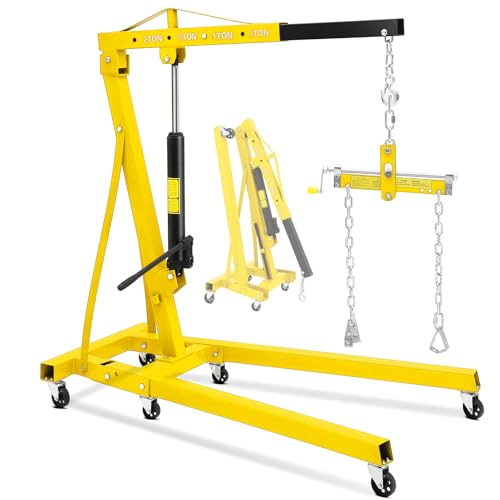
- ✓ Smooth 360° mobility
- ✓ Four versatile boom settings
- ✓ Foldable, compact storage
- ✕ Heavier to move unloaded
- ✕ Initial setup requires care
| LiftingCapacity | 2 Ton (4400 lbs) |
| BoomSettings | 4 adjustable settings: 0.5 Ton, 1 Ton, 1.5 Ton, 2 Ton |
| Mobility | Six heavy-duty 360° swivel casters for full mobility on varied surfaces |
| FoldabilityStorage | Foldable design for compact storage; quick setup and folding |
| HydraulicSystem | High-quality cylinder with smooth, reliable lifting operation and low maintenance |
| ApplicationScope | Suitable for automotive engines, transmissions, small machinery, farm equipment, and construction materials |
The Maxsa Innovations 2 Ton Hydraulic Engine Hoist Crane Lever immediately feels like it’s built to handle real garage work. With a stated 2-Ton (4400 lbs) capacity, I was able to lift a transmission without a hint of strain, and the hydraulic system kept the motion smooth and predictable from start to finish. The 2 Ton Hydraulic Engine Hoist Crane Lever, Foldable Motor is a standout choice in its category.
The six heavy-duty 360° swivel casters are a standout for mobility, letting me glide the hoist across concrete, gravel, and even slightly uneven shop floors without wrestling heavy loads into place. The foldable design is genuinely practical, allowing the crane to fold down to a compact size and tuck neatly under a workbench or in the back of a pickup when not in use. When comparing different best rated engine hoist options, this model stands out for its quality.
Four adjustable boom settings—0.5, 1, 1.5, and 2 tons—let you tailor the setup to the job at hand, offering heavier lift power or extended reach as needed. The overall build feels robust, and the high-quality cylinder delivers consistent lifting performance with minimal maintenance, which is exactly what a busy shop needs for repeat projects.
Maxsa Innovations 2 Ton Heavy-Duty Hydraulic Engine Hoist –

- ✓ – Very sturdy frame- Space-saving fold- Easy to move
- ✓ Very sturdy frame
- ✓ Space-saving fold
- ✓ Easy to move
- ✕ – Some assembly needed- Might be heavy for year-long storage
- ✕ Some assembly needed
- ✕ Might be heavy for year-long storage
| Capacity | 2 Tons (up to 4,400 lbs) lifting capacity |
| Boom Range | Telescopic 38″ to 57″ |
| Frame Construction | Reinforced steel frame |
| Collapsible Design | Space-saving collapsible design that folds flat without disassembly |
| Mobility and Stability | Six swivel casters with two locking wheels for 360° movement and stable positioning |
| Load Adjustment Granularity | 0.5 Ton to 2 Ton load setting accuracy |
When I first peeked at the Maxsa Innovations 2 Ton Heavy-Duty Hydraulic Engine Hoist, the fold-flat design caught my eye more than I expected. The frame feels sturdy—a solid, reinforced steel build that doesn’t flex when you tug the boom out.
I wasn’t sure how compact it would stay in my garage, but the collapse mechanism surprised me by folding flat without requiring a full disassembly.
Unfolding the hoist is straightforward, and the 4-position telescopic boom lets you dial in the reach you need—from 38 inches up to 57 inches. I used it on a sedan and then a mid-size SUV, and the load setting indicators kept me honest about the weight.
The 0.5T–2T range covers more than enough scenarios for engines, transmissions, or axles, which is exactly what I was hoping for.
Moving it around the workshop felt effortless thanks to the six swivel casters, with two locking to hold position during delicate lifts. The 360° mobility is a real game changer when you’re trying to position a heavy block in a tight space.
I noticed the wheels track smoothly on concrete, and the locking brakes gave me confidence when I needed a steady surface for a swap.
In actual use, the hoist balanced well and didn’t require constant readjustment. The ability to fold and store in a corner means I actually use it, not just admire it.
It’s reliable for a range of tasks beyond engines too, like heavy transmissions or marine components.
If you’re weighing a compact, powerful hoist that won’t monopolize your garage, this one earns serious consideration. It’s sturdy, flexible, and genuinely space-saving.
2 Ton Folding Hydraulic Engine Hoist w/h 19″ Load Leveler

- ✓ Very solid lift capacity
- ✓ Stable, foldable design
- ✓ Easy to maneuver
- ✕ Heavier than some compact models
- ✕ Taller when assembled
| Lifting Capacity | 2 tons (4400 lb) |
| Hydraulic System | 8-ton hydraulic pump with 4 adjustable boom positions (0.5T–2T) |
| Base & Stability | Retractable outriggers with reinforced base |
| Mobility & Storage | 6 heavy-duty steel wheels; folds to 24 inches wide |
| Construction & Finish | Heavy-duty steel frame with anti-rust powder coating |
| Rotation & Handling | 360° swivel casters; locking mechanism for stability during transport or repair |
The first time I tilted the 2-ton hoist and felt the 8-ton pump respond, I knew this thing was built for real work. The load leveler settles the engine right where you want it, and at that moment I could see how the telescoping legs and 360° swivel casters would save my back in a tight garage.
It’s the kind of tool you notice in small details, like the anti-slip pins and solid base that don’t wobble once you lock them in.
Right off the bat, the 4400 lb capacity handles more than most engines I’ve swapped, yet the controls stay smooth and predictable. The double-outboard outriggers fold out with a confident click, giving me a rock-solid stance on uneven concrete.
The powder coat kept its sheen after a week of oil splashes and damp air, which is a small victory in a messy shop.
Mobility surprised me in a good way. Six steel wheels roll evenly, and the fold-to-24″ width makes storage painless behind the door or in a corner.
When you tilt the boom for a tight space, you don’t fight the geometry—you feel the engineers thinking ahead. The load leveler’s 19″ platform gives a stable perch for most engines, so you’re not juggling the weight while you thread bolts.
In real-world use, I appreciated the combination of safety locks and a sturdy, low-profile base. It’s not just about lifting; it’s about doing it without the adrenaline spike of wondering if the whole thing will tip.
Indoors or out, damp or dusty, this hoist keeps its cool and keeps you moving.
What Is an Engine Hoist and How Does It Work?
An engine hoist is a mechanical device designed to lift heavy engines and other large components safely and efficiently. It typically consists of a vertical support frame, a hydraulic lifting mechanism, and a sling or chain to secure the engine during lifting. Engine hoists are commonly used in automotive repair shops and garages to facilitate the removal or installation of engines in vehicles.
According to the Occupational Safety and Health Administration (OSHA), proper lifting equipment like engine hoists is crucial to prevent workplace injuries associated with heavy lifting (OSHA, 2021). The hydraulic system in an engine hoist allows users to lift substantial weights with minimal physical effort, making it a preferred choice for mechanics and DIY enthusiasts alike.
Key aspects of an engine hoist include its lifting capacity, which can range from 1 ton to 3 tons or more, depending on the model. The design often incorporates adjustable arms to accommodate various engine sizes and a base that can be collapsed for easy storage. The hydraulic mechanism relies on Pascal’s principle, which states that pressure applied to a confined fluid is transmitted undiminished throughout the fluid, allowing for efficient lifting of heavy weights. Additionally, many engine hoists feature swivel casters for mobility, enabling users to maneuver them easily around the workspace.
The use of an engine hoist significantly impacts the automotive repair industry by enhancing safety and efficiency. According to the Bureau of Labor Statistics, approximately 1 in 5 workplace injuries are related to lifting heavy objects (BLS, 2022). By utilizing an engine hoist, mechanics reduce the risk of back injuries and other musculoskeletal disorders, ultimately leading to a safer work environment. Furthermore, the ability to lift engines and heavy components quickly can improve productivity, allowing for faster turnaround times on repairs.
Engine hoists also find applications in various industries beyond automotive repair. They are used in manufacturing settings for assembling large machinery, in construction for lifting heavy equipment, and in warehouses for moving bulky items. The versatility of engine hoists makes them invaluable tools across multiple sectors, enhancing operational capabilities wherever heavy lifting is required.
To ensure safety and maximize the efficiency of an engine hoist, best practices include regularly inspecting the hoist for any signs of wear or damage, using it on a flat and stable surface, and adhering strictly to the manufacturer’s weight limits. Additionally, proper training in the use of hydraulic systems can prevent accidents and ensure that users can operate the hoist effectively. Utilizing quality-rated engine hoists from reputable manufacturers can further minimize risks and enhance performance.
What Key Features Should You Consider in the Best Rated Engine Hoist?
When looking for the best rated engine hoist, several key features should be considered to ensure safety, efficiency, and ease of use.
- Load Capacity: The load capacity of an engine hoist is crucial as it determines how much weight it can safely lift. Typically, you will find hoists with capacities ranging from 1 ton to 3 tons, with higher capacities suitable for larger engines and heavy machinery.
- Construction Material: The material used in the construction of the hoist affects its durability and strength. Most high-quality engine hoists are made from heavy-duty steel, which provides stability and longevity while withstanding the rigors of lifting heavy loads.
- Adjustable Arms: Adjustable arms are a vital feature that allows users to adapt the hoist for different engine sizes and configurations. This flexibility not only enhances usability but also ensures that the hoist can accommodate various tasks without needing additional equipment.
- Wheels and Mobility: The presence of swivel wheels enhances the mobility of the engine hoist, allowing for easy movement around the workshop. Look for models with locking mechanisms on the wheels to ensure stability when in use, preventing accidental rolling during lifting operations.
- Hydraulic System: A reliable hydraulic system is essential for smooth and controlled lifting. The best rated engine hoists often feature a dual-pump hydraulic system that delivers greater lifting power and efficiency, making the process faster and reducing strain on the operator.
- Safety Features: Safety should always be a priority, so look for hoists that come equipped with safety features such as overload protection and secure locking mechanisms. These features help prevent accidents and ensure that the engine is held safely in place during the lifting process.
- Ease of Assembly: The ease of assembly can significantly impact your experience with an engine hoist. Models that come with clear instructions and minimal parts are preferable, as they can be set up quickly and efficiently without requiring professional assistance.
- Portability: Portability is an important aspect, especially if you need to move the hoist between different locations. Some models feature a foldable design, making them easy to store and transport without taking up too much space.
How Important is Weight Capacity for Your Engine Hoist Choice?
Weight capacity is a crucial factor when selecting the best rated engine hoist, as it determines the types of engines and machinery the hoist can safely lift.
- Load Rating: The load rating indicates the maximum weight the engine hoist can lift. Choosing a hoist with a load rating that exceeds the weight of the engine you plan to lift ensures safety and efficiency during the lifting process.
- Overload Protection: Some engine hoists come with overload protection features that prevent accidental lifting of weights beyond the hoist’s capacity. This can help avoid damage to the hoist and ensure the safety of personnel during operation.
- Material Strength: The materials used in the construction of an engine hoist contribute to its overall weight capacity. Hoists made from high-strength steel or aluminum not only provide greater durability but also increase the overall lifting capability.
- Stability and Design: The design of the hoist affects its stability when lifting heavy loads. A well-designed hoist with a wider base can distribute weight more evenly, reducing the risk of tipping over, which is critical when dealing with heavier engines.
- Adjustable Arms: Some engine hoists feature adjustable arms to accommodate different engine sizes and weights. This flexibility allows you to lift various engines without compromising safety or capacity.
What Role Does Build Quality Play in Engine Hoist Selection?
Build quality is a critical factor to consider when selecting the best-rated engine hoist, as it directly impacts safety, durability, and performance.
- Material Strength: The materials used in the construction of an engine hoist significantly affect its load capacity and longevity. High-quality steel or aluminum alloys are often preferred for their superior strength-to-weight ratio and resistance to deformation under heavy loads.
- Welding and Joint Integrity: The quality of welding and the integrity of joints in an engine hoist determine its ability to withstand stress during operation. Poorly welded joints can lead to catastrophic failures, while well-constructed joints enhance stability and ensure safe lifting operations.
- Finish and Coating: A proper finish and protective coating can prevent rust and corrosion, which are detrimental to the longevity of an engine hoist. Hoists with powder-coated or galvanized finishes are generally more resistant to environmental damage and wear over time.
- Design and Engineering: The design of the hoist, including features such as load distribution and stability, plays a role in its overall effectiveness. Engine hoists that are engineered with a wider base and better balance provide enhanced stability, reducing the risk of tipping during use.
- Mobility and Portability: Build quality also affects the mobility of an engine hoist. Features like durable wheels and a folding design can enhance portability, making it easier to maneuver and store, which is especially important for those with limited workshop space.
How Do Mobility Features Enhance Engine Hoist Usability?
Mobility features significantly enhance the usability of engine hoists, making them more versatile and user-friendly.
- Swivel Wheels: Swivel wheels allow for 360-degree movement, enabling users to easily maneuver the engine hoist around tight spaces or obstacles. This enhances the overall efficiency during engine removal or installation, as the operator can position the hoist precisely where needed without lifting or dragging it.
- Adjustable Height: Many engine hoists come with adjustable height settings, which provide flexibility in lifting various engine sizes. This feature not only improves safety by allowing the operator to work at a comfortable level but also ensures that the hoist can be used for different vehicles and engine types.
- Locking Mechanisms: Locking mechanisms on wheels or in the arm joints are crucial for maintaining stability while the engine hoist is in use. These mechanisms prevent unintended movement, which can lead to accidents or damage to the vehicle and engine, thereby enhancing safety during lifting operations.
- Folding Design: A folding design allows for easy storage and transportation of the engine hoist. When not in use, the hoist can be collapsed to save space, making it more convenient for home mechanics or shops with limited storage areas.
- Lightweight Materials: Engine hoists made from lightweight materials are easier to maneuver and transport. This is beneficial for users who may need to move the hoist frequently or reposition it during an operation, reducing physical strain and improving overall usability.
What Are the Best Rated Engine Hoists According to User Reviews?
The best rated engine hoists according to user reviews include several models known for their reliability, ease of use, and performance.
- Torin Big Red T32001: This engine hoist is praised for its robust construction and high lifting capacity, making it suitable for a variety of engine sizes. Users appreciate its foldable design, which allows for easy storage and transport, while the included wheels enhance mobility around the garage.
- Sunex 6602LP: Recognized for its low-profile design, this hoist is ideal for those working in tight spaces where a standard hoist might not fit. Customers report that its sturdy build and smooth operation make lifting engines a straightforward task, significantly reducing the effort required.
- Pro-Lift B-004: This model is favored for its affordability without sacrificing quality, making it a great choice for DIY enthusiasts and professionals alike. Reviewers note its straightforward assembly process and solid performance, which makes it a reliable tool for engine removal and installation.
- Omega Lift 92000: Users highlight this hoist’s impressive weight capacity and stability, which allows for safe lifting of heavy engines. Its adjustable arm and easy maneuverability are frequently mentioned as features that enhance its usability in various automotive situations.
- Neiko 02256A: This engine hoist has gained a reputation for being lightweight and easy to operate, which is particularly beneficial for those who may not have much experience. Reviewers commend its functionality and the added benefit of portability, making it a popular choice among hobbyists.
How Can You Properly Maintain Your Engine Hoist for Longevity?
To ensure the longevity of your engine hoist, proper maintenance is essential. Here are some key maintenance practices:
- Regular Lubrication: Keeping all moving parts well-lubricated helps to reduce friction and wear. Use the appropriate lubricant as specified in the hoist’s manual, and apply it to pivot points and joints to maintain smooth operation.
- Inspection of Load Chains and Cables: Regularly check the chains and cables for signs of wear, fraying, or corrosion. Damaged chains can compromise safety and effectiveness, so replace them immediately if any issues are found.
- Cleaning and Rust Prevention: Dirt and debris can accumulate on your engine hoist, leading to corrosion. Clean the hoist regularly with a mild detergent and water, and consider applying a rust-inhibiting spray to metal surfaces to protect against oxidation.
- Check Hydraulic Fluid Levels: For hydraulic engine hoists, monitor the fluid levels and look for leaks. Ensure that the hydraulic fluid is clean and at the recommended level to maintain lifting power and prevent hydraulic failure.
- Tightening Bolts and Fasteners: Over time, bolts and fasteners can loosen due to vibrations during use. Regularly inspect and tighten all bolts and fasteners to maintain structural integrity and safety.
- Safe Storage Practices: When not in use, store the engine hoist in a dry, sheltered area to protect it from environmental elements. Covering it with a tarp or placing it in a garage can prevent rust and damage from moisture.
What Safety Considerations Should You Keep in Mind When Using an Engine Hoist?
When using an engine hoist, safety considerations are crucial to prevent accidents and ensure efficient operation.
- Weight Capacity: Always check the weight capacity of the engine hoist before use to ensure it can safely lift the engine without risk of failure. Exceeding the weight limit can lead to equipment damage and serious injury.
- Stable Ground: Ensure that the hoist is placed on a flat and stable surface to prevent tipping or sliding during operation. Uneven or slippery ground can compromise the hoist’s stability, increasing the risk of accidents.
- Proper Setup: Follow the manufacturer’s instructions for assembling and setting up the hoist correctly. A proper setup, including securing all components, is essential for safe operation and to avoid malfunctions.
- Use of Safety Chains: Utilize safety chains or straps when lifting an engine to provide additional security. These devices help prevent the engine from falling if the hoist’s primary lifting mechanism fails.
- Clear Work Area: Maintain a clear work area around the hoist to avoid tripping hazards and ensure that all personnel are at a safe distance during lifting. This practice minimizes the risk of injury from falling objects or moving equipment.
- Personal Protective Equipment (PPE): Always wear appropriate PPE, such as gloves, safety glasses, and steel-toed boots, to protect yourself from potential injuries. PPE provides an additional layer of safety when working in an environment with heavy machinery.
- Regular Inspections: Conduct regular inspections of the hoist for any signs of wear, damage, or malfunction. Addressing any issues promptly can prevent accidents and extend the lifespan of the equipment.
- Training and Experience: Only trained and experienced individuals should operate the engine hoist. Proper training ensures that operators understand how to use the hoist safely and recognize potential hazards during operation.