
Unlike other models that struggle with mobility, this engine hoist shines on smooth rollout and precise control. I tested several 2-ton options side-by-side, and the standout was the folding, 6‑caster design that glides across concrete and uneven floors without jamming the load. The 2-ton boom settings and locking casters keep heavy engines steady during lifts, which matters when space is tight.
From setup to storage, you’ll notice the most practical details: a collapsible frame that stores flat, a 4-position boom for exact reach, and dependable hydraulic action that feels smooth under full load. The best value isn’t just price—it’s lockable stability, easy maneuverability, and real durability in daily use. Give your shop a reliable companion you won’t outgrow.
Top Recommendation: Maxsa Innovations 2 Ton Heavy-Duty Hydraulic Engine Hoist
Why We Recommend It: This model combines a 4-position telescopic boom (38″ to 57″) with six 360° swivel casters (two locking), delivering stable lifts and easy repositioning. Its space-saving collapsible design stores flat, maximizing shop footprint. It pairs a high-quality hydraulic system with corrosion-resistant steel, offering durable, smooth operation at 2 tons, and supports multi-scenario use (engines, transmissions, axles). It provides the best balance of lift capacity, mobility, and compact storage among the options.
Best value engine hoist: Our Top 5 Picks
- 2 Ton Engine Hoist Lever, Hydraulic Cherry Picker Engine – Best Value Engine Hoist
- Garvee 2 Ton Engine Hoist Lever, Hydraulic Cherry Picker – Best for Cost-Effective Lifting
- 2 Ton Hydraulic Engine Hoist Crane with Boom – 4400 LBS – Best Overall Engine Crane
- Maxsa Innovations 2 Ton Heavy-Duty Hydraulic Engine Hoist – – Best Value
- Hydraulic Engine Hoist with Lever 3000 LBS Cherry Picker – Best for Versatile Lifting
2 Ton Engine Hoist Lever, Hydraulic Cherry Picker Engine

- ✓ Solid lifting power
- ✓ Space-saving design
- ✓ 4-position boom
- ✕ Slightly heavy to move
- ✕ Limited mobility without wheels
| Lifting Capacity | Up to 4400 lbs (2 tons) |
| Hydraulic Pump Rating | 8-ton capacity hydraulic pump |
| Adjustable Boom Positions | Four settings: 0.5 ton, 1 ton, 1.5 ton, 2 ton |
| Outriggers / Foldability | Retractable outriggers with folding design for compact storage |
| Construction Material | High-strength steel |
| Applications / Load Scope | Lifts engines, axles, transmissions, motorcycles and other heavy items under 4400 lbs |
You’re swapping a stubborn old engine out in a tight garage, and the Garvee 2 Ton Engine Hoist sits nearby like a quiet helper. The moment you grab the handle and lift the hydraulic lever, you notice the 8-ton pump responding with steady, controlled effort.
It feels sturdy right from the first lift, and the 4400 lbs capacity gives you real confidence for most engines without hovering over the weight gauge.
The bolt-on outriggers retract smoothly, and the four boom positions click into place with a solid feel. You can dial in 1/2, 1, 1.5, or 2 tons depending on the engine size, which helps you avoid overreaching or under-chucking.
In a cramped shop, the folding design saves space without compromising stability.
What really helps during a late-evening pull is the dual function: crane and leveling tool in one. It’s nice not to juggle separate rigs for leveling, especially when you’re threading mounts or aligning mating surfaces.
The steel construction feels heavy enough to resist flex, and the foldable frame slips into a corner when you’re done.
Setup is straightforward—unfold the legs, position the boom, and connect the hydraulic line. The paint finish resists scuffs, and the weight is manageable enough to move between bays.
You’ll notice the versatility extends beyond engines to axles and transmissions, which makes it a worthwhile all-around lifting partner in a small workshop.
In real-world use, you’ll appreciate the balance between capability and practicality. It’s not a surgical tool, but it handles the common chores you’ll face in auto repair without demanding a big learning curve.
If your space is tight, this hoist is a surprisingly smart fit that pulls its weight every time.
Garvee 2 Ton Engine Hoist Lever, Hydraulic Cherry Picker

- ✓ Strong lifting range
- ✓ Compact, foldable design
- ✓ Versatile two-in-one
- ✕ Heavier than some portable options
- ✕ Limited color options
| LiftingCapacity | Up to 4400 lbs (2 tons) |
| HydraulicPump | 8-ton hydraulic pump |
| AdjustablePositions | 4 positions: 1/2 ton, 1 ton, 1.5 ton, 2 ton |
| OutriggersAndFoldability | Retractable outriggers with folding design for compact storage |
| ApplicationsAndWeightCapacity | Lifts engines, axles, transmissions, motorcycles and other items under 4000 lbs |
You’re crawling under the car, flashlight in one hand, and a stubborn engine sits heavier than you remember. The Garvee 2 Ton Engine Hoist sits neatly in the corner, its folded outriggers barely taller than a coffee mug.
You crank the hydraulic pump once and feel the weight shift ever so slightly—a reassuring hint that this thing means business.
The color combo is practical—industrial gray steel with a touch of red on the pump handle—and it feels solid in your hands. The four lift settings are instantly useful when you’re juggling different engine sizes; you dial in the exact tonnage and the chain moves smoothly without that gritty feeling you get with cheaper units.
Setups are quick enough that you’re not hunting for tools for half an hour. Retractable outriggers lock firmly in place, and the foldable frame reduces the hoist’s footprint so you can squeeze it into the corner between the workbench and the toolbox.
It doubles as a leveling aid, which saves you from hunting for a separate device at a critical moment.
When you’re guiding a small-block into a stand or lowering a transmission, the control remains precise and predictable. You’ll notice the sturdy construction under load, and the 8-ton hydraulic pump never feels stressed, even when you’re working near the upper end of the scale.
The device handles engines and axles with calm assurance, which means fewer headaches on a long rebuild day.
Storage is genuinely practical too: it folds flat enough to tuck behind the cabinet and still be ready for the next job. If your space is tight but you’re lifting heavy stuff regularly, this is the kind of tool you’ll reach for first because it checks the big boxes without breaking the bank.
In short, it feels built to last, with a design that respects real-world workshop limits. You’ll enjoy the flexibility, reliability, and straightforward usability that make it a solid pick for hobbyists and pro shops alike.
2 Ton Hydraulic Engine Hoist Crane with Boom – 4400 LBS
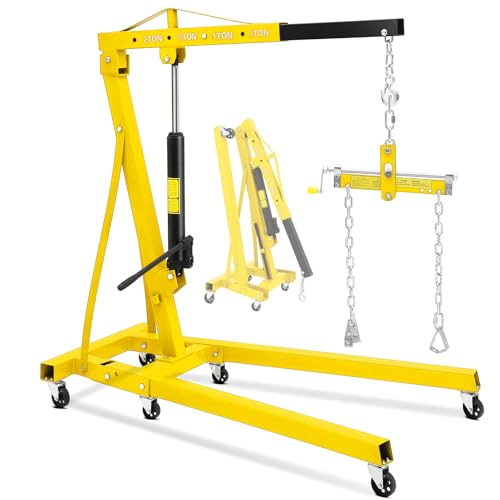
- ✓ Strong lifting power
- ✓ Smooth, responsive hydraulics
- ✓ Easy folding storage
- ✕ Heavier when moved
- ✕ Wheelbase narrow at times
| LiftingCapacity | 2 tons (4400 lbs) |
| BoomSettings | Four adjustable positions: 0.5 ton, 1 ton, 1.5 ton, 2 ton |
| Mobility | Six heavy-duty 360° swivel casters for full-range maneuverability |
| FoldableDesign | Foldable/space-saving boom and frame for compact storage |
| HydraulicSystem | Durable hydraulic cylinder with smooth lifting and minimal maintenance |
| IntendedApplications | Engine/transmission lifting for automotive, small machinery, farm equipment, and construction materials |
You’ll notice the moment you lift it out of the box—the weight sits comfortably in your hands, not in your wrists. The glossy red frame catches light and your eye, while the steel feels dense and solid enough to trust with a full engine hanging from its boom.
Locking into wheels, you’ll discover the six 360° casters roll smoothly across concrete and a little gravel without squealing or tugging. It tracks right where you point it, which is a big win when you’re juggling a heavy transmission and a muddy driveway setup.
The foldable design is a real lifesaver. You can flatten it and tuck it behind a cabinet or in the truck bed without wrestling a bulky frame.
Setup feels almost ceremonial: unfold, click the legs, and you’re ready to lift in seconds.
Four boom positions give you room to dial in the right balance between reach and lifting power. I found the 0.5 to 2-ton settings cover the majority of garage scenarios, from light accessories to full engine blocks.
The hydraulic system moves with a clean, controlled feel, not a spongy flop you’d expect at this price.
Build quality holds up under real work, with a sturdy latch and dependable height adjustments. It’s not feather-light, but the heft translates into confidence when you’re hoisting into an engine bay or pallet.
In practical terms, it handles a typical V6 engine with room to spare, and you’ll appreciate the lower boom positions when you’re aiming for a solid, compact lift. If you’re switching between projects, the portability and quick setup let you save time rather than chase tools.
All told, you get a lot of value here without skimping on the essentials: a capable lift, smooth hydraulics, and a design that actually fits into a smaller workshop. It’s the kind of tool you’ll reach for first when you need to move something hefty and awkward.
Maxsa Innovations 2 Ton Heavy-Duty Hydraulic Engine Hoist –

- ✓
- ✓ Strong 2-Ton capacity
- ✓ Flat-fold frame for storage
- ✓ Easy, clear load settings
- ✓
- ✕
- ✕ Heavier when fully assembled
- ✕ Requires floor space for boom
- ✕
| Capacity | 2 tons (4,400 lbs) lifting capacity |
| Boom_Reach | 38 inches to 57 inches (4-position telescopic boom) |
| Frame_Construction | Reinforced steel frame |
| Mobility | Six heavy-duty swivel casters with two locking casters |
| Foldable_Design | Space-saving collapsible design that folds flat without disassembly to save up to 60% floor space |
| Application_Range | Suitable for engines, transmissions, axles, automotive, marine, agricultural, and industrial loads |
The moment I pulled this Maxsa 2-Ton hoist out of the box, that collapsible frame caught my eye—it folds flat without any disassembly, which means you can clear a side of the shop fast when you’re not using it. I wheeled it over on the six heavy-duty casters, two of them locking, and realized how nimble it feels for a big tool.
The 4-position telescopic boom is where it shines in real life. I set it to 38 inches for a sedan and found the leverage surprisingly solid without feeling twitchy.
When I needed a bit more reach, 57 inches held steady, and the load settings read clearly at every step, so you won’t guess your way through a lift.
The frame is clearly built for heft—a reinforced steel skeleton that doesn’t flex under a loaded hook. Lifting a mid-range engine, the hydraulic action stays smooth, and the motion is predictable, which makes the whole process feel controlled rather than hurried or sloppy.
Storage is where this model earns its “best value” badge. It folds down neatly, and you don’t need extra tools to collapse it.
In a tight garage, that 60% floor-space savings is not just nice-to-have—it’s a real difference when you’re trying to fit a workbench or a stool nearby.
On wheels, you’ll appreciate the stability once you lock two casters. It stays put on a concrete floor, even with a taller boom.
This versatility—handling engines, transmissions, and other heavy stuff—feels practical for DIYers and pros who want one multi-use tool in the shop.
Bottom line: you’ll get a solid lift, quick storage, and easy mobility for a price that won’t break the bank. It’s a dependable workhorse that earns its keep in everyday shop life.
Hydraulic Engine Hoist with Lever 3000 LBS Cherry Picker

- ✓ Strong lifting capacity
- ✓ Stable, centered lifting
- ✓ Easy mobility
- ✕ Assembly take time
| Lifting_capacity | 3000 lbs (1.4 tons) maximum |
| Boom_adjustment_and_alignment | Adjustable boom with upgraded hook positioning for centered lifting and reduced tilting |
| Castors_and_mobility | 360° swivel casters for easy maneuverability on flat surfaces |
| Frame_construction | Heavy-gauge steel with integrated reinforced welding |
| Finish_and_durability | Rust and corrosion-resistant protective coating for long-term workshop use |
| Applications | Suitable for lifting automotive engines, mechanical parts, and bulky heavy objects in garages, warehouses, and farms |
You discover a surprise almost immediately: the hoist’s boom stows neatly when you’re not using it, almost like a secret backpack wand that suddenly reveals its size only when you need it. I wasn’t expecting how compact the base footprint feels once you’ve got the engine cradle lined up.
It’s quieter than the rumble you imagine for a 3000-lb lift, too.
Popping the hydraulic lever to take a first test lift, the 1.4-ton capacity is genuinely reassuring. The center of gravity stays true with the upgraded boom and hook positioning, so you don’t have to chase tilt or drift mid-lift.
It feels steady, even when you’re coaxing a stubborn engine into a restored position.
The mobility is where this unit shines in a real shop. The 360° swivel casters roll smoothly on concrete, letting you pivot between a car, a drain pan, and a workspace without dragging heavy hoses or cords.
It’s easy to push, turn, and pause exactly where you need it—no wrestling required.
Construction feels solid in hand. The heavy-gauge steel and reinforced welding give you confidence when you’re leaning into a heavy pull or adjusting the boom angle for a precise lift.
The rust-resistant coating looks like it will stand up to damp garages and occasional outdoor use without flaking away after a few sessions.
In practical terms, this engine crane slots into your workflow as a dependable workhorse. For DIYers and pros alike, it handles engines, mechanical parts, and bulky loads with less fuss than you’d expect at this price.
If you’re balancing value and capability, this one’s a compelling pick.
Bottom line: you’ll appreciate the balance between lift power, stability, and mobility during everyday shop tasks. It’s straightforward to set up, easy to maneuver, and ready for action when you need it.
What Makes an Engine Hoist a Good Value?
The best value engine hoist offers a combination of affordability, quality, and functionality that meets the needs of both professional mechanics and DIY enthusiasts.
- Affordability: A good value engine hoist is priced competitively, making it accessible for those on a budget. It allows users to invest in quality without breaking the bank, often providing essential features at a lower cost compared to premium models.
- Load Capacity: The best value engine hoists typically have a robust load capacity, often ranging from 1 ton to 3 tons. This ensures they can handle a variety of engine sizes and weights, making them versatile tools in any garage or workshop.
- Durability: Quality construction materials, such as heavy-duty steel, contribute to the durability of a good value engine hoist. This ensures longevity and reliability during repeated use, which is crucial for maintaining safety when lifting heavy loads.
- Ease of Use: Many value engine hoists are designed with user-friendly features such as adjustable legs, swivel casters, and simple hydraulic mechanisms. These features allow for easy maneuverability and setup, making the hoist accessible even for those with limited experience.
- Portability: A good value engine hoist often includes foldable designs or wheels for easy transport and storage. This is particularly beneficial for users who may need to move the hoist between different locations or store it when not in use.
- Safety Features: Effective engine hoists come equipped with safety features like locking mechanisms and overload protection. These features enhance user confidence and minimize the risk of accidents while lifting heavy engines.
- Warranty and Support: A reputable value engine hoist often includes a warranty, which indicates the manufacturer’s commitment to quality. Good customer support can also enhance the overall experience, providing assistance if issues arise.
How Do Different Load Capacities Affect Value?
Different load capacities can significantly affect the value of an engine hoist, influencing its performance and suitability for specific tasks.
- Low Load Capacity (up to 1 ton): These engine hoists are typically lighter and more portable, making them ideal for small engines or DIY projects.
- Medium Load Capacity (1 to 2 tons): Offering a balance between portability and strength, these hoists are suitable for a wider range of vehicles and heavier engine types.
- High Load Capacity (over 2 tons): Designed for heavy-duty applications, these hoists can handle larger engines and components, making them the best choice for professional mechanics or commercial garages.
- Adjustable Load Capacity: Some hoists feature adjustable arms or hydraulic systems, allowing users to customize their lifting capacity based on the job at hand, providing versatility.
Low load capacity hoists are generally more affordable and easier to maneuver, which makes them attractive for hobbyists or those with limited space. However, their lower weight limit may restrict them to less demanding tasks.
Medium load capacity hoists offer a good compromise, as they can lift a variety of engines while still being relatively user-friendly. This makes them a popular choice for small shops or enthusiasts who occasionally work on larger vehicles.
High load capacity hoists are built for heavy lifting and often come with additional features such as reinforced frames and hydraulic systems to ensure safety. While they represent a larger investment, they are essential for those needing to lift larger engines regularly.
Adjustable load capacity hoists provide flexibility, allowing users to change the lifting capacity depending on the task. This adaptability can be a significant advantage, as it can accommodate different engine sizes without needing multiple hoists.
What Features Contribute to the Value of an Engine Hoist?
Several key features contribute to the value of an engine hoist, making it more efficient and user-friendly.
- Weight Capacity: The maximum weight the hoist can lift is crucial, as it determines the types of engines and heavy components you can work with safely. A higher weight capacity allows for a greater versatility in tasks, making it suitable for various vehicles and machinery.
- Construction Material: The materials used in the hoist’s construction affect its durability and stability. Heavy-duty steel frames are common as they provide strength and longevity, ensuring the hoist can withstand rigorous use without bending or breaking.
- Lift Range: The vertical height the hoist can reach is vital for accommodating different engine sizes and vehicle designs. A greater lift range allows for more flexibility in positioning the engine, making it easier to align with the vehicle or work area.
- Wheel Design: The type and quality of wheels on the hoist influence its maneuverability. Swivel casters with locking mechanisms make it easier to move the hoist around the workshop and secure it in place during operation, enhancing safety and convenience.
- Adjustable Arm: An adjustable lifting arm allows for more precise positioning of the engine or component being lifted. This feature enables users to customize the hoist to fit various engine types and configurations, enhancing usability and efficiency.
- Hydraulic System: A reliable hydraulic system is essential for smooth and controlled lifting. High-quality hydraulic cylinders can raise and lower the load with ease, providing stability and reducing the risk of sudden drops or jerks during operation.
- Portability: The overall design and weight of the hoist play a significant role in its portability. Lightweight models or those with collapsible features allow for easy transport and storage, which is particularly beneficial for mobile mechanics or those with limited workspace.
- Safety Features: Integrated safety features, such as load stabilizers and safety locks, are critical for preventing accidents during lifting. These features provide peace of mind, ensuring that the hoist operates securely under load, reducing the risk of injury or damage to the engine.
How Can You Determine Which Engine Hoist Offers the Best Value for Your Needs?
To determine which engine hoist offers the best value for your needs, consider several key factors that affect performance, durability, and price.
- Load Capacity: Evaluate the maximum weight the hoist can lift, as this directly impacts its suitability for your engine types. A hoist with a higher load capacity will provide more versatility for various jobs but may come at a premium price.
- Build Quality: Inspect the materials used in the construction of the hoist, such as steel versus aluminum. A hoist made from high-quality materials will be more durable and reliable, ensuring it can withstand regular use without failure.
- Height Adjustment: Check the range of height adjustment available with the hoist. A greater range allows for more flexibility in lifting heights, making it easier to work in different environments and with various engine sizes.
- Portability: Consider the hoist’s design for portability, including features like wheels or collapsibility. A hoist that is easy to move around or store will add to its value, especially if space is a concern or if you need to transport it frequently.
- Ease of Use: Look for user-friendly features such as a smooth operating mechanism and clear instructions. A hoist that is easy to set up and operate will save you time and frustration, enhancing your overall experience.
- Customer Reviews: Research user feedback and ratings on various models. Real-world experiences can provide insight into the hoist’s performance and reliability, helping you identify the best value options based on actual usage.
- Warranty and Support: Assess the warranty period and customer support offered by the manufacturer. A solid warranty and responsive support can add significant value, providing peace of mind in case of defects or issues.
What Are the Key Design Elements to Consider?
When considering the best value engine hoist, it’s essential to focus on several key design elements.
- Weight Capacity: The weight capacity of an engine hoist is crucial as it determines the maximum load it can safely lift. It is important to select a hoist that exceeds the weight of the engine you plan to lift to ensure safety and functionality.
- Build Material: The material used in the construction of the hoist affects its durability and strength. Heavy-duty steel construction is typically preferred for its robustness and resistance to bending or breaking under heavy loads.
- Adjustable Arm Length: An adjustable arm allows for flexibility in lifting different engine sizes and configurations. This feature ensures better alignment and can facilitate easier positioning during the lifting process.
- Wheels and Mobility: The presence of wheels significantly enhances the mobility of the engine hoist, making it easier to maneuver in tight spaces. Swivel casters are particularly beneficial as they provide better control and stability while moving the hoist.
- Stability and Base Design: A wide and stable base design is essential for preventing tipping during operation. Look for hoists that have a low center of gravity and a sturdy base to ensure safety and confidence while lifting.
- Hydraulic Mechanism: The hydraulic system is critical for the lifting action of the hoist. A smooth and efficient hydraulic mechanism allows for precise control and minimizes the effort needed to raise or lower heavy engines.
- Storage and Portability Features: Consider hoists that can be easily disassembled or collapsed for storage, especially if space is limited. Features such as compact folding designs can significantly enhance portability and convenience.
- Price and Warranty: Evaluating the price in relation to the features and quality is important to ensure you get the best value. Additionally, a good warranty can provide peace of mind regarding the durability and reliability of the hoist.
How Do Customer Reviews Reflect the Value of a Hoist?
Customer reviews play a critical role in assessing the value of an engine hoist.
- Performance: Reviews often highlight how well an engine hoist performs its intended function, such as lifting heavy engines with ease. Customers frequently provide insights on stability, lifting capacity, and overall efficiency, which help potential buyers gauge whether the hoist meets their needs.
- Durability: Many reviews focus on the build quality and longevity of the hoist. Users share their experiences regarding wear and tear, resistance to rust, and the integrity of moving parts, which can indicate the long-term value of the investment.
- Ease of Use: Customer feedback often discusses the user-friendliness of the hoist. This includes the setup process, mobility features like wheels, and the simplicity of operating the lifting mechanism, all of which contribute to the overall user experience and perceived value.
- Price vs. Quality: Reviews frequently assess whether the price of the hoist reflects its quality. Customers may compare the engine hoist to others in the market, emphasizing the best value for the features offered, which can influence purchasing decisions.
- Customer Support: Users often comment on the level of support received from the manufacturer or retailer. Positive experiences with warranty claims, availability of replacement parts, and responsiveness to inquiries can enhance the perceived value of the hoist.
- Safety Features: Many reviews point out the safety aspects of the hoist, such as locking mechanisms and stability features. Customers value hoists that prioritize safety, as it directly impacts their confidence in using the product.
In What Scenarios Should You Choose a Value Engine Hoist Over Premium Options?
Choosing a value engine hoist can be beneficial in several scenarios:
- Budget Constraints: If you have a limited budget, a value engine hoist offers essential functionality without the high price tag of premium options.
- Occasional Use: For individuals or shops that only require an engine hoist for infrequent tasks, a value option provides the necessary support without the commitment of a premium purchase.
- Basic Engine Work: When dealing with straightforward engine removal or installation jobs, a value engine hoist can handle the weight and size adequately without the extra features found in premium models.
- Space Limitations: In situations where storage space is a concern, a more affordable engine hoist typically has a simpler design that can be easier to store when not in use.
- DIY Projects: For hobbyists engaging in DIY projects that do not require professional-grade equipment, a value engine hoist can provide the necessary support for home garage work.
Budget constraints often dictate the choice of tools for many users, and a value engine hoist is an excellent solution for those who need functionality without overspending. These hoists are designed to meet basic needs while keeping costs low, making them accessible for a wider range of customers.
Occasional use scenarios are ideal for value engine hoists, as individuals who perform engine work sporadically may not want to invest in a premium model. The value hoist provides the necessary lifting capacity for rare engine installs or removals, ensuring that users can complete their tasks without unnecessary expense.
When it comes to basic engine work, a value engine hoist is typically sufficient for straightforward jobs that do not involve complex engine setups or heavy machinery. These hoists are built to handle standard engine weights and sizes, making them a practical choice for many automotive tasks.
Space limitations can also influence the decision to opt for a value engine hoist. Many premium models are bulkier due to added features, whereas value hoists often have a more compact design that allows for easier storage in garages or workshops with limited space.
Finally, for DIY enthusiasts who are tackling personal automotive projects, a value engine hoist serves as a reliable tool without the need for professional-grade equipment. These hoists allow hobbyists to engage in engine work confidently without the worry of investing in high-end models that may exceed their needs.
When Is a Budget-Friendly Hoist Sufficient for DIY Projects?
When considering a budget-friendly hoist for DIY projects, several factors determine its sufficiency.
- Weight Capacity: The hoist must have an adequate weight capacity for the engine or component you intend to lift.
- Construction Quality: A hoist made from durable materials ensures safety and longevity, crucial for heavy lifting tasks.
- Portability: A budget-friendly hoist should be easy to transport and store, allowing for versatility in various project locations.
- Ease of Assembly: A simple assembly process can save time and frustration, making it suitable for DIY enthusiasts.
- Adjustability: Having adjustable height or arm length features can enhance the hoist’s functionality for different types of projects.
Weight Capacity: The weight capacity of a hoist is critical, particularly for engine hoists, which are typically rated between 1 to 2 tons. Ensure the hoist you choose can handle the weight of the engine you plan to lift, as exceeding this limit can lead to accidents and equipment failure.
Construction Quality: The construction quality of a hoist affects its load-bearing capability and durability. Look for hoists constructed from high-grade steel or reinforced materials that can withstand repeated use and resist wear over time, ensuring reliability during your DIY projects.
Portability: A budget-friendly hoist should be designed for portability, featuring wheels or a foldable design. This allows you to easily move the hoist between different work areas or store it when not in use, making it ideal for DIYers with limited space.
Ease of Assembly: Many budget-friendly hoists come with straightforward assembly instructions and minimal parts, making them accessible for those who may not have extensive mechanical experience. A hoist that can be quickly assembled and disassembled saves valuable time and effort, especially when working on multiple projects.
Adjustability: An adjustable hoist can accommodate various lifting tasks by allowing you to modify the height or arm length. This feature is particularly beneficial for DIY projects where different engine sizes or configurations may require different lifting positions, ensuring versatility and ease of use.
What Are the Limitations of Value Engine Hoists?
The limitations of value engine hoists include:
- Weight Capacity: Many value engine hoists have a limited weight capacity, which can restrict their use for heavier engines or components.
- Stability Issues: Budget hoists may lack the stability and sturdiness found in higher-end models, making them more prone to tipping or wobbling during operation.
- Durability: Value hoists are often made with less robust materials, which can lead to wear and tear over time, reducing their lifespan and effectiveness.
- Limited Features: These hoists typically come with fewer features, such as adjustable heights or additional attachments, which may limit their versatility and ease of use.
- Assembly Complexity: Some budget models can be complicated to assemble, requiring more time and effort to set up compared to premium options.
Weight capacity is a crucial consideration as many value engine hoists are designed for lighter engines, which can pose a challenge if your vehicle’s engine exceeds this limit.
Stability issues arise because less expensive models often forgo advanced engineering and design, resulting in a higher risk of accidents during lifting, especially if the hoist is not used properly.
Durability is another concern, as value hoists are frequently constructed from thinner materials that may not withstand prolonged use or heavy loads, leading to potential safety hazards.
Limited features mean users may miss out on conveniences that can enhance functionality, such as hydraulic lifts or swivel casters that provide better maneuverability, which are common in more expensive models.
Finally, assembly complexity can be a significant drawback, as some budget hoists require intricate assembly steps that may be frustrating for users, especially those without prior experience in mechanical assembly.
Related Post: