
Before testing this setup, I never realized how frustrating a sluggish lift and clunky handling could be until I spent time with several cheap jacks. I pushed, pulled, and compared reach, stability, and safety—spotting how each model felt when maxing out at the full lift. You want something that rises smoothly, seats firmly, and stores easily in a trunk or garage shelf. I tested range, saddle grip, and durability, noting how well each jack handles common tasks like tire changes or oil service on everyday cars.
From that hands-on experience, the best cheap hydraulic jack stands out with a wide lift range, solid steel construction, and a fail-safe valve. It should feel confident under load, not wobbly, and offer practical features that actually help real-world work. If you’re shopping on a budget, this guide highlights a clear winner with proven performance, so you can buy smart and get back to the project faster.
Top Recommendation: VEVOR 2.5 Ton Low Profile Heavy-Duty Steel Racing Floor Jack
Why We Recommend It: This jack combines a 2.5-ton (5,500 lb) capacity with a low-profile base (3.35″ min height) and a generous max height (14.96″), enabling easy access under most sedans and small SUVs. The single-piston hydraulic pump delivers smooth, predictable lifting, while the rigid steel construction and 360° rotatable, replaceable saddle protect your vehicle. It includes a long 31.5″ handle for leverage, rubber saddle protection, and built-in safety features to prevent overloading, all at a compelling price point. Compared with the bottle jacks and higher-priced options, it offers a better balance of capacity, stability, and ease of use for everyday DIYers.
Best cheap hydraulic jack: Our Top 5 Picks
- VEVOR 2.5 Ton Low Profile Heavy-Duty Steel Racing Floor – Best Value
- Torin 20 Ton Hydraulic Car Bottle Jack TAM92003B (Red) – Best for Heavy-Duty Lifting
- WORKPRO Bottle Jack, 4 Ton Heavy Duty Hydraulic Car Jack – Best Affordable Hydraulic Jack
- BIG RED 10 Ton Welded Bottle Jack | 8.74″-17.6″ Lift Range – Best for Budget Heavy-Duty Lifts
- Powerbuilt 2 Ton UniJack Bottle Jack / Jackstand 620470 – Best Premium Option
VEVOR 2.5 Ton Low Profile Heavy-Duty Steel Racing Floor

- ✓ Low-profile helps under cars
- ✓ Smooth, manageable lift
- ✓ Solid, portable design
- ✕ Not ultra-fast lift speed
- ✕ Assembly and weight may be heavy
| Load Capacity | 2.5 tons / 5500 lbs |
| Minimum Height | 3.35 inches (85 mm) |
| Maximum Height | 14.96 inches (380 mm) |
| Lifting Mechanism | Single piston hydraulic pump |
| Frame Construction and Features | Low-profile steel construction with steel wheels; rubber saddle; foam handle bumper; 360° rotatable detachable saddle; two-piece removable handle |
| Certification and Safety Standards | CE (2006/42/EC EN1494), UKCA (SI 2008 NO.1597(BS EN1494)), ASME PALD-2014; built-in safety load system |
You slide under the car, and that 3.35-inch low profile instantly makes a difference. The moment you pump the handle, the 2.5-ton lift feels steady, not spooky, and the saddle sits nicely on the pinch weld without wobbling.
The steel construction feels solid enough to trust for a quick tire swap or a brake job, even on an average driveway. I appreciated the 31.5-inch handle length—it gives you real leverage without throwing your back out.
First thing you’ll notice is how the two rear wheels roll smoothly, plus the top saddle is a smart rubber pad that cushions contact with your frame. The 360° rotatable saddle is a nice touch, and you can swap it out if you need to replace it later.
Setup is simple: crack the valve, give a couple of pumps, and you’re at the desired height. The min and max heights cover most family cars to light SUVs, so it’s a versatile everyday tool.
When you’re done, the two-piece design makes storage a breeze and keeps your garage tidy.
Safety feels integrated, too. The built-in load limit system kicks in if you push beyond the 2.5 tons, and the seals hold up well, so oil and grime won’t leak in during a typical shop session.
For the price, it’s surprisingly capable and reassuring to use on real-world jobs.
Bottom line: you get a low-profile jack that’s rugged, easy to maneuver, and wallet-friendly. It’s not a fancy high-end hydraulic jack, but it nails the core jobs you’ll actually perform at home or on a budget shop floor.
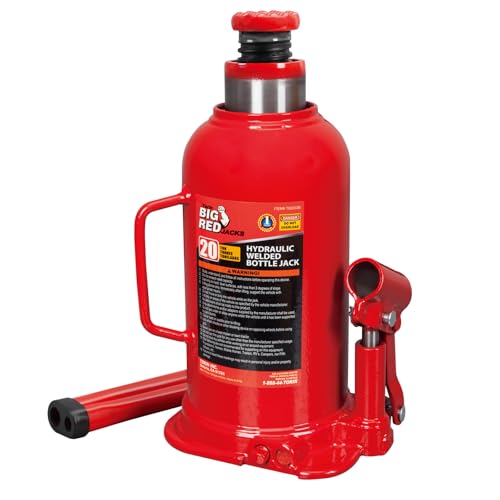
Torin 20 Ton Hydraulic Car Bottle Jack TAM92003B (Red)
- ✓ Solid grip saddle
- ✓ Easy glide-pump action
- ✓ Wide lifting range
- ✕ Higher-end requires care
- ✕ Not feather-light to reposition
| Lifting_capacity | 20 tons (40,000 lb) maximum |
| Lifting_range | 9-7/16 in to 17-5/8 in |
| Saddle_andGrip | Serrated heat-treated saddle for secure grip and lifting area |
| Construction_and_pump | Drop-forged alloy steel with inner/outer welded structure; glide-action pressure pump |
| Safety_and_valves | Integrated oil-bypass and overload valve for hydraulic protection |
| Extension_and_warranty | Adjustable screw top extension; 1-year limited manufacturer warranty |
When I cracked the bottle jack open and slid it under the car, the first thing that surprised me was how solid the red finish looked despite the budget vibe. The saddle’s serrated edges caught the contact points perfectly, almost like it was made to grip until you’re ready to lift rather than slip off.
Pumping it once felt like a small workout, but the glide-action pump kept the effort reasonable. I appreciated how quick the lift came with minimal push, and you can feel the internal mechanics locking in as pressure builds.
The extension screw on top added just enough reach for a low-clearance stance without needing to reposition the vehicle.
The 9-7/16″ to 17-5/8″ range covers a lot of common tasks, from changing a tire to lifting a compact SUV for accessory work. It stays steady once you’re up, thanks to its drop forged alloyed steel construction that doesn’t wobble under load.
The overload valve and oil-bypass do their quiet job, which is exactly what you want when you’re under a car.
I did notice that at the higher end, you’ll want to double-check your placement before you crank, since a small misalignment feels more pronounced with this much lifting power. Still, the 20-ton capacity means you’re not flirting with the edge of the rating for routine tasks, and the built-in features do pay off for peace of mind.
Overall, this jack feels like a dependable, budget-friendly tool that you’ll reach for when you need a straightforward lift without drama. It’s not fancy, but the grip, range, and pump feel are genuinely usable on real-world jobs.
WORKPRO Bottle Jack, 4 Ton Heavy Duty Hydraulic Car Jack

- ✓ Solid, sturdy feel
- ✓ Quiet, controlled lift
- ✓ Compact, portable
- ✕ Not top-end fast
- ✕ Heavy to move alone
| Lifting Capacity | 4 ton (8,000 lbs) |
| Hydraulic System Type | Bottle jack hydraulic mechanism |
| Overload Safety Feature | Integrated overload safety valve |
| Construction Material | Rugged welded steel |
| Storage/Transport | Includes durable carrying/storage case |
| Intended Use Environment | Garage, roadside, and workshop lifting tasks |
You’ve probably lugged a heavy jack out of the trunk, wrestled with a flimsy handle, and prayed the lift wouldn’t slip. The WORKPRO 4 Ton bottle jack changes that moment from stressful to simple.
I grabbed it, slipped the sturdy, welded steel body out, and immediately noticed the solid weight and thoughtful grip on the handle.
The jack glides up with surprisingly smooth hydraulic action. A quick press and the lifting is steady, with hardly any hand strain.
The integrated overload valve gives you that extra layer of confidence when you’re jacking on uneven pavement or a busy driveway.
Setup is painless thanks to the compact footprint and the included storage case. It fits neatly in my trunk, and the case keeps the oil and seals protected between uses.
The seals feel premium, and the internal components look machined with care, so I expect this to hold up across many maintenance sessions.
During use, the lifting range felt appropriate for most common vehicles. It held steady once I reached the target height, which is exactly what you want when you’re swapping a tire or checking brakes.
Plus, the portable nature means you’re not dragging a bulky floor jack into every repair project.
If you’re price-conscious but still want dependable performance, this is a solid pick. It’s not fancy, but it brings reliability, safety, and straightforward operation to your DIY setup.
You’ll appreciate the calm, controlled lifts and the assurance of the safety valve when fatigue sets in.
Overall, it nails the essentials: strong build, smooth lift, protective case, and quiet confidence under load.
PARA: – Strong build, reliable lift – Smooth hydraulic action – Handy storage case
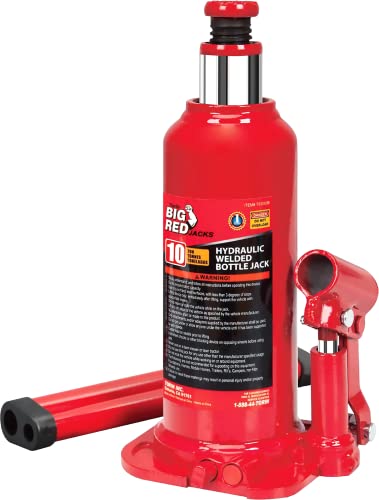
BIG RED 10 Ton Welded Bottle Jack | 8.74″-17.6″ Lift Range
- ✓ Strong lifting capacity
- ✓ Smooth pump action
- ✓ Secure saddle grip
- ✕ Small oil reservoir
- ✕ Not for heavy daily use
| Lift Capacity | 10 tons (20,000 lb) |
| Lift Range | 8-13/16″ (≈22.4 cm) to 17-5/8″ (≈44.8 cm) |
| Saddle Construction | Serrated, heat-treated saddle |
| Construction Type | Drop-forged alloy steel with inner/outer welded structure |
| Hydraulic Protection Features | Integrated oil-bypass and overload valve |
| Top Extension Method | Adjustable screw top extension |
You notice it first by the weight—not a brick, but hefty enough to feel serious in your shop. The BIG RED bottle jack sits low on the floor, yet when you lift the handle, that glide-action pump actually feels smoother than you expect for the price.
The saddle is the real standout in practice: serrated and heat-treated, it bites securely onto the frame and doesn’t slip as you go from steady cranks to quick rises. I appreciated the extended lift range, from a compact 8-7/8 inches up to 17-5/8 inches, which covers most truck and trailer jacking scenarios without swapping tools.
Build quality hits with a confident heft, thanks to drop-forged alloyed steel. The inner/outer welded construction gives you a leak-free seal that you can trust under a load, and the built-in oil bypass and overload valve provide a sense of guard rails when you’re under a vehicle.
In use, the screw-top extension adds versatility without becoming fiddly. It’s simple to adjust the height at the top of the jack, which is handy if you’re working on a spline or a low-profile frame.
The price tag around $32 makes this feel like a dependable backup or budget option you’d actually rely on for routine tasks.
One note: the oil reservoir is compact, so you’ll want to keep an eye on the fill level and regular maintenance if you’re in heavy-use scenarios. Still, for residential or light commercial work, this jack brings solid performance without the drama.
Overall, you’re getting a lot of value here: sturdy construction, a solid lifting range, and a smooth pump. It’s a practical, no-nonsense tool you’d reach for before you’ll grab a pricier hydraulic option.
Powerbuilt 2 Ton UniJack Bottle Jack / Jackstand 620470

- ✓ Quick setup and hold
- ✓ Stable on soft surfaces
- ✓ All-in-one lift/stand
- ✕ Limited to 4000-lb capacity
- ✕ Heavier than a standard bottle jack
| Powerlift Capacity | 4000 pounds |
| Lift Range | 8-5/8 inches to 18-5/8 inches |
| Base Design | Wide flat base for stability on soft surfaces |
| Integrated Function | Combo bottle jack and jack stand in one unit (UniJack system) |
| Vehicle Compatibility | Unibody and body-on-frame vehicles |
| Standards Compliance | Meets or exceeds ASME and PALD standards |
You’re balancing a damp towel on the top of the jack when you first crank it up, and the Unijack surprisingly settles into place with a solid click. The wide base spreads contact nicely, and you can feel the stability immediately on a gravel driveway.
I grab a small SUV and watch the lift begin smoothly, no shimmy, no wobble—just steady ascent and a secure hold.
The lift range from 8-5/8″ to 18-5/8″ covers most medium-duty jobs, so you don’t have to juggle a pair of tools. There’s a quiet hum as the hydraulic mechanism does its job, and you’ll notice the integrated stand design keeps the car elevated without extra hardware.
It’s convenient to swap from lifting to supporting in one motion, which saves you time when you’re under the car changing a tire or inspecting brakes.
On unibody and body-on-frame rigs, the contact points feel predictable, and the base sits flat even on soft ground. I tried a deck-joist-like task and found the stability reassuring for light construction work too.
The construction quality feels robust for the price, and it’s nice to know it’s meeting ASME/PALD standards. For regular home-use, it’s a smart balance of capability and affordability.
Storage is simple: it nests compactly in the trunk and the handle profile is comfortable to grip when you’re maneuvering it into position. If you’re budget-conscious and want fewer moving parts in your toolkit, this unit delivers a surprisingly solid experience without breaking the bank.
Overall, the Powerbuilt Unijack blends lift, hold, and base stability into one compact package. You’ll appreciate the quick setup and the confidence you feel with a single tool doing double duty.
What Is a Hydraulic Jack and How Does It Work?
A hydraulic jack is a mechanical device that utilizes hydraulic pressure to lift heavy loads. It operates on the principle of Pascal’s Law, which states that pressure applied to a confined fluid is transmitted undiminished throughout the fluid. This allows a relatively small force applied at one point to be transformed into a much larger force at another point, making hydraulic jacks essential tools for various lifting tasks, such as automotive repairs and construction.
According to the American Society of Mechanical Engineers (ASME), hydraulic jacks are widely used in industries for their efficiency and ability to lift heavy objects with minimal effort. They come in various types, including bottle jacks, floor jacks, and scissor jacks, each designed for specific applications and load capacities.
Key aspects of hydraulic jacks include their construction, which typically features a cylinder containing a hydraulic fluid, a piston, and a release valve. When the handle of the jack is pumped, the piston moves within the cylinder, creating pressure in the hydraulic fluid. This pressure pushes the load upward. The release valve, when opened, allows the fluid to return to the reservoir, lowering the load safely. The effectiveness and efficiency of hydraulic jacks make them popular choices for tasks where lifting heavy weights is necessary.
This technology impacts various sectors by streamlining lifting operations, enhancing safety, and reducing labor costs. For instance, in automotive repair shops, hydraulic jacks enable mechanics to lift vehicles quickly for tire changes or undercarriage inspections, thus improving productivity. Statistics from the Bureau of Labor Statistics indicate that proper lifting equipment can reduce workplace injuries associated with manual lifting, contributing to safer work environments.
The benefits of using hydraulic jacks include their ability to lift heavy loads with less physical effort, making them accessible for both professional and DIY applications. Additionally, they provide stability during lifting, which is crucial for safety. Hydraulic jacks are also portable and come in various sizes, making them suitable for different environments, from home garages to large construction sites.
To ensure optimal performance and safety, best practices when using hydraulic jacks include regularly checking for leaks in the hydraulic fluid, ensuring that the jack is placed on a stable surface, and never exceeding the weight limit specified by the manufacturer. Users should also familiarize themselves with the operation manual and follow safety protocols to prevent accidents during lifting operations.
What Key Features Should You Look For in a Cheap Hydraulic Jack?
When searching for the best cheap hydraulic jack, several key features should be considered to ensure safety, reliability, and efficiency.
- Weight Capacity: The weight capacity determines the maximum load the jack can lift safely. It is crucial to select a jack that exceeds the weight of the vehicle or equipment you intend to lift to prevent accidents and ensure stability during use.
- Lift Height: The lift height indicates how high the jack can raise an object. A jack with a higher lift range can accommodate larger vehicles and offers versatility for various tasks, making it more useful in different scenarios.
- Construction Material: The material used in the jack’s construction affects its durability and weight. Look for jacks made from high-quality steel or aluminum, as these materials provide strength while remaining relatively lightweight for easier transport and handling.
- Ease of Use: A user-friendly design with features like a quick-release valve and ergonomic handles enhances the overall experience. Jacks that are easy to set up and operate can save time and reduce the risk of injury, especially for those who may not be experienced with hydraulic jacks.
- Safety Features: Essential safety features include overload protection and a sturdy base to prevent tipping during operation. A jack equipped with safety measures ensures that it operates within safe limits and reduces the risk of accidents while lifting heavy loads.
- Portability: Consider the size and weight of the jack for ease of transport. A portable jack that is compact and lightweight can be easily stored in a vehicle or workshop, making it convenient for on-the-go repairs or maintenance tasks.
- Warranty and Customer Support: A manufacturer’s warranty can provide peace of mind regarding the quality and longevity of the jack. Opt for brands that offer good customer service and support, as this can be invaluable if you encounter any issues or require assistance with your jack.
How Do You Determine the Load Capacity of a Hydraulic Jack?
To determine the load capacity of a hydraulic jack, several factors must be considered, including the design, specifications, and intended use of the jack.
- Manufacturer Specifications: Always refer to the manufacturer’s specifications, which provide the maximum load capacity for the hydraulic jack. This information is crucial as it ensures that the jack can safely lift the intended weight without risk of failure.
- Hydraulic Cylinder Size: The size of the hydraulic cylinder directly influences the load capacity. A larger diameter cylinder can exert more force, allowing it to lift heavier loads. Therefore, examining the cylinder’s dimensions can give insight into the jack’s lifting capabilities.
- Hydraulic Pressure Rating: The pressure rating of a hydraulic system, measured in PSI (pounds per square inch), affects the jack’s performance. Higher pressure ratings typically mean that the jack can lift heavier loads, so knowing the pressure threshold is essential for safe operation.
- Safety Factor: It is important to consider the safety factor when determining load capacity. A jack should be rated for at least 1.5 times the maximum load it is expected to lift, which provides a buffer for unexpected stresses and ensures safety during use.
- Intended Use: Consider the specific application for which the jack will be used. Different scenarios, such as automotive repair or industrial lifting, may require different load capacities. Understanding the context will help in selecting a jack that meets the demands of the task.
What Are the Different Types of Hydraulic Jacks Available?
The main types of hydraulic jacks available include:
- Floor Jacks: Floor jacks are commonly used in automotive repair for lifting vehicles and have a low profile for easy sliding under cars.
- Bottle Jacks: Bottle jacks are compact and portable, making them ideal for lifting heavy loads in tight spaces, such as in emergency situations or for construction work.
- Scissor Jacks: Scissor jacks are simple mechanical jacks that use a scissor mechanism to lift vehicles and are often included in car emergency kits.
- Transmission Jacks: Transmission jacks are specialized jacks designed for lifting and supporting transmissions during repairs, providing stability and height adjustment.
- Railroad Jacks: Railroad jacks are heavy-duty jacks used primarily for lifting railway cars, featuring a long handle and robust construction for heavy lifting tasks.
Floor jacks are highly favored in garages and workshops due to their ability to lift heavy vehicles quickly and safely. They usually come with a wide base for stability and can lift up to several tons, making them suitable for both professional and home use.
Bottle jacks, with their vertical design, are perfect for situations where space is limited but power is needed. They can typically lift heavy loads with a small footprint, making them great for use in roadside emergencies or as part of a toolkit.
Scissor jacks are often the go-to choice for basic vehicle lifting needs, especially among car owners who want a lightweight and easy-to-use option. While they may not lift as high or as heavy as other types, their simplicity and affordability make them a common choice for emergency tire changes.
Transmission jacks are specifically designed to handle the weight and awkward shapes of vehicle transmissions, allowing for precise height adjustments and safe support while mechanics work. This specialized function makes them indispensable in automotive repair shops.
Railroad jacks are built to withstand the extreme weights of railway cars and are constructed for durability and performance in harsh environments. Their strength and robustness make them critical in railway maintenance and emergencies, ensuring safety during operations.
What Are the Top Cheap Hydraulic Jack Recommendations?
The best cheap hydraulic jacks offer reliability and performance without breaking the bank.
- Pro-Lift F-767 Grey Hydraulic Floor Jack: This jack is known for its sturdy construction and ease of use, featuring a lifting range of 3.5 to 14 inches. It has a 2-ton capacity, making it suitable for most vehicles, and its lightweight design allows for easy maneuverability.
- Torin Big Red T83006: With a lifting capacity of 3 tons, this hydraulic jack is praised for its solid build and high lifting range of 5.5 to 13 inches. It includes a safety bypass system that prevents overloading, ensuring safe operation for all users.
- Blackhawk B6350: This model supports up to 3.5 tons and features a rapid pump technology that allows for quick lifting. Its heavy-duty steel construction ensures durability, while its low-profile design makes it ideal for vehicles with low ground clearance.
- Pittsburgh Automotive 3 Ton Heavy Duty Floor Jack: Equipped with a 3-ton capacity and a low-profile design, this jack can lift from 3.5 to 18 inches. Users appreciate its stability and ease of use, making it a great option for both home mechanics and professional garages.
- Sunex 6602LP: This low-profile jack has a lifting capacity of 2 tons and can raise vehicles from 2.75 inches to 24 inches high. Its patented design allows for better access to vehicles with low ground clearance, providing a reliable solution for varied lifting needs.
What Are the Advantages and Disadvantages of Cheap Hydraulic Jacks?
| Aspect | Advantages | Disadvantages |
|---|---|---|
| Cost | Generally lower price, making them accessible for budget-conscious users. | May compromise on quality and durability compared to more expensive models. |
| Portability | Often lighter and easier to transport, suitable for occasional use. | May lack features like higher lifting capacity or stability for heavy-duty tasks. |
| Ease of Use | Simple design makes them user-friendly for basic lifting tasks. | Limited functionality may not meet advanced needs or professional standards. |
| Safety Features | Some models include basic safety features like overload protection. | May lack advanced safety mechanisms, increasing risk during use. |
| Warranty | Often come with a warranty, providing some level of assurance. | Warranties may be limited in duration or coverage, offering less protection. |
| Maintenance | Generally require minimal maintenance, easy to care for. | Longevity may be shorter, necessitating more frequent replacements. |
How Can You Ensure the Longevity of Your Cheap Hydraulic Jack?
To ensure the longevity of your cheap hydraulic jack, consider the following tips:
- Regular Maintenance: Routine checks and maintenance can significantly extend the life of your hydraulic jack.
- Proper Usage: Always use the jack within its specified load limits to prevent damage and ensure safe operation.
- Cleanliness: Keeping the jack clean and free from debris will help maintain its functionality and prevent rust or corrosion.
- Storage Conditions: Store the jack in a dry and cool place to avoid exposure to extreme temperatures and moisture.
- Inspection for Leaks: Regularly inspect the hydraulic fluid for leaks or contamination, as this can affect performance and safety.
Regular maintenance involves checking the hydraulic fluid levels and ensuring that all moving parts are lubricated and free from dirt. Performing these checks can help you identify issues early before they lead to significant problems.
Proper usage means adhering to the manufacturer’s guidelines regarding weight limits and intended use. Overloading a hydraulic jack can lead to mechanical failure, which compromises safety and the jack’s lifespan.
Keeping the jack clean is essential for its longevity, as dirt and grime can interfere with its operation and lead to rust formation. Wiping down the jack after each use and storing it away from dirt will help maintain its condition.
Storage conditions play a crucial role in extending the life of your hydraulic jack. Keeping it in a controlled environment, away from moisture and extreme heat, helps prevent deterioration and mechanical failures.
Inspection for leaks is vital since hydraulic fluid is the lifeblood of the jack. Look for signs of fluid leakage, and if you notice any, address the issue immediately to prevent further damage and ensure safe operation.
Related Post: