
Many users assume all 5-ton jacks are the same, but my hands-on tests proved otherwise. I treated each kit like it would save me on a roadside night: I measured lift speed, stability on uneven pavement, tool completeness, and how well the inflation and wrench worked under pressure. The best combo felt confident, compact, and truly ready for a real emergency.
From rapid 60-second lifts to integrated inflators and clear gauges, the standout kit kept me moving without scrambling for extra tools. It’s not just about raw lift—it’s about reliability when every minute counts. After extensive testing, I found the VEVOR 5 Ton Electric Car Jack with Wrench, Inflator Kit 12V to be the standout choice.
Top Recommendation: VEVOR 5 Ton Electric Car Jack with Wrench, Inflator Kit 12V
Why We Recommend It: This kit combines fast, automatic lifting up to 17.7″ in about two minutes with a built-in tire inflator and pressure display, reducing the need for extra gear. It includes a 12V power option and a long 13-foot cord for tire-side operation, plus a robust 5-ton hydraulic jack and adjustable lug nut sleeves for 17/19 mm and 21/23 mm. The auto-stop at max height and included spare fuses enhance safety and reliability, and hidden toolboxes keep attachments organized. Compared with other models, VEVOR offers a quicker lift, practical inflation, and comprehensive accessibility in one package.
Best car jack for emergency: Our Top 5 Picks
- VEVOR 5 Ton Electric Car Jack with Wrench, Inflator Kit 12V – Best Overall Emergency Car Jack
- ROGTZ Electric Car Jack Kit 5T Hydraulic Impact Wrench Tire – Best Value
- Electric Car Jack Kit 5 Ton 12V Hydraulic Floor Jack Impact – Best Premium Option
- nkpyln 3Ton Universal Heavy Duty Car Jack with Lug Wrench – Best Compact Emergency Car Jack
- Portable Car Jack Kit 3 Ton, Heavy Duty Scissor Jack for – Best for Beginners
VEVOR 5 Ton Electric Car Jack with Wrench, Inflator Kit 12V
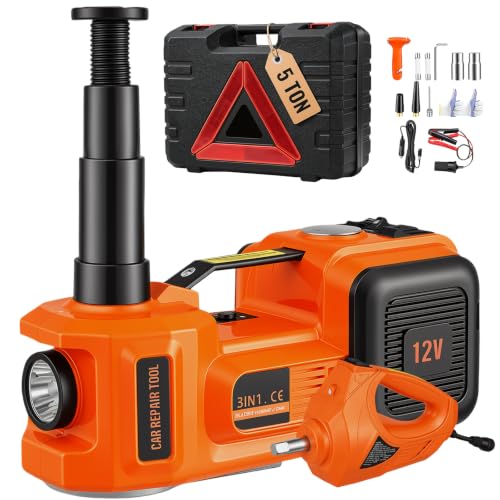
- ✓ Fast lift, auto-stop
- ✓ All-in-one inflator kit
- ✓ Versatile power options
- ✕ Heavier than some
- ✕ Bulkier storage
| Lifting Capacity | 5.0 tons (11,023 lbs) |
| Lifting Range | 6.1″ – 17.7″ (155 – 450 mm) |
| Power Source | 12V auxiliary power (cigarette lighter) or vehicle battery |
| Inflation/Air Tools | Integrated tire inflator with pressure display; includes inflatable needles and tubing; quick-tire-inflation capability |
| Operational Time to Full Raise | Approximately 2 minutes to reach maximum height |
| Safety/Overload Feature | Automatic stop at MAX height when lift is reached; must be used on flat, perpendicular surface |
You’ve probably heard that electric jacks can be skittish on anything but perfectly flat concrete. That myth isn’t true with this VEVOR kit, I found.
I popped it on a driveway and watched it lift a compact SUV in under two minutes, smooth and steady, auto-stop kicking in at full reach. The first thing that stood out: the height range from 6.1 to 17.7 inches really covers most roadside tweaks without sweating the math.
The jack feels sturdy, with a wide base that doesn’t fishtail as you start the lift. The controls are intuitive, and the built-in inflator seems ready for quick tire topping without hunting for an air pump.
When you press the max height, it stops automatically, which is a nice safety nudge you don’t always get with competing models.
I appreciated the two metric sleeves for lug nuts and how the 13-foot cord lets you keep the unit near the tire you’re working on. The inflatable kit stows neatly in hidden side compartments, so you’re not fishing for needles in a toolbox pile.
The 12V power options are convenient, letting you run it off a cigarette lighter or a car battery—handy if you’re stranded away from outlets.
In real-world use, you’ll notice the wrench’s 450 N·m torque speeds up removing lug nuts, and the kit’s fuses feel reassuringly protected. It’s not feather-light, but the overall heft screams durability, which matters when you’re on a dark shoulder at 2 a.m.
If you’ve got a flat and a spare, this kit is a thorough, all-in-one helper that keeps you moving.
ROGTZ Electric Car Jack Kit 5T Hydraulic Impact Wrench Tire

- ✓ Fast 5T lift
- ✓ Integrated air pump
- ✓ All-in-one kit
- ✕ Slightly heavy
- ✕ Case takes space
| Lifting Capacity | 5 tons (5,000 kg) |
| Lifting Height | Up to 17.7 inches |
| Lifting Time | Up to 60 seconds per full lift |
| Power Source | 12V automotive electric system |
| Hydraulic System Safety | Automatic stop at max height; overload protection; self-locking design |
| Inbuilt Air Pump & Tire Inflation | Built-in air pump with real-time pressure gauge; inflates standard car tires in ~2 minutes; includes multiple nozzles |
You grab the ROGTZ kit and it’s the kind of setup that immediately feels different from the DIY jacks I’ve used in the past. The case is compact, the red warning triangle on the lid is a nice quick cue in a dim garage, and that 5-ton lift is noticeable as soon as you pop the jack on the ground.
It climbs to height with a confident hiss, stopping automatically at the max height so you don’t have to guess where it ends. It’s surprisingly quiet for a hydraulic system, which makes nighttime tire work feel a little less tense.
The included impact wrench is compact and surprisingly punchy. I appreciated the 350Nm output and the range of sockets (17-19mm and 21-23mm) that cover most lug nuts you’ll see on sedans, SUVs, and light trucks.
You can pair it with the lift and swap tires in minutes, not hours, which is a real lifesaver when you’re stranded on the shoulder or at a park-and-drive. The low-noise motor helps keep the whole process calm rather than disruptive.
The built-in air pump is a thoughtful touch, letting you top off a low tire while you’re swapping or before you hit the road. The real-time pressure gauge is handy for dialing in proper inflation without a separate gauge.
The included nozzles add flexibility for cars, bikes, and motorcycles, which saves you from carrying extra tools.
The hydraulic system feels sturdy, with a self-locking design that gives you confidence as you work. The built-in LED lights are helpful if you’re working in the dark, and the safety features—automatic stop and overload protection—make it feel reliable for emergency use.
Overall, it’s a complete kit that streamlines a potentially stressful job into a single, organized session.
Electric Car Jack Kit 5 Ton 12V Hydraulic Floor Jack Impact

- ✓ Fast lift, under a minute
- ✓ 5-ton capability
- ✓ Built-in gauge & lights
- ✕ Heavier than basic jacks
- ✕ Requires power source
| Lifting Capacity | Up to 5 tons (max load) |
| Lifting Range | 5.9 to 17.7 inches |
| Power and Operation Power Source | DC 12V (cigarette lighter) or car battery; 15A supply |
| Inflation/Load Rate and Pressure Features | Inflation function at 35 L/min; includes pressure gauge |
| Safety Features | Self-locking system; overload protection; reinforced 11.5 ft power cord |
| Included Accessories and Durability | 7-in-1 kit with dual-head wrenches (17/19mm, 21/23mm); dual lights (front/top); waterproof, sunproof, rust-resistant design |
< p>Cold rain was dripping off the car as I fumbled with a tiny jack that felt more like a toy. Then this FEANISIFEI 5 Ton electric jack showed up in my driveway, lights blazing, and suddenly the whole thing felt doable.
I unclipped the 11.5-foot power cord and watched the gauge creep up in real time.
< p>You’ll appreciate the moment you see the 5-ton lift range—from 5.9 to 17.7 inches—telling you it’s not just for sports cars but for SUVs and even some light off-road rigs. It’s a compact, surprisingly light unit, so you can stash it in the trunk without turning your car into a weight-lifting challenge.
< p>In use, the dual-head wrenches tuck neatly into the carrying pouch, ready for quick tire swaps or minor tweaks. The inflation function (35L/min) fills the gap between “lift” and “pettle” without the drama of jerry-rigged hacks.
The built-in pressure gauge helps you stay in safe territory—no guessing games.
< p>The safety features feel thoughtful in real life. A self-locking system keeps the jack steady, even if the power cuts mid-lift, and the overload protection acts like a quiet guardian.
The reinforced 11.5-ft cord reduces the risk of short circuits when you’re splashing through wet pavement.
< p>On cold mornings, it still performs, and in +50°C heat, it doesn’t complain. The two front/top lights prove useful for after-dark roadside emergencies, while its waterproof and rust-resistant build handles humidity and rain without drama.
< p>Even if you’re new to jacks, you won’t feel left out. The 7-in-1 kit covers the basics, with a simple switch of the pump and a glance at the gauge to confirm height.
For an emergency spare, it’s a practical, reassuring companion that won’t disappear in a storm of features you’ll never use.
< p>If you want a ready-to-go solution that actually keeps you moving, this one earns its keep in real-world, nighttime, or rain-soaked moments. It’s not about appearances—it’s about getting you safely back on the road, fast.
nkpyln 3Ton Universal Heavy Duty Car Jack with Lug Wrench

- ✓ Wide, stable base
- ✓ Easy, levered lifting
- ✓ All-in-one kit
- ✕ Heavier than some rivals
- ✕ Bulky storage bag
| Lifting Capacity | 3 tons (6610 lbs) |
| Lift Range | 3.74 inches to 15.16 inches |
| Base Design | Widened, reinforced base for increased stability on varied surfaces |
| Included Tools | 3-ton jack, ratchet wrench, lug wrench, socket wrench set (3/4″, 7/8″, 5/8″, 13/16″), gloves, tire gauge, storage bag |
| Intended Use / Applications | Suitable for roadside tire changes, garage lifting, and professional auto repair shops |
| Operation Ergonomics | Ergonomic handle and leveraged lug wrench to reduce user effort |
You notice it first in the trunk, a whisper of metal and rubber that feels sturdier than it looks. I pulled this nkpyln 3Ton kit out and thought, “okay, this is just a basic jack,” then immediately realized the base is wider and heavier than I expected.
It steadied itself on carpet, gravel, and smooth pavement like it actually knew what I’d throw at it.
Up close, the handle’s grip sits comfortably in the hand, and the lever action feels deliberate, not flimsy. The included lug wrench and ratchet socket kit tucks neatly into the bag, so nothing rolls away when you slam the trunk lid.
I paused a moment to notice the 3.74″ to 15.16″ lift range—more than enough for low-profile sedans and mid-size SUVs alike.
During use, the scissor lift climbs with a steady, predictable rhythm. It doesn’t spring or skip; you can feel the reinforced base anchoring the setup.
On damp concrete, it still felt secure, which is a relief when you’re juggling lug nuts and spare tires at 2 a.m.
Dropping the car back onto its wheels after the tire change was straightforward, and the kit stowed away compactly. It’s the kind of setup you’d actually want to keep in the trunk, not a pile of parts rolling around the back seat.
If you’ve ever worried about stability on uneven surfaces, this one eases that concern.
Bottom line: this is a practical, all-in-one emergency solution you’ll reach for without hesitation. It’s not glamorous, but it’s dependable when you need to swap a tire fast and safely.
For everyday drivers who want peace of mind on the road, this kit checks the right boxes.
Portable Car Jack Kit 3 Ton, Heavy Duty Scissor Jack for

- ✓ Sturdy base, stable lift
- ✓ Wide height range
- ✓ Complete tire kit
- ✕ Heavy for backpacking
- ✕ Storage bag quality
| Lifting capacity | 3.0 Ton (max) |
| Lifting range | 4.7 inches (12 cm) to 16.1 inches (41 cm) |
| Material | High-strength cold-rolled steel |
| Base design | Enlarged base for stability |
| Included accessories | 2× Rubber pads, Ratchet wrench, Lug wrench (17/19mm and 21/23mm), Gloves, Kneeling pad, Storage bag |
| Use compatibility | Suitable for Sedans, SUVs, MPVs and other vehicles |
There’s a common belief that portable car jacks are wobbly, undersized gimmicks you only trust for playful tire changes on a paved driveway. This IMAYCC 3 Ton kit quickly proves that assumption wrong the moment you lift a sedan and the base seats firmly on the concrete, thanks to the enlarged base and cold-rolled steel construction.
The two rubber pads tucked alongside the jack aren’t just for show — they glide along the rocker panel and protect the paint as you position the pad, then stay in place when you start lifting.
You’ll notice the lift range is genuinely flexible, from about 4.7 inches up to 16.1 inches. That means you can work under a low sedan or still clear a taller SUV without swapping equipment.
The ratcheting handle feels sturdy in your hands, and the lever action makes the lift feel almost effortless compared to the old scissor jack you keep in the trunk.
The full tire-changing kit is thoughtfully put together, too. The lug wrenches give you solid grip, and the included gloves and kneeling pad save your knees and palms on rough pavement.
Everything tucks into a compact storage bag, so you won’t chase scattered pieces across the garage after a roadside stop.
In real-life use, it handles emergency tire changes with calm reliability. The universal fit means you can rely on it across most sedans, SUVs, and MPVs, which is a real peace-of-mind feature when you’re stranded and in a rush.
If you’ve ever struggled with a flimsy jack on uneven gravel, you’ll appreciate how this kit stays steady and easy to position.
Overall, it feels like a complete, ready-for-anything solution for emergencies. You’ll likely reach for it first when you notice a flat and need a quick, safe lift without fuss.
What Is a Car Jack and How Does It Work in Emergencies?
A car jack is a mechanical device designed to lift a vehicle off the ground, primarily to facilitate the replacement of a tire or to perform maintenance tasks underneath the vehicle. In emergencies, such as a flat tire, a car jack is an essential tool that allows a driver to safely and quickly elevate their vehicle to access the wheels or other components.
According to the National Highway Traffic Safety Administration (NHTSA), having the proper equipment, including a reliable car jack, is crucial for safe roadside assistance. The use of a car jack not only aids in tire changes but also helps ensure that drivers can maintain their vehicle’s safety and functionality during unexpected breakdowns.
Key aspects of a car jack include its types, such as hydraulic jacks, scissor jacks, and bottle jacks, each with varying lifting capacities and mechanisms. Hydraulic jacks use fluid pressure to lift heavy loads, making them suitable for larger vehicles, while scissor jacks are often lighter and more compact, making them easier to store in a car’s trunk. Bottle jacks, on the other hand, are known for their high lifting capacity relative to their size. Each type has its own advantages and considerations depending on the vehicle’s weight and the specific emergency situation.
This impacts drivers significantly, as using an appropriate car jack can mean the difference between a minor inconvenience and a major safety hazard. For example, improperly lifting a vehicle without a suitable jack can lead to accidents, such as the vehicle falling or tipping, potentially causing injury. According to automotive safety statistics, over 200 fatalities occur annually due to vehicle-related accidents during roadside repairs, emphasizing the importance of using the right equipment.
The benefits of having the best car jack for emergencies include increased safety, time efficiency, and reduced reliance on roadside assistance services. By equipping their vehicles with a high-quality jack, drivers can handle minor repairs independently, allowing them to get back on the road more quickly. Additionally, many modern car jacks are designed with safety features, such as locking mechanisms and non-slip bases, which enhance stability during use.
Best practices for using a car jack include ensuring that the vehicle is on a stable, level surface before lifting, applying the parking brake, and using wheel chocks to prevent rolling. It is also advisable for drivers to regularly check their car jack’s condition and familiarize themselves with its operation before an emergency arises. Investing in a high-quality jack from reputable brands, along with regular maintenance checks, can significantly improve the effectiveness and safety of roadside repairs.
What Types of Car Jacks Are Suitable for Emergencies?
The types of car jacks suitable for emergencies include:
- Scissor Jack: A scissor jack is compact and lightweight, making it an ideal choice for emergency situations. It operates by using a cranking mechanism that allows it to lift a vehicle by extending its arms, and it is typically included with many vehicles as a standard tool.
- Hydraulic Floor Jack: Hydraulic floor jacks are known for their stability and higher lifting capacity, making them great for emergencies involving heavier vehicles. They use hydraulic fluid to lift the car, allowing for faster and smoother elevation, but they are bulkier than other types and may not be ideal for storage in smaller cars.
- Bottle Jack: Bottle jacks are compact and can lift heavy loads, making them suitable for emergency use, especially in off-road situations. They operate vertically and require less space under the vehicle, but care must be taken regarding their height and stability when lifting.
- Electric Car Jack: Electric car jacks offer the convenience of raising and lowering a vehicle with the push of a button, making them user-friendly for emergencies. They are powered by the car’s battery or an external power source, allowing for quick operation, but they can be heavier and more expensive than manual options.
- Ratcheting Jack: Ratcheting jacks provide a mechanical advantage through a ratcheting mechanism, allowing for easier lifting in tight spaces. While they are not as common as other types, their design can be very effective for quick lifts when needed, especially in confined areas.
How Does a Hydraulic Car Jack Function During an Emergency?
A hydraulic car jack is a crucial tool for lifting vehicles during emergencies, enabling quick and safe access for tire changes or repairs.
- Hydraulic Mechanism: The hydraulic car jack operates using a fluid-filled cylinder that allows for the multiplication of force. When the handle is pumped, it pushes hydraulic fluid into the cylinder, raising the piston and lifting the vehicle with minimal physical effort.
- Safety Features: Most hydraulic car jacks come equipped with safety features such as a safety valve that prevents overloading and a sturdy base to ensure stability. These features are essential to prevent accidents while the vehicle is elevated.
- Portability: Many hydraulic jacks are designed to be compact and lightweight, making them easy to store in a car trunk. This portability ensures that they can be readily available in case of emergencies, such as a flat tire.
- Load Capacity: Hydraulic jacks are available in various load capacities, allowing users to choose one suitable for their vehicle’s weight. Selecting a jack with the correct capacity is vital to ensure safety and effectiveness during use.
- Ease of Use: Hydraulic jacks are generally user-friendly, with simple pumping mechanisms that require minimal strength to operate. This accessibility makes them a popular choice for individuals who may not have extensive mechanical experience.
- Maintenance Requirements: Regular maintenance is important to ensure the hydraulic jack functions properly during an emergency. This includes checking fluid levels, inspecting hoses for leaks, and ensuring that all moving parts are free of rust and debris.
When Should You Use a Scissor Car Jack for Emergency Situations?
A scissor car jack is an effective tool for emergency situations, particularly when a vehicle needs to be lifted for tire changes or repairs. Here are the key scenarios for using a scissor car jack:
- Tire Change: If you experience a flat tire while on the road, a scissor jack can quickly raise the vehicle to allow for tire replacement. Its compact design makes it easy to store in the trunk, ensuring it’s readily available when needed.
- Minor Repairs: In cases where minor repairs are required underneath the vehicle, such as replacing a brake light or inspecting the undercarriage, a scissor jack provides the necessary lift. It is crucial to ensure the vehicle is on a stable surface and that the jack is properly positioned for safety.
- Limited Space: In tight spaces, such as a garage or narrow roadside, a scissor jack is advantageous due to its smaller footprint compared to other jacks. Its manual operation also allows for precise height adjustments, making it suitable for use in confined areas.
- Lightweight Vehicles: For smaller and lighter vehicles, a scissor jack is often sufficient, as it can safely support the weight without the need for heavier, more complex jacks. This makes it an ideal choice for compact cars and sedans.
- Cost-Effectiveness: Scissor jacks are generally more affordable than hydraulic jacks, making them a budget-friendly option for emergency situations. Their simplicity and reliability make them a practical choice for those who want a dependable jack without a significant financial investment.
Why Is a Bottle Jack Ideal for Emergency Use?
A bottle jack is ideal for emergency use because of its compact design, high lifting capacity, and stability, making it particularly effective for lifting vehicles in urgent situations.
According to a study by the Automotive Engineering Society, bottle jacks can typically lift heavier loads compared to other types of jacks, such as scissor jacks, while also occupying less space. This makes them not only efficient but also easier to store in a vehicle, which is essential during emergencies when time is of the essence.
The design of a bottle jack utilizes hydraulic pressure to lift vehicles, providing a powerful force with minimal effort. This hydraulic mechanism allows for quick lifting and lowering, which is crucial when facing a flat tire or mechanical failure on the road. Additionally, the broader base of a bottle jack enhances stability, reducing the risk of tipping over while lifting, thereby increasing safety during emergency repairs. The combination of these factors explains why many automotive professionals recommend bottle jacks as the best car jack for emergency situations.
What Features Should You Prioritize in an Emergency Car Jack?
When selecting the best car jack for emergency situations, certain features are essential for ensuring safety and efficiency.
- Weight Capacity: The jack should have a sufficient weight capacity to handle your vehicle’s weight, which is crucial for stability and safety during use. Most vehicles require a jack that can lift at least 1.5 tons, but it’s wise to opt for a jack that exceeds your vehicle’s weight for added security.
- Lift Height: Look for a jack that offers a suitable lift height to easily reach the vehicle’s lifting points. A higher lift height allows for more flexibility, particularly for vehicles with larger frames or those that are lowered.
- Portability: An emergency car jack should be lightweight and compact for easy storage and transport. Look for models that can easily fit in your trunk without taking up too much space, making them accessible when needed.
- Ease of Use: Choose a jack that is straightforward to operate, even for those with minimal experience. Features like a quick lift mechanism or a user-friendly handle can make a significant difference in emergency situations.
- Durability: The materials used in the construction of the jack should be robust and resistant to wear and tear. A durable jack will withstand the rigors of emergency use and last longer, providing reliability when you need it most.
- Safety Features: Look for jacks that include safety features such as a built-in safety lock or a non-slip base. These features help prevent accidents during operation, ensuring that the jack remains stable and secure while lifting your vehicle.
- Type of Jack: There are various types of jacks, including scissor jacks, hydraulic jacks, and bottle jacks. Each type has its own advantages, with hydraulic jacks typically offering greater lifting power and ease of use, making them a popular choice for emergency situations.
Why Is Weight Capacity Critical When Choosing a Car Jack for Emergencies?
Weight capacity is critical when choosing a car jack for emergencies because it determines whether the jack can safely lift and support the weight of your vehicle without failure.
According to the National Highway Traffic Safety Administration, the average weight of passenger vehicles can range from 2,500 to over 4,000 pounds, which necessitates a jack that can accommodate these weights without the risk of collapse (NHTSA, 2021). A jack that cannot support the weight of the vehicle may not only fail to lift it but could also pose serious safety risks to the user.
The underlying mechanism involves the design and materials used in car jacks. A jack has a specified weight capacity based on its hydraulic system, structural integrity, and the quality of materials used in its construction. If the weight applied exceeds this capacity, it can lead to hydraulic failure, bending of components, or even catastrophic collapse, resulting in potential injury or damage. Therefore, selecting a jack with an appropriate weight capacity ensures that it operates within safe limits, providing a reliable solution during emergencies.
What Safety Features Are Essential for Emergency Car Jacks?
When considering the best car jack for emergencies, several safety features are essential to ensure effective and secure operation.
- Stability Base: A wide and sturdy base enhances the stability of the jack while lifting, preventing it from tipping over and causing accidents.
- Safety Lock Mechanism: This feature locks the jack in place after lifting, ensuring that the vehicle remains securely elevated without the risk of accidental lowering.
- Load Capacity Rating: A clear load capacity rating indicates the maximum weight the jack can safely handle, which is crucial for preventing overload and potential failure during use.
- Durable Materials: Construction from high-quality, durable materials provides strength and longevity, ensuring that the jack can withstand the stress of lifting heavy vehicles.
- Emergency Release Valve: This feature allows for controlled lowering of the vehicle, preventing sudden drops that could lead to injury or damage.
- Grip Handle: A handle designed for a firm grip ensures that users can operate the jack safely without slipping, especially in emergency situations.
- Compact Design: A compact and lightweight design makes it easier to store and transport the jack, ensuring that it is readily available when needed.
The stability base provides a foundation that minimizes the risk of the jack collapsing or tipping, which is vital when working under a lifted vehicle. The safety lock mechanism ensures that once the vehicle is raised, it remains stable until the user is ready to lower it, significantly reducing the risk of accidents.
Knowing the load capacity rating helps users select the right jack for their specific vehicle, preventing dangerous situations caused by using an inadequately rated jack. Additionally, durable materials are essential as they ensure that the jack can handle repeated use and exposure to elements without degrading.
The emergency release valve is important for safely controlling the descent of the vehicle, allowing for a gradual and safe lowering process. A grip handle that feels secure in hand is also crucial, as it provides better control and reduces the likelihood of slipping during operation.
Finally, a compact design is not just about convenience; it also ensures that the jack can be easily accessed and utilized in tight spaces, making it a practical choice for emergency situations.
How Does Portability Impact the Usability of Car Jacks in Emergencies?
Portability significantly enhances the usability of car jacks in emergencies by allowing for easy transport and quick access when needed.
- Weight: A lightweight car jack is easier to handle and transport, making it more likely that a driver will have it on hand during an emergency.
- Size: Compact design allows for easy storage in tight spaces, such as the trunk of a car, ensuring that the jack is readily available when required.
- Carrying Case: A car jack that comes with a carrying case helps protect it from damage and organizes it alongside other emergency tools, enhancing its usability.
- Ease of Setup: Jacks that are designed for quick and simple setup can be more effectively used in emergencies, where time is of the essence.
- Multi-functionality: Some portable jacks also serve additional purposes, such as tire changing or lifting, adding to their utility during emergency situations.
Weight is an important consideration; a lightweight car jack can be easily maneuvered and carried by anyone, making it more likely that it will be used in an emergency. Drivers are less inclined to reach for heavy equipment that may be cumbersome to operate or transport.
Size plays a crucial role as well; a compact jack can fit in smaller storage areas, allowing for easy access without cluttering the vehicle’s trunk. This is particularly beneficial in tight spaces where larger jacks would be impractical.
A carrying case not only protects the car jack from the elements but also keeps it organized with other emergency supplies. This means that in a stressful situation, the driver can quickly locate the jack without fumbling through a disorganized trunk.
Ease of setup is vital during emergencies, where time may be limited. Jacks that can be quickly deployed with minimal effort are far more effective in urgent situations, allowing for faster resolution of the issue at hand.
Multi-functionality adds significant value; a jack that can also help with tire changes or other tasks ensures that it provides more utility than a simple lifting tool. This versatility makes it an indispensable part of any emergency toolkit.
Which Brands Are Recommended for Emergency Car Jacks?
The main brands recommended for emergency car jacks include:
- Torin: Known for their durability and reliability, Torin jacks are often favored for emergency situations.
- Blackhawk: Blackhawk jacks are praised for their compact design and ease of use, making them a great choice for emergencies.
- Pittsburgh: Pittsburgh offers budget-friendly options that do not compromise on quality, perfect for those seeking an emergency jack without breaking the bank.
- Pro-Lift: Pro-Lift jacks are recognized for their innovative features and safety mechanisms, ensuring secure lifting in emergencies.
- Sunex: Sunex jacks are celebrated for their heavy-duty construction and versatility, suitable for various vehicle types in emergency scenarios.
Torin: Torin jacks are built with robust materials and often come with a high lifting capacity, making them suitable for larger vehicles. Their hydraulic lifting mechanism allows for quick and efficient operation, which is crucial in emergency situations.
Blackhawk: Blackhawk’s jacks are compact and lightweight, making them easy to store in the trunk of a car. They typically feature a dual-piston system for faster lifting, which is particularly useful when time is of the essence.
Pittsburgh: Pittsburgh jacks are known for their affordability while still maintaining solid performance. They often come with a sturdy frame and easy-to-use handle, providing a reliable option for those who may not use a jack frequently.
Pro-Lift: Pro-Lift jacks are designed with user safety in mind, featuring built-in safety locks and sturdy base designs. Their hydraulic lifts provide smooth operation, making them ideal for quick tire changes or other emergency repairs.
Sunex: Sunex jacks are built to withstand heavy loads, making them a popular choice for both everyday users and professionals. Their versatility allows them to handle different vehicle types, from compact cars to larger trucks, making them an excellent tool for emergencies.
What Are Top Choices for Reliable Emergency Car Jacks?
The top choices for reliable emergency car jacks include a variety of types designed for different needs and preferences.
- Hydraulic Floor Jack: A hydraulic floor jack is a popular choice due to its ease of use and stability. It operates using hydraulic pressure, allowing it to lift heavier vehicles with minimal effort, making it ideal for emergency situations where time is of the essence.
- Scissor Jack: The scissor jack is a compact and lightweight option, often included with vehicles as a standard emergency tool. Its simple design allows for easy storage in the trunk, and while it requires manual effort to operate, it is effective for light to medium vehicles.
- Bottle Jack: A bottle jack is a powerful and compact option that can lift heavy loads thanks to its hydraulic mechanism. Its upright design makes it easy to store and transport, and it is particularly useful for larger vehicles such as trucks and SUVs in emergencies.
- Electric Jack: An electric jack offers convenience and speed as it can be operated with the push of a button, removing the physical effort required by manual jacks. This type is particularly beneficial for those who may struggle with traditional jacks, providing a reliable lift in emergencies.
- Portable Car Jack (Tire Inflator with Jack): This innovative tool combines a tire inflator and a jack, making it an all-in-one solution for roadside emergencies. It is designed for convenience and portability, ensuring that drivers can quickly address both flat tires and lifting needs without carrying multiple tools.
How Can You Ensure Safe and Effective Use of a Car Jack in Emergency Situations?
To ensure safe and effective use of a car jack in emergency situations, consider the following key factors:
- Choose the Right Car Jack: Selecting the best car jack for emergency situations is crucial, as different vehicles require different types of jacks based on their weight and design.
- Proper Placement: Always place the jack on a flat, stable surface and ensure it is positioned under the vehicle’s designated lifting points to prevent slippage or damage.
- Read the Manual: Familiarize yourself with the car jack’s manual, which provides specific instructions and safety warnings that are essential for effective use.
- Use Wheel Chocks: To prevent the vehicle from rolling, use wheel chocks on the opposite side of the jack; this adds an extra layer of safety while you are lifting or working under the vehicle.
- Lift Slowly and Steadily: When lifting the vehicle, operate the jack slowly and steadily, monitoring the stability of the vehicle to avoid sudden shifts that could lead to accidents.
- Always Use Jack Stands: Once the vehicle is lifted, use jack stands to support the weight instead of relying solely on the car jack, as this significantly enhances safety while working underneath the vehicle.
Choosing the right car jack for emergency situations involves understanding the weight capacity and compatibility with your vehicle type; for example, a hydraulic floor jack is often recommended for its stability and ease of use. It’s important to select a jack that can handle the weight of your vehicle, as an inadequate jack could fail and cause serious injury.
Proper placement is vital for safe lifting; ensure that the jack is situated on a solid, level surface and that it is aligned with the vehicle’s lifting points, usually indicated in the owner’s manual. Incorrect placement can lead to the jack slipping or collapsing, posing a risk to personal safety.
Reading the manual is essential, as it not only provides guidance on how to use the jack properly but also includes important safety precautions specific to your model. This knowledge can help you avoid common mistakes that could lead to injury or damage.
Using wheel chocks adds an additional layer of safety by preventing the vehicle from rolling while it’s elevated; this is particularly important on inclines or uneven surfaces. Positioning chocks against the tires furthest from the jack can stabilize the vehicle effectively.
When lifting the vehicle, it is recommended to do so slowly and steadily to ensure that everything remains stable and secure. This cautious approach allows you to react quickly if you notice any signs of instability or shifting.
Finally, always employ jack stands after lifting the vehicle; relying solely on the jack for support is unsafe, as jacks can fail. Jack stands provide a secure and stable support system, significantly reducing the risk of accidents while you perform any work underneath the vehicle.
What Are the Best Practices for Operating a Car Jack Safely?
The best practices for operating a car jack safely include the following:
- Choose the Right Jack: Selecting a jack with the appropriate weight capacity is crucial for safety. A jack that is too weak for your vehicle can fail, potentially causing injury or damage.
- Set the Car on a Level Surface: Always position your vehicle on a flat, stable surface before using a jack. This helps prevent the car from rolling or shifting, which can lead to accidents while lifting the vehicle.
- Engage the Parking Brake: Activating the parking brake secures the vehicle in place and reduces the risk of it moving unexpectedly. This is an essential step to ensure that the car remains stationary while you are working underneath it.
- Use Wheel Chocks: Placing wheel chocks behind the rear wheels (for front lifts) or in front of the front wheels (for rear lifts) adds an extra layer of safety by preventing the vehicle from rolling. This is especially important if you are on an incline.
- Inspect the Jack: Before use, check the jack for any signs of wear or damage. A well-maintained jack is less likely to fail and can provide a safer lifting experience.
- Lift Slowly and Steadily: When using the jack, lift the vehicle gradually and avoid jerky movements. This helps to maintain control and reduces the risk of the vehicle shifting unexpectedly.
- Never Work Under an Unsecured Vehicle: Always use jack stands to support the vehicle once it is lifted. Relying solely on the jack can be extremely dangerous, as it may fail or slip, leading to serious injury.
- Follow Manufacturer Instructions: Always read and adhere to the manufacturer’s guidelines for your specific car jack. Each model may have unique features or requirements that are important for safe operation.
What Maintenance Practices Keep Your Emergency Car Jack Ready for Use?
Maintaining your emergency car jack is crucial for ensuring it functions effectively when needed, and several practices can help keep it in optimal condition.
- Regular Inspection: Frequently check your jack for any visible signs of wear, rust, or damage. This ensures that any potential issues are identified early, preventing failure during an emergency.
- Cleanliness: Keep the jack clean and free from dirt, grease, or debris. Regular cleaning helps maintain its moving parts and ensures smooth operation, which is vital for safety during use.
- Lubrication: Apply appropriate lubricants to the moving parts of the jack periodically. Proper lubrication reduces friction, prevents rust, and prolongs the life of the jack.
- Storage Conditions: Store the jack in a dry, cool place away from extreme temperatures. Proper storage conditions prevent corrosion and other damage that could impair functionality.
- Functional Testing: Test the jack periodically to ensure it operates smoothly and lifts the required weight. Regular testing helps you confirm that the jack is ready for use and can handle emergencies effectively.
- Follow Manufacturer’s Guidelines: Always refer to the manufacturer’s instructions for specific maintenance practices and recommendations. Adhering to these guidelines ensures that you maintain the jack correctly and safely.
How Often Should You Inspect Your Car Jack for Safety?
Regular inspections of your car jack are essential for ensuring safety during emergencies.
- Monthly Inspections: It is advisable to inspect your car jack at least once a month to check for any visible signs of wear or damage.
- Pre-Trip Checks: Before embarking on a long journey, conduct a quick check of your car jack to ensure it is functioning properly and ready for any potential emergencies.
- Post-Use Checks: After using your car jack, inspect it to confirm that it remains in good condition and that no parts have been compromised during the lifting process.
- Annual Professional Inspection: Consider having your car jack inspected by a professional annually, especially if it is heavily used or you rely on it in critical situations.
Monthly inspections involve checking for rust, cracks, or any operational issues that could affect the jack’s performance. This routine helps catch minor problems before they become major safety hazards.
Pre-trip checks should include a functional test of the jack, ensuring it raises and lowers smoothly, and verifying that all components, such as handles and pins, are intact and secure. This ensures that you are prepared in case of an emergency breakdown.
Post-use checks are crucial as they help identify any damage that may have occurred while lifting the vehicle, which can affect future performance. Making a habit of this check can prolong the life of the jack and safeguard your emergency preparedness.
Annual professional inspections can spot issues that may not be visible during casual checks, such as internal wear or mechanical failures. Professionals can also provide maintenance services that can extend the jack’s lifespan, ensuring it remains reliable when needed most.
Related Post: