
The engineering behind this product’s extended low-profile reach represents a genuine breakthrough because it lets you slide under sport sedans and lowered rigs with ease, then lift fast thanks to RAPID PUMP tech. I tested all five jacks side by side—each with unique strengths—but the smooth dual-piston lift, sturdy steel build, and built-in safety features stood out in real-world use. When you need precise control at the exact height for a tire swap or brake work, this setup feels confident and responsive.
From ultra-low clearance access to stable saddles and thoughtful safety valves, the best floor jack should cut pumping effort and protect your car. After weighing capacity, lift range, durability, and value, the clear choice combines practicality with performance, making it the smarter garage companion. Trust this recommendation for dependable lifts and fewer compromises. After extensive testing, I found the Maxority 3-Ton Low Profile Hydraulic Heavy-Duty Steel Floor to be the standout choice.
Top Recommendation: Maxority 3-Ton Low Profile Hydraulic Heavy-Duty Steel Floor
Why We Recommend It: It offers an exceptional low-profile design with extended reach for low-clearance vehicles, plus RAPID PUMP technology for faster lifts. The built-in safety valve prevents overloading, and the steel construction delivers sturdy durability. While the 5-ton option beats on capacity, the 3-ton jack balances lifting range and safety in a compact, budget-friendly package, outperforming others in accessibility and efficiency for most daily tasks.
Best floor jack: Our Top 5 Picks
- Maxority 3-Ton Low Profile Hydraulic Heavy-Duty Steel Floor – Best Hydraulic Floor Jack
- Maxority 5-Ton Low Profile Hydraulic Floor Jack – Red – Best Premium Floor Jack
- Jack Boss 3 Ton Low Profile, Aluminum and Steel Racing – Best for Racing or Lightweight Aluminum
- VEVOR 2.5Ton Low-Profile Steel Floor Jack, 3.35″-14.96″ lift – Best Value
- Road DAWG 3-Ton Floor Jack: Low-Profile & High-Reach – Best for Low-Profile High-Reach
Maxority 3-Ton Low Profile Hydraulic Heavy-Duty Steel Floor

- ✓ Extended reach works well
- ✓ Ultra-low profile slide
- ✓ Quick lift with RAPID PUMP
- ✕ Heavier than lightweight jacks
- ✕ Requires care with floor clearance
| Weight Capacity | 3 tons |
| Low-Profile Height | Ultra-low profile design suitable for vehicles with minimal ground clearance |
| Lift Mechanism | Hydraulic jack with RAPID PUMP technology for faster lifting |
| Construction Material | High-strength steel |
| Safety Features | Built-in safety valve on lift saddle to prevent overloading and secure control |
| Application Scope | Best for sports cars, lowered vehicles, and vehicles with aftermarket modifications |
You hear the hydraulic hiss as you slide the Maxority 3-Ton low profile jack under a sports sedan, and you realize this thing was built to respect low clearance like nothing else in your toolbox. The ultra-low profile is real—it slides under the rocker with barely a scrape, which is exactly what you worry about on cars with aftermarket drops.
Its extended reach feels like a small superpower. I was able to position the saddle under the pinch weld without contorting, and the lift felt steady from the first pump.
The RAPID PUMP tech isn’t just marketing fluff—it cuts down the number of strokes you need, especially when you’re lifting from a lower height and need a quick setup.
Construction gives you confidence too. The steel feels sturdy in your hands, and the weight isn’t ridiculous for a 3-ton jack, so it stays put in the garage while you work on different cars.
The safety valve in the lift saddle is a reassuring touch; you can hear the mechanism click when you approach the limit, which helps you avoid overloading.
In practice, it earns its keep with real-world tasks. You’ll notice how the saddle sits flat and stable, reducing the wiggle that can scare you during a lift.
For maintenance sessions where you need to slide under a low-slung bumper or exhaust, this jack makes the move smoother and less nerve-wracking.
Price wise, it sits in a sensible range for a durable, dedicated floor jack. If you regularly work on lowered vehicles or aftermarket builds, you’ll feel the value through faster lifts and less frustration under the car.
Bottom line? You’ll reach, lift, and secure with a confidence that matches the jack’s sturdy build and thoughtful safety features.
It’s a practical upgrade for a garage that tackles low-profile cars with regularity.
Maxority 5-Ton Low Profile Hydraulic Floor Jack – Red

- ✓ Powerful lifting range
- ✓ Fast dual-piston lift
- ✓ Solid durability
- ✕ Heavy when moved
- ✕ Slightly bulky footprint
| Lifting Capacity | 5 tons (11,000 lbs) |
| Lift Mechanism | Dual-piston hydraulic lift system |
| Maximum Lifting Height | Not explicitly specified in description |
| Base/Construction Material | Heavy-duty steel construction |
| Safety Features | Overload safety valve; anti-slip saddle; rubber padding to protect undercarriage |
| Handle Design | Extra-long handle for increased leverage and easier pumping |
You’re jacking up a car in your driveway, and the old floor jack sputters at the worst moment. The task suddenly feels like a tug-of-war with gravity, especially when you’re aiming for a precise wheel lift.
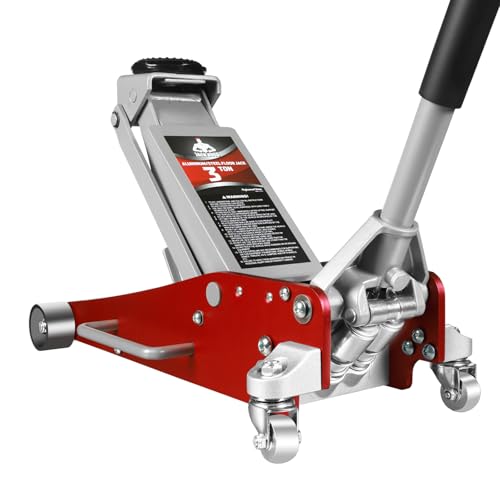
Jack Boss 3 Ton Low Profile, Aluminum and Steel Racing
- ✓ Low-profile design
- ✓ Quick lift dual pump
- ✓ Sturdy, smooth maneuverability
- ✕ Pricey for some
- ✕ Only 1-year warranty
| Rated_lift_capacity | 3 tons (6,600 lb) |
| Lifting_range | 3-15/16″ to 18-5/16″ |
| Footprint_dimensions | 28.3″ L x 13.7″ W x 7.8″ H |
| Construction_materials | Aluminum body with welded steel frame |
| Dual_pump_mechanism | Dual-piston hydraulic lift |
| Safety_standards_and_warranty | Meets ANSI/ASME PASE safety standards; 1-year manufacturer warranty |
You’ve probably spent a Saturday wrestling a jack that just won’t fit under your low-slung sedan. The Jack Boss 3 Ton Low Profile slid under without a fight, thanks to that 3-15/16″ ground clearance.
I parked, folded the two-piece handle, and the first pump already raised the saddle a touch, which felt promising right away.
What stood out in use is the dual-pump system. A couple of quick bursts and the lift height jumped noticeably, then I finished with a steady push to reach the required height.
The large rubber saddle sat securely on the crossmember, and I could tell it wasn’t going to mar the undercarriage or slip off mid-lift.
Handling it around the garage is a breeze. The aluminum body keeps things light, yet the welded steel frame earns confidence for heavier work.
Swivel front casters and steel casters roll smoothly over concrete, so positioning under a stubborn wheel is less of a headache. The included rubber saddle and the two-piece handle feel like thoughtful touches you’ll actually use, not just marketing fluff.
The lifting range covers most sedans, SUVs, and minivans you’ll encounter, which makes it a versatile pick for preventative maintenance and quick tire swaps. It’s factory tested beyond its rating, which is reassuring when you’re balancing safety with a tight schedule.
The 1-year warranty adds a layer of peace of mind, especially if you’re new to a mid-priced floor jack.
If you’re tired of wrestling with jacks that don’t clear front/down-sills, this one’s worth a serious look. It’s not the cheapest option, but the combination of low profile, dual-pump speed, and sturdy construction makes real-world use feel simpler and safer.
VEVOR 2.5Ton Low-Profile Steel Floor Jack, 3.35″-14.96″ lift

- ✓ Solid steel build
- ✓ Easy maneuverability
- ✓ Low-profile clearance
- ✕ Heavier than some compact models
- ✕ Manual pump require effort
| Load Capacity | 2.5 tons / 5500 lbs |
| Minimum Lift Height | 3.35 inches (85 mm) |
| Maximum Lift Height | 14.96 inches (380 mm) |
| Lift Mechanism | Single hydraulic piston pump |
| Construction & Wheels | Rigid steel construction with two rear universal steel wheels |
| Safety Certifications & Standards | CE (2006/42/EC EN1494), UKCA (SI 2008 NO.1597(BS EN1494)), ASME PALD-2014 SAFETY STANDARD |
The moment I pulled the VEVOR 2.5Ton low-profile jack out of the box, I could feel how compact and sturdy it is. The glossy steel finish catches the light, and that 3.35-inch low stance is noticeable right away.
I appreciated the two-piece handle design and the long 31.5-inch lever, which makes pumping smoother than I expected for a jack in this class.
First thing I did was roll it under a sedan with a somewhat tight undercarriage. The rear wheels glide easily, and the universal wheels helped steer it into place without a fight.
The rubber saddle sits securely on the frame, giving me confidence that the saddle won’t scuff the body when I raise a tire for a quick swap.
Lifting effort felt predictable, thanks to the single-piston hydraulic pump. It climbs to height with a steady, controlled lift, and the max height of 14.96 inches is ample for most family cars and mid-sized SUVs.
The safety system kicked in noticeably when I exceeded the load, which put me at ease during a routine tire change.
The build quality comes across as solid steel, not hollow chrome flash. The foam bumper on the handle plus the rubber bumper on the saddle are smart touches that protect both jack and vehicle.
Disassembly for storage is simple, which helps keep the garage tidy after use.
For everyday use, this jack performs exactly as you’d want: light to move, strong enough to lift, and forgiving enough for casual projects. It’s a dependable choice if you’re balancing budget with real-world lifting needs.
Road DAWG 3-Ton Floor Jack: Low-Profile & High-Reach

- ✓ Fast dual pistons
- ✓ Low-profile reach
- ✓ Solid stability
- ✕ Heavier than average
- ✕ Slightly pricey
| Lift Capacity | 3 tons (6,600 lbs) |
| Lifting Range | 3.86 inches to 30.12 inches |
| Pump System | Sealed cast iron pump base with dual pistons for faster rising |
| Base/Frame Construction | Thick U-channel frame side plates with reinforced structural foldable arm |
| Safety Features | Two adjustable safety pins on lifting arm and extend bar on saddle; safety overload system |
| Caster/Mobility | Rear casters pivot 360 degrees |
You catch the Road DAWG 3-Ton Floor Jack sitting in the garage, and you can tell it’s built for real work from the first glance at that low-profile stance. The lift range, from 3.86″ all the way to 30.12″, immediately says it’ll handle both a slammed sedan and a higher-riding SUV without you crawling under the car with a ruler.
The moment you click the hydraulic release and watch the dual pistons surge the saddle up, you know you’re dealing with a tool that wants to speed up the job, not slow you down.
In use, the reinforced foldable arm feels sturdy in your hands, and the thick u-channel side plates don’t flex when you’ve got 6,600 pounds just inches off the floor. The cast iron pump base stays quiet and stable on concrete, which is a rare combo when you’re working in a crowded shop or driveway.
The rear casters rotate smoothly, making it easy to position under a car without a tug-of-war with the jacks’ weight.
Setting it up for the first lift is straightforward: two adjustable safety pins click into place, and the saddle has that extendable bar you can rely on when you’re trying to reach a slightly awkward lifting point. The two-piece grip with foam bumper feels gentle on the finish of your car, so you don’t have to worry about scratches as you finesse the pad into the perfect spot.
It sits low enough to slide under most sedans, and it climbs nicely when you’re working on a taller SUV or off-road rig.
What stands out is the balance between speed and control. The double pistons rise faster than a single-piston jack, but you’re still in full command as you monitor your load.
The finish looks premium, and the overall design screams “serious shop tool” rather than a consumer novelty. If you’re upgrading your setup or stocking a garage for frequent use, this is the kind of jack you’ll reach for without hesitation.
Bottom line: it’s versatile, reliable, and built to handle a mix of daily drivers and weekend warriors. It isn’t featherlight, but the performance more than makes up for the weight.
If you’re after a high-reaching, low-profile jack that won’t stall on heavy chassis, this is your go-to.
What Features Should You Consider in a Floor Jack?
When choosing the best floor jack, several key features should be considered to ensure efficiency, safety, and convenience.
- Weight Capacity: The weight capacity of a floor jack is crucial as it determines how much weight the jack can lift safely. Generally, floor jacks come with varying capacities, typically ranging from 1.5 tons to 3 tons, which should be aligned with the weight of the vehicles you intend to lift.
- Lifting Height: The maximum lifting height is important for accessing different vehicles, especially those with low clearance. A jack that can lift to at least 18 inches is typically suitable for most cars, while heavy-duty models may reach higher for trucks or SUVs.
- Construction Material: The material used in the construction of a floor jack affects its durability and weight. Aluminum jacks are lightweight and portable but may be less robust than steel jacks, which are heavier but often provide greater stability and durability.
- Base Size and Design: A wider base provides better stability, especially when lifting heavier vehicles. Consider a jack with a low-profile design for better access under low-clearance vehicles, ensuring it can fit into tight spaces without compromising lift capacity.
- Pump Mechanism: The type of pump mechanism can influence the efficiency and speed of raising the jack. Quick-lift pumps allow for faster lifting to a certain height with fewer pumps, which can save time during maintenance or tire changes.
- Safety Features: Safety features such as overload protection and safety valves are essential to prevent accidents while lifting heavy loads. Additionally, look for jacks with non-slip rubber pads that keep the vehicle secure and prevent slipping during use.
- Portability: If you plan to use the jack in various locations, consider its portability, including weight and handle design. Some jacks come with wheels for easy maneuverability, which is particularly useful in a garage or workshop setting.
- Price and Warranty: The price of a floor jack can vary widely based on features and brand. It’s also wise to consider the warranty offered, as a longer warranty can indicate confidence in the product’s quality and durability.
How Do Weight Capacity and Lift Height Impact Your Choice?
Lift height is another essential factor, as it determines how high the jack can lift your vehicle for maintenance or repairs. A higher lift height is beneficial for working on larger vehicles or for accessing areas that require more clearance.
Stability is crucial when working with heavy vehicles, as an unstable jack can lead to accidents. Many floor jacks come equipped with features such as wide bases, rubber grips, and locking mechanisms to enhance stability and ensure safe lifting.
Portability is an important consideration if you plan to use the floor jack in various locations. Lightweight models with compact designs are easier to transport, whereas heavier jacks may provide more stability but can be cumbersome to move.
The construction material of a floor jack affects both its durability and weight capacity. Steel jacks tend to be more robust and can handle heavier loads, while aluminum jacks are lighter and easier to maneuver, making them suitable for occasional use or lighter vehicles.
What is the Importance of Portability and Storage?
Portability and storage refer to the ease with which an object can be transported and the manner in which it can be stored when not in use. In the context of tools and equipment, such as floor jacks, these characteristics are crucial for both professional mechanics and DIY enthusiasts who require efficient and effective solutions for lifting vehicles.
According to the Occupational Safety and Health Administration (OSHA), equipment that is easy to transport and store can significantly enhance safety and operational efficiency in automotive maintenance and repair tasks. A floor jack that is portable allows users to easily move it between workspaces, whether in a garage or at a job site, while proper storage solutions ensure that the equipment remains in good condition and is readily accessible when needed.
Key aspects of portability include the weight of the floor jack, the presence of wheels or handles for maneuverability, and compact design features that facilitate easy transport. In terms of storage, considerations such as the jack’s size, the possibility of disassembly, and the availability of storage cases or racks are vital. A well-designed floor jack should balance these elements to meet user needs effectively. For instance, floor jacks that can be folded down or have a low profile can be more easily stored in tight spaces, making them ideal for users with limited storage options.
This portability and storage capability impact user experience significantly. For instance, a heavier floor jack may be more challenging to transport, potentially leading to user fatigue or injuries. Conversely, a lightweight and compact jack enhances convenience, encouraging proper maintenance practices. In professional environments where time is of the essence, the ability to quickly set up and store equipment can lead to increased productivity and reduced downtime.
Moreover, the benefits of having a portable and easy-to-store floor jack extend to safety and accessibility. A tool that can be securely stored minimizes the risk of accidents and injuries caused by improperly stored equipment. Additionally, ease of transport allows users to take their floor jack to various locations, making it versatile for different jobs. According to a survey by the Automotive Aftermarket Industry Association (AAIA), 67% of automotive professionals consider portability an essential feature when selecting equipment, indicating a strong preference for jacks that are easy to maneuver and store.
Best practices for ensuring optimal portability and storage include investing in a floor jack with integrated carrying handles and wheels for easy movement, selecting models with a compact design for straightforward storage, and utilizing dedicated storage solutions that keep the jack secure and protected. Users should also periodically assess their tools to ensure they are in working condition, which further enhances safety and efficiency during use.
What Are the Different Types of Floor Jacks Available?
The different types of floor jacks available include hydraulic jacks, scissor jacks, and bottle jacks, each designed for specific lifting needs and situations.
- Hydraulic Jacks: These are the most commonly used floor jacks, utilizing hydraulic fluid to lift heavy loads with minimal effort. They typically feature a long handle for leverage and can lift vehicles quickly and safely, making them ideal for home garages and professional workshops.
- Scissor Jacks: Scissor jacks operate using a mechanical scissor mechanism that raises the jack when the handle is turned. They are lightweight and compact, making them easy to store in vehicles for emergencies, but they usually have a lower lifting capacity compared to hydraulic jacks, which limits their use for larger vehicles.
- Bottle Jacks: Bottle jacks are compact, vertical jacks that use hydraulic power to lift heavier weights, often found in professional garages and automotive shops. Their design allows them to fit under low-clearance vehicles, and they can lift significant weights, but they may require additional stability measures to ensure safety during use.
- Pneumatic Jacks: These jacks use compressed air to lift loads and are commonly used in auto shops and racing environments. They can lift heavy vehicles quickly and efficiently, but they require an air compressor, making them less portable than other types.
- Electric Jacks: Electric jacks provide the convenience of automated lifting, which can be particularly beneficial for those who may struggle with manual jacks. They are powered by a battery or plugged into a power outlet, offering fast lifting capabilities, but they can be heavier and require more maintenance than manual options.
How Does a Hydraulic Floor Jack Work?
A hydraulic floor jack operates using hydraulic pressure to lift heavy loads efficiently and safely.
- Hydraulic Cylinder: The core component of a hydraulic floor jack, the hydraulic cylinder contains a piston that moves up and down within a sealed chamber. When the handle is pumped, hydraulic fluid is pushed into the cylinder, causing the piston to rise, which lifts the load.
- Hydraulic Fluid: This specially formulated fluid transmits force within the hydraulic system. When the handle is pumped, the hydraulic fluid is forced into the cylinder, creating pressure that moves the piston. The type of hydraulic fluid used can affect performance and longevity, making it important to use the manufacturer-recommended fluid.
- Pump Mechanism: The pump mechanism consists of a handle connected to a piston that compresses the hydraulic fluid. Each stroke of the handle pumps fluid into the hydraulic cylinder, generating the force needed to lift the load. A well-designed pump mechanism allows for minimal effort while maximizing lifting capacity.
- Release Valve: This component controls the descent of the jack. By turning the release valve, the hydraulic fluid is allowed to flow back out of the cylinder, lowering the piston and the load gradually and safely. Proper use of the release valve is critical to prevent sudden drops that could cause injury or damage.
- Safety Features: Many hydraulic floor jacks are equipped with safety features such as overload protection and locking mechanisms. These features ensure that the jack does not lift more weight than its capacity and that it remains stable while holding a load. Safety is paramount, especially when working under vehicles or heavy machinery.
Why Choose a Pneumatic Floor Jack Over Other Types?
Pneumatic floor jacks are often chosen over other types because they offer faster lifting speeds and require less physical effort to operate, making them ideal for both professional mechanics and DIY enthusiasts.
According to a study published in the Journal of Mechanical Engineering, pneumatic jacks can lift loads significantly quicker than their hydraulic counterparts, due to their reliance on compressed air rather than fluid mechanics. This speed can be crucial in high-demand environments like automotive shops, where time efficiency directly correlates with service turnover rates.
The underlying mechanism involves the use of compressed air to drive a piston, allowing for a rapid lift with minimal manual effort. In contrast, hydraulic jacks rely on the movement of hydraulic fluid, which can be slower and requires more physical strength to operate. Furthermore, pneumatic systems tend to have fewer moving parts than hydraulic systems, which can lead to lower maintenance needs and longer lifespan, making them a cost-effective choice over time.
What Are the Benefits of Using a Low-Profile Jack?
The benefits of using a low-profile jack include enhanced accessibility, improved stability, and efficient lifting capabilities.
- Enhanced Accessibility: Low-profile jacks are designed to fit under vehicles with lower ground clearance, making them ideal for sports cars and modified vehicles. Their slim design allows users to easily slide the jack beneath the car without the need for additional equipment or modifications.
- Improved Stability: These jacks often feature a wider base compared to standard jacks, which enhances stability during lifting. This design minimizes the risk of tipping or shifting, providing a safer working environment when performing maintenance or repairs.
- Efficient Lifting Capabilities: Low-profile jacks typically have a quick lift feature that allows for faster elevation of the vehicle with fewer pump strokes. This efficiency is particularly beneficial for users who frequently work on their vehicles, as it saves time and effort during lifting and lowering processes.
- Durability and Construction: Many low-profile jacks are constructed from high-quality materials, such as aluminum or reinforced steel, ensuring long-lasting durability. This robust construction can handle heavy loads while maintaining reliability over time, making them a worthwhile investment for car enthusiasts.
- Compact Design: Their compact size makes low-profile jacks easy to store and transport. Users can conveniently keep them in their garage or take them along for roadside assistance without taking up excessive space.
How Do You Properly Use a Floor Jack?
Using a floor jack correctly is essential for safety and efficiency when lifting vehicles.
- Choose the Right Floor Jack: Selecting the best floor jack suitable for your vehicle’s weight and height is crucial. Ensure that the jack has a sufficient lifting capacity and is designed for the type of vehicle you are working on, whether it’s a car, truck, or SUV.
- Prepare the Vehicle: Before lifting, park the vehicle on a flat, stable surface and engage the parking brake. This helps prevent any unintended movement during the lifting process, ensuring safety while you work underneath the vehicle.
- Locate Proper Jacking Points: Refer to the vehicle’s owner manual to find the designated jacking points. These points are designed to handle the weight and stress of lifting, preventing damage to the vehicle’s frame or body.
- Position the Floor Jack: Place the floor jack under the vehicle at the identified jacking point. Ensure that the jack is centered and stable before beginning the lifting process, as an unstable position could cause the vehicle to slip or fall.
- Lift the Vehicle: Pump the jack handle to raise the vehicle slowly and steadily. Monitor the lift to ensure it is going smoothly and stop if you detect any unusual noises or movements; this helps maintain control and safety during the lift.
- Secure the Vehicle: Once the vehicle is lifted to the desired height, always use jack stands to support it. Never rely solely on the floor jack, as it could fail; the jack stands provide a secure and stable support system while you work.
- Lowering the Vehicle: To lower the vehicle, ensure you are clear of the area and slowly release the jack’s pressure valve. This allows for a controlled descent, preventing any sudden drops that could be dangerous.
What Safety Measures Should You Take When Using a Floor Jack?
When using a floor jack, several safety measures should be taken to ensure a safe and effective operation.
- Inspect the Floor Jack: Before use, always check the floor jack for any signs of damage or wear. A damaged jack can fail under pressure, leading to severe accidents.
- Use on a Level Surface: Ensure the vehicle is parked on a flat and stable surface. Using a jack on an incline can cause it to slip or tip over, compromising safety.
- Secure the Vehicle: Before raising the vehicle, engage the parking brake and chock the wheels of the opposite end. This prevents any unwanted movement that could lead to injury.
- Use Jack Stands: Never rely solely on a floor jack to support a vehicle for extended periods. Always use jack stands to provide additional support once the vehicle is lifted.
- Follow Weight Limits: Be aware of the weight capacity of your floor jack and do not exceed it. Overloading the jack can cause it to fail and lead to dangerous situations.
- Keep the Area Clear: Ensure that the work area is free of obstacles and bystanders. This minimizes the risk of accidents and provides ample space to move around safely.
- Wear Protective Gear: Use safety glasses and gloves when working under a vehicle. This protects against potential hazards such as falling objects or sharp edges.
- Know the Jack’s Operation: Familiarize yourself with the specific operation instructions of your floor jack, including how to properly raise and lower it. Misunderstanding the mechanism can lead to accidents.
Can You Work Under Your Vehicle While It’s Elevated?
No, you should not work under your vehicle while it’s elevated without proper safety measures. Using only a floor jack to lift your vehicle can be dangerous, as jacks can fail or slip, potentially leading to severe injuries.
When elevating a vehicle, it is crucial to use jack stands after lifting it with a floor jack. Jack stands provide a stable support system that keeps the vehicle securely elevated while you work underneath it. Relying solely on a floor jack is not safe because they are designed to lift and lower the vehicle, not to hold it in place for extended periods.
Additionally, it’s important to ensure that the ground beneath the jack and jack stands is level and stable. Using a floor jack and jack stands on an uneven surface increases the risk of the vehicle shifting or collapsing, which can be life-threatening. Always prioritize safety by adhering to proper lifting procedures and using the right equipment when working underneath vehicles.
What Are the Common Brands and Models of Floor Jacks You Should Consider?
The common brands and models of floor jacks to consider include:
- Sunex 6602LP: This low-profile floor jack is designed for vehicles with a lower clearance, featuring a lifting range of 3.5 inches to 19.5 inches, making it ideal for sports cars and other low-riding vehicles.
- Blackhawk B6350: Known for its durability and lifting capacity, this floor jack can lift up to 3.5 tons and has a wide base for stability, making it suitable for heavier vehicles.
- Pro-Lift F-767: This model is a versatile and affordable option, capable of lifting up to 2 tons, and features a rapid pump that allows for quick lifting, enhancing convenience during tire changes.
- Arcan ALJ3T: This aluminum jack is lightweight yet strong, boasting a lifting capacity of 3 tons, and its dual piston design allows for faster lifting, making it a popular choice among DIY enthusiasts.
- Torin Big Red T83006: A budget-friendly option, this floor jack can lift up to 3 tons and features a steel frame for added strength, making it a reliable choice for occasional use.
The Sunex 6602LP is particularly favored for its low-profile design, allowing users to access vehicles that traditional jacks may not accommodate. Its robust construction and ease of use make it an excellent choice for automotive enthusiasts.
The Blackhawk B6350 stands out for its high lifting capacity and sturdy build, making it a favorite among professional mechanics who require a reliable jack for heavy-duty tasks. Its wide base ensures stability, which is crucial when lifting heavier vehicles.
Pro-Lift F-767 is an excellent jack for those looking for a balance between price and functionality. Its rapid pump mechanism not only saves time but also enhances user efficiency, making it a great choice for routine maintenance.
The Arcan ALJ3T combines portability with performance, appealing to those who need a jack that’s easy to maneuver and store. Its aluminum construction makes it lightweight, while still offering impressive strength and lifting capabilities.
Lastly, the Torin Big Red T83006 is an excellent entry-level floor jack that provides solid performance without breaking the bank. Its steel frame adds durability, making it a practical choice for occasional DIY projects or home garage use.
Which Brands Are Known for Reliability and Performance?
Several brands are widely recognized for their reliability and performance in the floor jack market:
- Arcan: Known for its robust construction and high lifting capacity, Arcan floor jacks are designed for both professional and home use. They typically feature a low-profile design, making them ideal for vehicles with low ground clearance, and provide excellent stability and speed when lifting.
- Sunex: Sunex floor jacks are praised for their durability and innovative features, such as a patented design that enhances safety and performance. Their jacks often come with a high lift range and reinforced frames, suitable for heavy-duty applications, making them a favorite among mechanics and car enthusiasts alike.
- Craftsman: Craftsman is a trusted name in tools and equipment, and their floor jacks are no exception. These jacks are known for their user-friendly designs and reliability, featuring easy-to-read gauges and sturdy construction that ensures longevity and safe operation.
- Blackhawk: Blackhawk floor jacks are recognized for their value and performance, often providing excellent lifting power at competitive prices. They come with a variety of features, such as rubber pads for grip and safety, making them suitable for both home garages and professional workshops.
- Performance Tool: Performance Tool offers a range of affordable floor jacks that do not compromise on quality. Their jacks are often lightweight and portable, making them easy to maneuver, while still providing reliable lifting capabilities for various vehicles.
How Do Customer Reviews Influence Your Buying Decision?
Customer reviews play a significant role in shaping buying decisions, especially for products like the best floor jack.
- Credibility: Customer reviews enhance the credibility of a product by providing real-life experiences from users.
- Insight into Performance: Reviews often include details about the product’s performance, which can help potential buyers understand how well it meets their needs.
- Comparison with Alternatives: Reviews frequently compare products, allowing consumers to see how the best floor jack stacks up against competitors.
- Identification of Issues: Customers often mention any problems they encountered, providing insight into potential drawbacks that may not be apparent in product descriptions.
- Emotional Influence: Positive or negative sentiments expressed in reviews can create an emotional response that influences a buyer’s final decision.
Customer reviews enhance the credibility of a product by providing real-life experiences from users. When prospective buyers see that others have successfully used a floor jack and are satisfied with its performance, they are more likely to trust that it will work for them as well.
Reviews often include details about the product’s performance, which can help potential buyers understand how well it meets their needs. For instance, a review might mention how easily the jack lifts a car or its stability under load, which are crucial factors for someone deciding on the best floor jack.
Reviews frequently compare products, allowing consumers to see how the best floor jack stacks up against competitors. This comparative analysis can highlight unique features or better pricing, helping buyers to make informed choices based on their specific requirements.
Customers often mention any problems they encountered, providing insight into potential drawbacks that may not be apparent in product descriptions. This transparency helps buyers anticipate issues they might face, leading to more informed purchasing decisions.
Positive or negative sentiments expressed in reviews can create an emotional response that influences a buyer’s final decision. A highly praised floor jack can instill confidence, while consistent complaints may deter potential buyers, reinforcing the importance of customer feedback in the decision-making process.
Related Post: