
You’ll feel the weight first—not heavy, but solid, with a reassuring grip and a low-profile edge that slides under a lowered car like it was built for it. As you lift, the lever feels smooth, the saddle seats the chassis, and you hear a clean hydraulic thump that says, “this is real.”
From there, you compare reach, stability, and safety: a long-reach jack for sports cars, a compact bottle jack with a built-in stand, and a beefy 5-ton electric option for quick roadside fixes. The best home jack should lift reliably, hold securely, and fit your garage geometry without fuss. I tested balance, lift height, and safety valves to see which one handles everyday maintenance and emergencies with calm confidence.
Top Recommendation: Maxority 3-Ton Low Profile Hydraulic Heavy-Duty Steel Floor Jack
Why We Recommend It: It’s the best all-around balance of low-profile access and robust lifting. It has an ultra-low profile for tight clearance, RAPID PUMP for faster lifts, a built-in safety valve, and durable steel construction. Compared with DNA MOTORING’s 2-ton and the 5-ton electric options, Maxority offers more load capacity (3 tons), easier manual operation in tight spaces, and strong safety features, delivering reliable performance for both regular maintenance and occasional heavy tasks. This combination of reach, speed, and safety stands out after comparing all features and use cases.
Best home car jack: Our Top 5 Picks
- Maxority 3-Ton Low Profile Hydraulic Heavy-Duty Steel Floor – Best Value
- DNA MOTORING 2 Ton Low Profile Hydraulic Floor Jack, – Best Premium Option
- VEVOR 5-Ton Electric Car Jack with Inflator Kit (12V) – Best electric car jack for quick lifts
- Powerbuilt 3 Ton, Bottle Jack and Jack Stands in One, 6000 – Best for Beginners
- Electric Car Jack kit 5 Ton 12V Electric Floor Jack Lift – Best Most Versatile
Maxority 3-Ton Low Profile Hydraulic Heavy-Duty Steel Floor

- ✓ Low-profile reach
- ✓ Rapid pump efficiency
- ✓ Sturdy construction
- ✕ Heavier than some rivals
- ✕ Manual may feel stiff initially
| Lift Capacity | 3 tons |
| Minimum Lift Point / Low-Profile Height | Ultra-low profile design (sufficient to slide under low-clearance vehicles) |
| Maximum Lift Height | Not specified in description (inference: designed for floor jack typical range; concrete number not provided) |
| Hydraulic System | RAPID PUMP technology for faster lifting |
| Construction Material | High-strength steel |
| Safety Features | Built-in safety valve on lift saddle to prevent overloading; stable lift saddle to prevent slipping |
You slide this Maxority jack out of the box, and the first thing you notice is how low it sits on the floor—the ultralow profile is real. The moment you slide the saddle under a lowered bumper, you’ll feel the confidence rise with every inch of clearance gained.
The extended reach feels like a design that actually understands real-world garages. It hooks under sports sedans and aftermarket setups without a fight, and the long arm don’t fight you as you line up the saddle with a lifting point.
When you start pumping, the RAPID PUMP technology kicks in and you get a noticeable lift with half as many strokes as you expect. It shaves minutes off a tire swap or brake job, which means you’ll actually enjoy doing basic upkeep again.
The build quality is solid enough to reassure you during repeat sessions. Steel construction feels sturdy in your hands, and the weight isn’t a backbreaker once you get used to the footprint.
Safety features feel thoughtful, too. The built-in valve acts as a guardrail, and the lift saddle sits steady, minimizing wiggle while the car climbs.
You’ll notice the saddle shape and contact points are designed to reduce slippage on common chassis rails.
In everyday use, the jack shines for accessibility—low ground clearance, easy positioning, quick lifting. It’s the kind of tool you reach for when you’re tackling routine maintenance on a variety of cars, without worrying about whether it will fit or hold steady.
At $139.99, you’re getting a practical upgrade to a home setup. It blends ease of use with dependable performance, like a solid work buddy that’s always ready when you are.
Overall, this Maxority jack nails the balance between low-profile access and robust lifting, making it a strong pick for the average homeowner who tackles sports cars and modified rigs on weekends.
DNA MOTORING 2 Ton Low Profile Hydraulic Floor Jack,

- ✓ Solid lift stability
- ✓ Easy maneuverability
- ✓ Quick, smooth hydraulic action
- ✕ Not for trucks/SUVs
| Capacity | 2 ton (4000 lbs) |
| Minimum Lift Height | 5.1 inches |
| Maximum Lift Height | 13 inches |
| Overload Protection | Built-in safety relief valve |
| Base/Support Features | Large saddle for stability |
| Construction and Mobility | Heavy-duty steel with swivel casters for easy positioning |
You lift the hood and feel the weight of solid steel settle into your hands—the 2 Ton Low Profile Hydraulic Floor Jack sits surprisingly light for what it is. The gray finish and clean welds give off that reassurance you’re not dealing with a flimsy tool.
The saddle is wide, and you notice the smooth swivel casters as soon as you roll it over the shop floor.
First use is the key moment: the lift is steady and quick, thanks to the hydraulic action. You’ll notice the min height of 5.1 inches, which clears most typical garage jacks without a fight, and the reach to 13 inches brings the car up without a second thought.
It feels stable, especially with the large saddle that cradles the contact points nicely.
There’s a practical, no-nonsense vibe to this jack. The safety valve eases your mind when you’re near the limit, and you can position it easily because the lightweight steel stays rigid under load.
Be mindful of the note in the manual—this is lifting, not supporting; a jack stand is still your best friend for anything other than a quick tire change.
In real-world use, it handles most sedans and compact SUVs with confidence. It’s not built for heavy-duty trucks or oversized vehicles, so you’ll save space and money if that’s your typical garage scenario.
The price tag sits at a friendly level, making it a practical upgrade for home garages without compromising performance.
Setup feels straightforward: place it under the pinch weld or chassis, pump, and you’re up. The rolling design helps you maneuver around a crowded workspace, which is a small but meaningful convenience.
Overall, it’s a dependable, efficient tool that keeps you moving on tasks you actually tackle at home.
You’ll appreciate the blend of lightness and durability, and you’ll likely reach for it for most quick lifts instead of dragging out a heavier unit. It’s a practical companion for routine maintenance and small repairs that don’t demand industrial strength.
Final thought? If you’re after a capable, affordable home jack that won’t slow you down, this one earns its keep without drama.
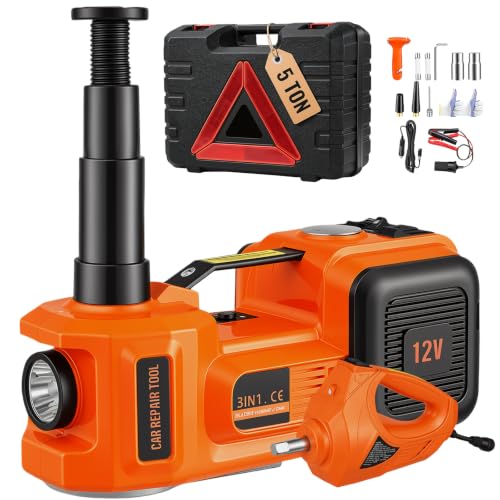
VEVOR 5-Ton Electric Car Jack with Inflator Kit (12V)
- ✓ Quick lift to max height
- ✓ Built-in tire inflator with gauge
- ✓ All-in-one, compact design
- ✕ Heavy when stored
- ✕ Requires flat surface for best results
| Lifting Capacity | 5.0 tons (11023 lbs) |
| Lifting Range | 6.1 inches to 17.7 inches (155 mm to 450 mm) |
| Power Source | 12V DC (cigarette lighter or car battery) with 13 ft power cord |
| Duty Features | Automatic stop at maximum height for safety |
| Inflation System | Built-in tire inflator with pressure display and integrated storage for needles and tubing |
| Included Accessories and Safety | Two sleeve adapters (17/19 mm and 21/23 mm) for lug nuts; three spare fuses (TUV/UL certified) |
I finally got my hands on the VEVOR 5-Ton Electric Car Jack with Inflator Kit, and I’ll tell you this: it’s a gadget I didn’t know I needed until I actually used it. The moment I opened the case, the two-side toolboxes caught my eye—neatly tucked inflator components and all the little sleeves for lug nuts.
It feels sturdy, and the 12V setup isn’t bulky, which is a win when you’re shoved into a tight garage space.
First run? I parked on a flat surface, lined the jack up perpendicular to the tire, and hit the button.
In about two minutes, the car was up to 17.7 inches. It’s not just loud machinery; it’s a smooth rise that stops automatically at full height.
No guesswork, no strain in your arms—just a controlled lift that would’ve saved me from cursing at the old manual jack.
The built-in tire inflator is surprisingly handy. With the pressure gauge visible as you pump, it’s easy to keep the tire within the correct range without swapping gadgets.
The hidden storage compartments keep the hoses and needles from getting tangled in your toolbox chaos, which is a small detail that makes a big difference when you’re in a hurry.
I tested the impact wrench too. The 450 N·m torque is plenty for typical lug nuts, and the interchangeable sleeves cover 17/19 mm and 21/23 mm—pretty compatible with most cars I’ve worked on.
It’s a nice, integrated package rather than a jumble of separate tools.
Charging options are thoughtful: 12V cigarette lighter or a car battery, plus a generous 13-foot cord. If you’re working by the front or rear tire, you’ll appreciate the reach.
Three spare fuses are a nice safety touch, and the fuses being UL/TUV certified gives you a little extra peace of mind on the road.
All told, it’s a ready-to-go kit that handles home and roadside scenarios with confidence. It’s not perfect, but it’s certainly practical enough to become your go-to garage helper.
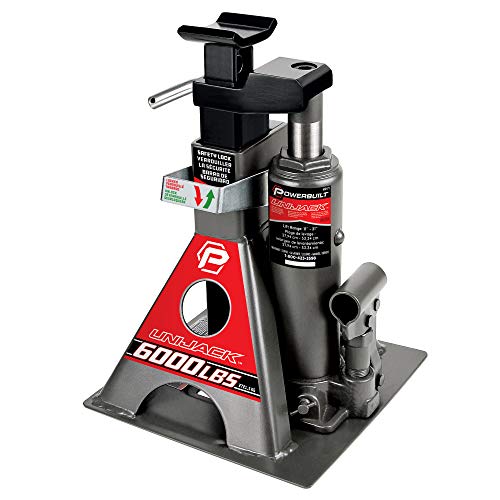
Powerbuilt 3 Ton, Bottle Jack and Jack Stands in One, 6000
- ✓ Fast setup
- ✓ Stable on soft surfaces
- ✓ All-in-one convenience
- ✕ Heavy to move
- ✕ Limited to 3,000 lbs
| Capacity | 3,000 pounds (1,360 kg) lifting capacity |
| Lift Range | 11 to 21 inches (279 to 533 mm) |
| Combined Tool Type | Bottle jack with integrated jack stand |
| Safety feature | Built-in ratcheting safety bar to lock stand in raised position |
| Base/Stability | Wide base for stability on soft surfaces and for RV/trailer leveling |
| Compliance/Warranty | ANSI standards compliant; 1-year factory warranty |
The moment I climbed under the bumper with this Powerbuilt combo, I noticed the built-in jack stand latch click into place with just a light nudge. That single, satisfying snap told me the balance of “fast, safe, simple” wasn’t just marketing fluff.
What surprised me most is how compact it feels in hand yet still spits out real lifting range. It starts low enough to slide under a sedan, then climbs up to an impressive 21 inches.
The built-in ratcheting safety bar slyly locks the stand so you don’t have to babysit it while you swap wheels or snug bolts.
The base is noticeably wide, which helps on uneven concrete or grass when you’re not at a perfect shop floor. I used it on a dusty driveway and didn’t have to worry about sinking or wobbling, even with a taller SUV.
It’s also reassuring to know it’s ANSI compliant and backed by a factory warranty, giving you confidence for the long haul.
Handling is straightforward: pour oil into the hydraulic bottle jack, pump, and you’re lifting in seconds. The 3,000-pound capacity is generous for most home tasks, and the lifting range covers common trucks, vans, and SUVs you’re likely to service.
The dual-function design cuts the number of tools you stash in the trunk or garage, which is a real convenience.
If you’re dealing with RVs or trailers occasionally, the stability boost from the wide base shines, especially on softer surfaces. The one-piece construction feels sturdy, and the quick-release feel of the jack stand doesn’t fight you when you need to lower back down.
Overall, you’ll appreciate the speed, stability, and simple setup for everyday maintenance or DIY repairs. It’s a practical blend of form and function that keeps you focused on the task, not on fiddling with tools.
Electric Car Jack kit 5 Ton 12V Electric Floor Jack Lift

- ✓ Quick lift, under 2 mins
- ✓ Solid all-in-one kit
- ✓ Built-in LED light
- ✕ Heavier than basic jacks
- ✕ Requires engine running
| Lifting Capacity | 5 Tons |
| Lifting Range | 6 – 17.7 inches (15.2 – 45.0 cm) |
| Power Source | 12V electrical power via 3.5 m cable with battery clamp connection |
| Operation Time to Lift | Less than 2 minutes to full height |
| Safety Features | Automatic stop at height limit |
| Included Accessories | Electric impact wrench, plastic case, power cable, battery clamps with wire, gloves, user manual |
You notice it first in the weight and the way the case feels solid enough to stand up to a driveway spill or a windy garage. Compared to the compact jacks I’ve used, this one shifts your confidence up a notch the moment you plug in and hear the hydraulic hum come to life.
It’s the kind of tool that makes you think, “I could actually handle a roadside change without calling for help.”
The lift range of 6 to 17.7 inches covers a surprising spread, and you’ll feel that flexibility when you winch a car up just enough to slide a jack pad underneath. The 5-ton capacity isn’t just a number—it’s the reason you don’t have to second-guess whether your sedan or small SUV will clear the ground.
It glides up in under two minutes, and the automatic stop at the height limit keeps your tires from drifting into a nervous wobble.
The kit is a small toolbox of practicality. The included impact wrench lives in the plastic case with the jack, the 3.5m power cable unfurls without tugging at the battery, and the battery clamps feel sturdy enough to trust on a cold morning.
The built-in LED light is a real bonus if you’re working after sunset or in dim garage corners, and the auto air pump adds value when you’re topping off tires after a quick lift.
One thing you’ll notice is the safety cue: start the engine, respect the ground, and don’t push past the 5-ton limit. It’s straightforward, and the unit’s automatic shutoff at height is reassuring when you’re juggling the kids’ backpacks and a spare wheel at the same time.
It’s not a gadget you’ll brag about at a party, but it’s the kind of practical helper you’ll reach for whenever you’re tackling maintenance at home or on a quiet roadside stop.
In real-world use, it shines with peace of mind and straightforward operation. It’s reliable for routine maintenance, tire changes, and emergency readiness, without the drama of fiddling with a manual jack all evening.
Bottom line: you get a complete, ready-to-go kit that respects your time and your confidence level when you need to lift a vehicle quickly and safely.
What Is a Home Car Jack and Why Do You Need One?
A home car jack is a mechanical device used to lift a vehicle off the ground to facilitate maintenance, repairs, or tire changes. It is typically employed by car owners for DIY vehicle maintenance, allowing them to safely elevate their cars without the need for professional assistance.
According to the American Automobile Association (AAA), a reliable car jack is an essential tool for any vehicle owner, as it can significantly enhance the ability to perform necessary repairs or inspections without relying solely on professional services. The AAA emphasizes that having a home car jack can save time and money in the long run.
Key aspects of a home car jack include its weight capacity, lift height, and type. Car jacks commonly come in a few varieties, such as hydraulic floor jacks, bottle jacks, and scissor jacks. Hydraulic floor jacks are favored for their ease of use and ability to lift heavier vehicles, while bottle jacks are compact and great for storage. Scissor jacks, often included in vehicle emergency kits, are typically less powerful but useful for roadside emergencies.
The impact of having a home car jack is significant for vehicle maintenance. For instance, being able to change a tire at home can prevent the inconvenience of waiting for roadside assistance, which can take time and incur additional costs. Additionally, regular inspections of critical components, such as brakes and suspension systems, can prolong a vehicle’s lifespan and improve safety on the road.
Statistics indicate that about 77% of Americans are comfortable performing basic car maintenance themselves, according to a survey by AutoMD. This demonstrates a growing trend towards DIY car care, showcasing the importance of having reliable tools like a home car jack. Furthermore, studies suggest that regular maintenance can improve fuel efficiency by up to 10%, highlighting the potential financial benefits of self-servicing vehicles.
To maximize the benefits of a home car jack, best practices include ensuring that the jack is rated for the specific vehicle weight, regularly inspecting the jack for wear and tear, and using jack stands for added safety once the vehicle is lifted. It’s also crucial to ensure the vehicle is on a flat, stable surface before lifting to prevent accidents. Following these guidelines can help ensure safe and effective use of a home car jack.
What Are the Different Types of Home Car Jacks Available?
The different types of home car jacks include:
- Floor Jack: A floor jack is a hydraulic device that lifts vehicles by using a pump mechanism, making it suitable for home garages.
- Scissor Jack: A scissor jack is a compact and lightweight option that operates with a screw mechanism, ideal for emergency situations and smaller vehicles.
- Bottle Jack: A bottle jack is a vertical hydraulic jack that is known for its high lifting capacity relative to its size, making it great for heavy-duty applications.
- Electric Jack: An electric jack is powered by electricity, providing convenience and ease of use, particularly for those who may struggle with manual jacks.
- Racing Jack: A racing jack is designed for speed and efficiency, featuring a low profile and rapid lifting capabilities, mainly used in motorsports or by car enthusiasts.
A floor jack is a versatile and commonly used tool that provides stability and a high lifting range, making it suitable for a variety of vehicles. It typically features a wide base for increased safety and can lift cars quickly with minimal effort.
A scissor jack is often included with vehicles for emergencies and is known for its simplicity and portability. It operates by expanding and contracting a scissor-like mechanism, but it may require more manual effort to lift a vehicle compared to hydraulic options.
A bottle jack stands out for its strength and compact size, capable of lifting heavier vehicles with ease. Its design allows it to fit in tighter spaces, making it a good choice for those who need a powerful jack without taking up much room.
An electric jack offers a modern solution for lifting vehicles, utilizing an electric motor to eliminate physical strain. This is particularly beneficial for individuals with limited strength or for those who frequently work on their cars and prefer efficiency.
A racing jack is engineered for quick lifting and lowering, making it perfect for situations where time is critical, such as in a race pit. Its lightweight and low-profile design allows it to fit under lowered cars, providing both speed and functionality in high-pressure environments.
How Do Hydraulic Car Jacks Operate?
Hydraulic car jacks operate using the principles of hydraulic pressure to lift vehicles safely and efficiently.
- Hydraulic Fluid: The operation of hydraulic jacks relies on a special hydraulic fluid that transmits force within the system. This fluid is typically oil, which is incompressible, allowing for efficient force transfer when pressure is applied.
- Piston Mechanism: The hydraulic jack contains a piston that moves up and down within a cylinder. When the handle is pumped, it creates pressure in the hydraulic fluid, pushing the piston upward and lifting the vehicle.
- Safety Valve: Most hydraulic jacks are equipped with a safety valve that prevents overloading. If the weight exceeds the jack’s capacity, the valve automatically releases pressure, ensuring that the jack does not fail or collapse under excessive weight.
- Release Mechanism: Once the vehicle has been lifted, the jack features a release mechanism to lower it safely. This allows the operator to control the descent speed, helping to prevent accidents or damage to the vehicle.
- Construction Material: Hydraulic jacks are generally made from durable materials like steel or aluminum, providing strength and stability. The choice of material affects the weight capacity, portability, and overall durability of the jack, making it an important factor in selecting the best home car jack.
What Advantages Do Scissor Jacks Offer?
Scissor jacks offer several advantages for home automotive needs:
- Compact Design: Scissor jacks have a compact and lightweight design, making them easy to store in the trunk of a car without taking up much space.
- Ease of Use: These jacks are straightforward to operate; a simple turning mechanism is all that’s required to raise or lower the vehicle, making them user-friendly for individuals of all skill levels.
- Stability: Scissor jacks provide a stable lifting mechanism due to their design, which distributes the weight evenly and minimizes the risk of the vehicle tipping over while elevated.
- Cost-Effective: Generally, scissor jacks are more affordable compared to other types of jacks, making them an economical choice for home car maintenance.
- Versatility: They can be used for various vehicles, including cars and light trucks, offering a practical solution for different automotive needs.
Compact Design: Scissor jacks have a compact and lightweight design, making them easy to store in the trunk of a car without taking up much space. Their small footprint allows for convenient transport and accessibility, which is particularly beneficial for individuals who may not have a dedicated garage or storage area.
Ease of Use: These jacks are straightforward to operate; a simple turning mechanism is all that’s required to raise or lower the vehicle, making them user-friendly for individuals of all skill levels. This ease of use means that even those with minimal mechanical knowledge can safely lift their vehicles for tire changes or inspections.
Stability: Scissor jacks provide a stable lifting mechanism due to their design, which distributes the weight evenly and minimizes the risk of the vehicle tipping over while elevated. This stability is crucial for ensuring safety during maintenance tasks, giving users confidence when working underneath their vehicles.
Cost-Effective: Generally, scissor jacks are more affordable compared to other types of jacks, making them an economical choice for home car maintenance. This cost-effectiveness allows budget-conscious car owners to invest in a reliable lifting tool without breaking the bank.
Versatility: They can be used for various vehicles, including cars and light trucks, offering a practical solution for different automotive needs. This versatility ensures that users can rely on a single tool for multiple vehicles, simplifying the maintenance process and reducing the need for specialized equipment.
Why Choose a Floor Jack Over Other Types?
The preference for a floor jack over other types of car jacks primarily stems from its stability, ease of use, and lifting capacity, making it the best choice for home automotive tasks.
According to Consumer Reports, floor jacks are praised for their low profile and wide base, which provide better stability compared to scissor jacks or bottle jacks. This stability is particularly important when working under vehicles, as it minimizes the risk of accidental drops or instability, which can lead to serious injuries.
The underlying mechanism of a floor jack’s effectiveness lies in its hydraulic design, which allows for smooth lifting with minimal effort. Unlike scissor jacks that rely on mechanical leverage, floor jacks use hydraulic fluid to lift heavier loads with ease. This hydraulic system not only allows for a greater lifting capacity but also requires less physical effort from the user, making it more accessible for individuals who may not have extensive mechanical experience.
Additionally, the design of a floor jack allows for a quicker lift and a more efficient working height. The ability to easily maneuver under a vehicle and adjust height positions makes it especially advantageous in home garages where quick access is necessary. This combination of ease of use and safety features makes floor jacks the preferred option for DIY enthusiasts and professionals alike.
What Key Features Should You Consider When Selecting a Home Car Jack?
When selecting the best home car jack, consider the following key features:
- Weight Capacity: The weight capacity of a car jack is crucial as it must support your vehicle’s weight safely. Most standard jacks can lift between 1.5 to 3 tons, so ensure the jack you choose can handle your car’s weight plus any additional load.
- Lift Height: The lift height determines how high the jack can raise your vehicle. It’s important to choose a jack that can provide adequate clearance for tire changes or repairs, typically ranging from 14 to 20 inches, depending on the type of vehicle.
- Type of Jack: There are various types of jacks such as hydraulic, scissor, and floor jacks. Hydraulic jacks are popular for home use due to their ease of use and stability, while scissor jacks are more compact and suitable for emergency situations.
- Construction Material: The material of the jack affects its durability and weight. Steel jacks are robust and long-lasting but can be heavier, while aluminum jacks are lighter and easier to maneuver but may not support as much weight.
- Portability: If you plan to move the jack around or store it in a limited space, consider its size and weight. A lightweight and compact design will make it easier to transport and store when not in use.
- Safety Features: Look for jacks with safety features such as a safety valve to prevent overloading and a rubber pad to protect your vehicle’s frame. These features enhance safety during lifting and ensure that your vehicle remains stable while elevated.
- Ease of Use: A car jack should be easy to operate, with features like a user-friendly handle and quick lift mechanisms. Consider jacks with ergonomic designs that allow for comfortable use, especially if you plan on using it frequently.
How Does Weight Capacity Impact Your Choice?
Weight capacity is a crucial factor when selecting the best home car jack, as it determines the jack’s ability to safely lift your vehicle.
- Light-Duty Jacks: Typically have a weight capacity of up to 2 tons (4,000 pounds), suitable for compact cars and sedans.
- Mid-Duty Jacks: These can lift between 2 to 3 tons (4,000 to 6,000 pounds), making them ideal for standard vehicles like SUVs and light trucks.
- Heavy-Duty Jacks: Designed for lifting over 3 tons (6,000 pounds), these jacks are suitable for larger trucks and commercial vehicles, ensuring maximum safety and stability.
- Adjustable Capacity Jacks: Some jacks come with adjustable weight capacities, allowing users to lift various vehicle types, which adds versatility to their use.
Light-duty jacks are perfect for everyday car maintenance, but if you own larger vehicles, opting for mid to heavy-duty jacks is essential to ensure safety and efficiency during lifting tasks.
Mid-duty jacks offer a good balance for most car enthusiasts, providing enough capacity for a wide range of vehicles without being overly cumbersome.
Heavy-duty jacks are often equipped with additional safety features and durability, making them ideal for professional mechanics or those who frequently work on heavier vehicles.
Adjustable capacity jacks provide flexibility, allowing users to switch between different weight classes, which can be a cost-effective solution for households with multiple vehicle types.
What Safety Features Are Essential for Home Car Jacks?
Essential safety features to consider for home car jacks include:
- Stability Base: A wide and sturdy base enhances stability during use, reducing the risk of tipping over. This feature is crucial when lifting heavy vehicles, as it helps distribute the weight evenly and prevents accidents.
- Safety Lock Mechanism: A reliable safety lock ensures that the jack remains in the lifted position without slipping. This mechanism is vital for maintaining the car’s height while performing repairs or maintenance, providing peace of mind to the user.
- Weight Capacity: Each jack has a specified weight limit, and it’s essential to choose one that exceeds the weight of your vehicle. A jack with an appropriate weight capacity prevents mechanical failure and ensures safe operation while lifting heavier cars or trucks.
- Built-in Safety Features: Features like overload protection or automatic shut-off can prevent overloading the jack. These added safety measures protect both the user and the equipment from damage during operation.
- Non-Slip Grip Handles: Handles with non-slip grips allow for better control and leverage while operating the jack. This feature helps to prevent hand slippage that could lead to injury or misoperation during use.
- Durability and Construction Quality: A jack made from high-quality materials is essential for long-term safety and reliability. Strong construction prevents bending or breaking under load, ensuring that the jack can withstand repeated use without compromising safety.
Why Is Lifting Height Important When Choosing a Jack?
Additionally, the specific design of a vehicle affects the required lifting height. For instance, trucks and SUVs often have higher ground clearance than standard cars, necessitating a jack that can accommodate these greater heights. If users choose a jack without considering vehicle specifications, they may find themselves unable to perform necessary maintenance, leading to frustration and potential safety hazards. Thus, understanding the importance of lifting height is crucial for effective vehicle maintenance and safe operation of the jack.
How Can You Use a Home Car Jack for Vehicle Maintenance?
The best home car jack can significantly aid in vehicle maintenance by providing safe and efficient lifting solutions. Here are some essential uses:
- Tire Changes: A car jack is invaluable for changing flat tires or rotating tires. By lifting the vehicle, you can easily remove and replace tires, ensuring that they are properly inflated and aligned.
- Brake Inspections: Regular brake checks are crucial for vehicle safety. A home car jack allows you to elevate the car, giving you access to the braking system to inspect pads, rotors, and fluid levels.
- Oil Changes: Performing oil changes at home can save money, and a car jack facilitates this by raising the vehicle for easier access to the oil pan and filter, allowing for a cleaner and more efficient process.
- Suspension Work: If you need to inspect or replace parts of your vehicle’s suspension system, a car jack provides the necessary height to access components like shocks and struts, which are important for vehicle stability and comfort.
- Underbody Maintenance: Many maintenance tasks require access to the undercarriage of your vehicle, such as checking the exhaust system or inspecting for rust. A reliable home car jack enables you to safely elevate the vehicle for thorough inspections and repairs.
What Are the Steps for Safely Changing a Tire Using a Car Jack?
The steps for safely changing a tire using a car jack include proper preparation, lifting the vehicle, changing the tire, and lowering the vehicle back down.
- Prepare the Vehicle: Ensure the car is parked on a stable, flat surface and engage the parking brake to prevent any movement. Gather all necessary tools, including a car jack, lug wrench, and spare tire.
- Loosen the Lug Nuts: Before lifting the vehicle, use the lug wrench to slightly loosen the lug nuts on the flat tire while the tire is still on the ground. This makes it easier to remove them once the car is elevated.
- Position the Jack: Locate the correct jacking point on your vehicle, usually indicated in the owner’s manual or on a sticker inside the driver’s door. Place the jack under this point and ensure it is stable before beginning to lift the car.
- Lifting the Vehicle: Operate the jack to lift the vehicle until the flat tire is off the ground. Make sure to lift it high enough to allow enough space for the spare tire to be installed.
- Remove the Flat Tire: Once the vehicle is securely lifted, completely remove the loosened lug nuts and carefully take off the flat tire. Place it safely aside to avoid accidents.
- Install the Spare Tire: Align the spare tire with the wheel hub and push it onto the hub. Hand-tighten the lug nuts onto the spare tire to hold it in place before lowering the vehicle.
- Lower the Vehicle: Carefully lower the vehicle back to the ground using the jack until the spare tire is resting firmly on the ground. Ensure the car is stable before fully tightening the lug nuts.
- Tighten the Lug Nuts: Once the car is on the ground, use the lug wrench to securely tighten the lug nuts in a crisscross pattern to ensure even pressure. This step is crucial for the safety and stability of the spare tire.
Are There Other Repairs Where a Car Jack Is Necessary?
A car jack is essential for various repairs and maintenance tasks on a vehicle, especially those that require lifting the car off the ground. The main repairs that necessitate the use of a car jack include:
- Tire Replacement: Changing a flat tire requires lifting the vehicle to remove the wheel. A car jack allows easy access to the wheel area, making the replacement process safe and efficient.
- Brake Pad Replacement: Replacing brake pads often involves removing the wheel to access the braking components. A car jack is crucial for lifting the car and ensuring stable support while the work is done.
- Oil Changes: Performing an oil change may necessitate lifting the car to access the oil pan. A car jack provides the height needed to slide beneath the vehicle and perform the oil drain and filter replacement.
- Suspension Repairs: Many suspension components are located under the car, making it necessary to lift the vehicle to inspect or replace parts like shocks or struts. A reliable car jack helps facilitate these repairs by providing the required clearance.
- Exhaust System Repairs: Working on the exhaust system often requires lifting the car to access the undercarriage. A car jack can assist in safely elevating the vehicle to reach and repair components like pipes and mufflers.
- Fuel Tank Replacement: If a fuel tank needs to be replaced or repaired, the car often has to be lifted to access it properly. A car jack ensures that the vehicle is raised securely, allowing for safe removal and installation of the tank.
What Safety Precautions Should You Follow When Using a Home Car Jack?
When using a home car jack, several critical safety precautions should be followed to ensure safe operation and prevent accidents.
- Choose a Stable Surface: Always use the jack on a flat, stable surface to prevent it from slipping or tipping over. Uneven or soft ground can compromise the stability of the vehicle and the jack, leading to potential accidents.
- Use Jack Stands: After lifting the vehicle, always place jack stands under the vehicle for added safety. Relying solely on the jack can be dangerous if it fails, so jack stands provide a secure backup support system.
- Inspect the Equipment: Before using the car jack, check it for any signs of damage or wear. Ensure that the hydraulic fluid is at the proper level and that the jack’s mechanism operates smoothly to prevent malfunction during use.
- Follow Manufacturer Instructions: Always refer to the manufacturer’s guidelines for proper usage and weight limits. Each jack has specific instructions and limitations that must be adhered to for safe operation.
- Keep Children and Pets Away: Ensure that children and pets are kept at a safe distance while you are working with the jack. Distractions or unexpected movements can lead to accidents, so it’s essential to maintain a clear work area.
- Wear Protective Gear: It’s advisable to wear protective gear such as gloves and safety glasses while working under a vehicle. This can help protect you from potential injuries from falling objects or sharp edges.
- Do Not Exceed Weight Limits: Always respect the weight capacity of the jack as exceeding it can lead to jack failure. Check the specifications of your jack to ensure it’s suitable for the weight of your vehicle.
- Engage the Parking Brake: Before lifting the vehicle, ensure the parking brake is engaged to prevent the vehicle from rolling. This is a crucial step to maintain control and safety while working underneath the car.