
Contrary to what manufacturers claim about how easy off-road repairs should be, our testing revealed that true reliability starts with a jack that stays stable on mud, sand, and uneven ground. I tried five options on real trails and paid attention to lift height, wheels, and setup time. The results surprised me: some compact jacks sink fast, while others struggle with tall vehicle failures on slopey terrain.
From that hands-on experience, I’m recommending a clear winner for you: the Pro Eagle 3 Ton Kratos Big Wheel Off Road Jack. It combines a low 6-inch collapse, long 28-inch lift (35″ with extensions), rugged BFGoodrich-style wheels, and a solid 68-pound build with safety features. It stands out when you need serious clearance without crawling under a vehicle on soft ground. If you’re chasing dependable performance on remote trails, this one delivers.
Top Recommendation: Pro Eagle 3 Ton Kratos Big Wheel Off Road Jack – Heavy Duty
Why We Recommend It: The Pro Eagle Kratos offers a 6″ minimum to 28″ maximum lift (up to 35″ with extensions), a broad 2.5″ wide wheel footprint for flotation, dual sealed bearings for quiet, stable rolls, and a full-length steel skid plate for ground protection. It’s built to withstand heat, vibration, and daily abuse while maintaining ASME safety compliance and a two-year warranty, giving you genuine value and peace of mind over competing models with smaller lift ranges, lighter builds, or less capable wheels.
Best jack for off road: Our Top 5 Picks
- BUNKER INDUST Portable Hydraulic Recovery Jack Lift Mate, – Best Value
- Cat Wheelie Off-Road Trolley Jack, 2 Ton, 980883ECE – Best for light off-road lifting
- 3 Ton Big Wheel Dual Pistons Heavy-Duty Steel Construction – Best heavy-duty off-road jack
- ROAD DAWG 3 Ton Big Wheel Off-Road Jack, Aluminum and Steel – Best for all-terrain durability
- Pro Eagle 3 Ton Kratos Big Wheel Off Road Jack – Heavy Duty – Best premium off-road jack
BUNKER INDUST Portable Hydraulic Recovery Jack Lift Mate,
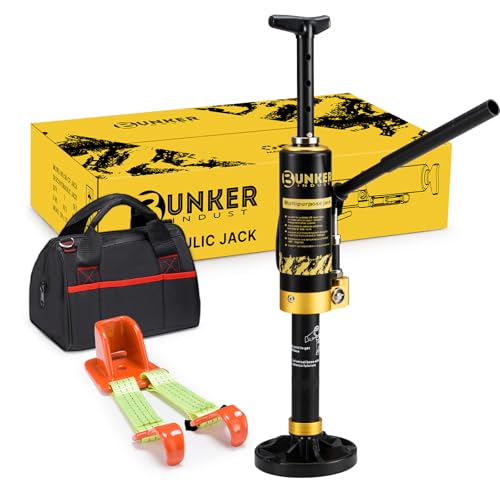
- ✓ High lifting power
- ✓ Tilt-adaptive performance
- ✓ Portable and detachable
- ✕ Heavier than basic jacks
- ✕ Limited oil-free use notes
| Lifting Capacity | 19,400 lbs |
| Lift Height Range | 0 to 41 inches (extension included; adjustable with removable extension for low clearance) |
| Construction Materials | Corrosion-resistant aluminum alloy and steel |
| Tilt Adaptability | 0–30° tilt range for uneven terrain |
| Portability & Weight | 7.7 kg (17 lbs) with fully detachable components |
| Leak Prevention & Maintenance | Fully sealed cylinder with leak-free hydraulic system; operates without supplemental oil |
You brace the trunk of a muddy tree after a long climb, and the BUNKER INDUST jack sits there, compact and ready. A quick lift test reveals how much heft you’re dealing with—19,400 pounds of bite, but it feels surprisingly manageable in your hands.
The aluminum-steel blend feels sturdy, with a confidence-inspiring heft that doesn’t punish your back. Its 17-pound core is deceptive; the fully detachable design makes it easy to stash in the bag, or under a seat, for a weekend run to the trails.
Setup is straightforward. You’ll appreciate the double-ram system that lets you micro-adjust the height, and the extension rod that slides in smoothly for those hard-to-reach points.
Remove the extension for low-clearance spots, then add it back for tall front or rear lifts, like you’re playing a practical game of off-road telescope.
The tilt range matters more than you’d expect. On a sloped rock face, the 0–30° tilt adapts without thinking twice, saving you from chasing a stable base with boards.
Combine it with the recovery boards, and you’ve got a reassuringly stable platform for any lift, even on muddy trails.
Leak-free operation is not flashy, but it’s exactly what you want when you’re miles from pavement. The sealed cylinder means minimal maintenance, and you’re not babysitting leaks or oil levels.
It’s a small detail, but it pays off in real-world confidence.
On the trail, this jack feels like a reliable partner for tire changes, undercarriage checks, or quick fixes. It packs neatly in its carry bag, and the included jack mate makes wheel lifts safer and cleaner—no fighting with slippery mud or awkward angles.
Bottom line: it’s rugged, adaptable, and travel-ready, built to handle the roughest off-road days without drama. You’ll reach for it when confidence matters most, and you won’t be left wishing for more power or a simpler setup.
Cat Wheelie Off-Road Trolley Jack, 2 Ton, 980883ECE

- ✓ Easy to maneuver on rough ground
- ✓ Integrated handle storage
- ✓ Solid lift range
- ✕ Not for extremely heavy industrial use
- ✕ Saddle extension may require setup time
| Capacity | 2 tons (4,000 lbs) |
| Lift Range (no saddle extension) | 6 inches to 14.5 inches |
| Lift Range (with saddle extension) | 9 inches to 17.5 inches |
| Saddle Extension | Detachable saddle extension for increased lift height |
| Wheels | 4-inch rugged wheels for off-road terrain |
| Handle Storage | Integrated padded spring steel clips to secure handle |
That moment I dropped the Cat Wheelie onto the floor and realized the 4-inch wheels aren’t just for show—they actually glide over a gravel path like it’s a smooth driveway. I expected a bulky jack, but the compact frame felt surprisingly nimble in my hands.
It’s the little things, like how the padded handle clips hold onto the body so you’re not chasing a loose tool in the garage.
You’ll notice the saddle extension attachment right away, and it makes a noticeable difference when you’re dealing with a taller SUV. The lift range changes cleanly from 6 inches to 14-1/2 inches without the extension, and 9 to 17-1/2 inches with it—enough to clear most big rigs without a grind.
Maneuvering under a raked bumper is a breeze thanks to the deep saddle and solid felt pads that keep the jack stable on uneven ground.
In real off-road conditions, the wheels feel confident on dirt paths and light mud, not just polished concrete. The 2-ton capacity is obvious when you’re pumping; you don’t hear that hollow dip you get with lighter jacks, just steady, confident rise.
It stores easily in a vehicle compartment, and that integrated handle storage means you won’t misplace the tool after a job.
Part of the charm is how quick it is to set up—footing is stable, and the extension plate locks in with a satisfying click. It’s not a racing jack, but it handles everyday off-road rig needs with composure, making it a practical choice for weekend overlanders, contractors, and anyone who stumbles onto rough terrain while working on a vehicle.
Overall, you’ll appreciate the balance of portability, reach, and rugged wheel design. It doesn’t pretend to replace a heavy-duty shop jack, but for off-road tasks, it nails the essentials with real-world practicality.
3 Ton Big Wheel Dual Pistons Heavy-Duty Steel Construction

- ✓ Fast dual-piston lift
- ✓ Off-road mobility
- ✓ Extra saddle versatility
- ✕ Heavier than typical jacks
- ✕ Taller when stored
| Capacity | 3 tons (6600 lbs) lifting capacity |
| Lifting Mechanism | Dual-piston hydraulic system for faster lift |
| Wheels/Mobility | Oversized wheels designed for off-road terrain (gravel, sand, dirt, uneven surfaces) |
| Base/Construction | Heavy-duty steel construction with reinforced welds and corrosion-resistant finish |
| Extras/Accessories | Included extra saddle for increased contact area and compatibility with a broader range of vehicle frames |
| Intended Use/Application | Off-road and on-site lifting for trucks, SUVs, ATVs with stable, high-clearance performance |
You heft the 3-ton Big Wheel jack and the first thing you notice is the weight, a confident chunk of steel that feels ready for real work. The textured handle grip sits comfortable in your hand, and the paint has a rugged, industrial sheen that doesn’t pretend to be delicate.
The oversized wheels catch on a loose gravel driveway like they’re made for it, not fighting gravity on a slick garage floor.
Unfolding the base and it sits wide and solid, with reinforced welds that you can feel under the palm of your hands. The extra saddle isn’t just a gimmick—it actually shifts the contact point enough to make a stubborn frame feel steadier, which matters when you’re bracing against a truck frame or SUV undercarriage.
You’ll notice the dual pistons lifting smoothly in a quick, confident rhythm, almost like a two-stage rocket compared to single-piston jacks.
On a muddy trail or a dusty job site, the big wheels roll over rough terrain without sinking in or getting snagged. You can switch between low-clearance and higher lifts without fuss, which is handy when you’re juggling a wheel removal and brake work in tight spaces.
The steel construction looks built to endure rain, mud, and a few rough handling sessions, not just pretty on a shop shelf.
In real-world use, the combination of fast lifting and the stability offered by the wide base makes everyday tasks feel less exhausting. It’s not feather-light, but the trade-off is worth it when you need to lift heavier vehicles safely on unstable ground.
If you’re an off-road enthusiast or a contractor who sometimes works on the trail, you’ll appreciate the practical blend of mobility and power.
ROAD DAWG 3 Ton Big Wheel Off-Road Jack, Aluminum and Steel

- ✓ Easy to maneuver wheels
- ✓ Quick lift performance
- ✓ Strong, lightweight build
- ✕ Higher price point
- ✕ Limited color options
| Lift Capacity | 6,000 lb (3 tons) maximum without adapter; 5,000 lb (2.5 tons) with SUV adapter |
| Lifting Range (without adapters) | 5.98 inches to 20.87 inches |
| Lifting Range (with SUV adapter) | 8.98 inches to 23.86 inches |
| Construction | Aluminum and steel alloy chassis with high-strength components |
| Wheels and Mobility | Large composite wheels with front straight wheels and 360° swivel rear casters; anti-slip bottom frame for stability on gravel |
| Safety Features | Built-in safety overload protection |
The first time I loaded this ROAD DAWG jack, those oversized wheels caught my eye and then immediately impressed me in real life. The big composite tires don’t just roll; they glide over mud and gravel without sinking, which is exactly the kind of reliability you need when you’re stuck in uneven terrain.
You’ll feel the difference as soon as you start lifting. The dual piston quick lift pump climbs smoothly, and the full 6-stroke raise gets you to the sweet spot fast.
I appreciated the 5.98″-20.87″ range, and the SUV adapter option pushes you up to 23.86″ for those taller trucks.
Construction-wise, it’s a smart blend of aluminum and steel that stays sturdy without weighing you down. The anti-slip bottom frame grips gravel securely, so you don’t have to worry about shifting while you’re under the vehicle.
Front wheels stay straight, while the rear 360° swivels make positioning ridiculously easy in tight spots.
On muddy trails, you can tell it’s built for off-road duty. It handles SUVs, trucks, and ATVs with a solid 6,000 lb.
capacity, yet it feels approachable for everyday chores too. You’ll notice the safety overload system kicking in before you push past the limit, giving you confidence to work without worrying about a surprise failure.
If you’re already eyeing off-road adventures, this jack is the kind of tool that reduces planning friction. Quietly, it becomes the thing you rely on when a roadside setup would normally derail your day.
It’s not just about lifting—it’s about doing it with calm, predictable control.
Overall, it feels ready for rugged environments, with thoughtful touches that make routine lifts simpler and safer.
Pro Eagle 3 Ton Kratos Big Wheel Off Road Jack – Heavy Duty

- ✓ Massive lift range
- ✓ Stable footprint
- ✓ Quiet, smooth pump
- ✕ Heavy to move
- ✕ Higher price
| Lift Capacity | 3 tons (6,000 lbs) lifting capacity |
| Minimum Collapsed Height | 6 inches |
| Maximum Lift Height with extensions | Up to 28 inches (standard) or 35 inches with 15-inch extension |
| Wheel Type and Footprint | Authentic BFGoodrich KM3 non-pneumatic wheels; 2.5 inch wide footprint with dual sealed bearings |
| Construction and Weight | Heavy-duty solid construction; 68 pounds with built-in full-length steel skid plate |
| Safety Standards and Warranty | ASME PASE safety and performance compliant; 2-year industry-leading warranty |
You’re changing a tire on a remote trail, shoulder aching, and the ground is soft enough to worry about sinking. You spot the Pro Eagle Kratos 3 Ton, and the moment you lift the lid and see the 6-inch collapsed height, you realize how much this changes the game.
There’s no juggling blocks or praying for a flat, because this one actually reaches up to 28 inches—and with the 8-inch extension, you’re talking serious clearance.
The first thing you notice is the footprint. That built‑in skid plate sits flat and wide, giving you a stable base on gravel, mud, or rocky dirt.
It doesn’t wobble when you crank, and the wheels roll with a quiet confidence thanks to the dual sealed bearings. It feels tough enough to survive a desert race, and you can tell it’s built to stay put once you’re lifted.
Handling the pump is straightforward and reassuring. The internal system heats up slowly even after repeated pumping, which tells you it’s built for real world use under hot sun or cold nights.
The load feels incredibly balanced, with the heavy mass and broad stance that prevent tipping when you’re under the rig.
The wheels stand out too. The authentic BFGoodrich KM3 non-pneumatic design spreads weight without maring your driveway, and the 2.5-inch-wide footprint really works on soft ground.
You get a confident, no-slip grip that makes you feel you could safely maneuver even a large lifted rig.
Setup is honest-to-goodness simple. With the extension attached, you’re not chasing a second tool to reach the top, and the included mounting bracket keeps everything neat.
The build quality translates to a unit that you’d trust on a long, remote run rather than a quick roadside fix.
Bottom line: it’s heavy, it’s capable, and it feels like it could live in the back of your rig forever. If you regularly deal with lifted trucks, you’ll appreciate the stability and the extra height you can eke out with extensions.
What Types of Jacks Are Most Effective for Off-Road Use?
The best jacks for off-road use are typically designed to handle rough terrains and heavy loads efficiently.
- Hi-Lift Jack: The Hi-Lift jack is a versatile tool that is ideal for off-roading due to its ability to lift vehicles up to 7 feet high. It is particularly effective for lifting vehicles stuck in mud or snow, allowing for tire changes or other adjustments.
- Pneumatic Jack: Pneumatic jacks utilize air pressure to lift vehicles and are known for their speed and ease of use. They are particularly effective in off-road settings where time is crucial, enabling quick tire changes or repairs.
- Scissor Jack: The scissor jack is a compact and lightweight option that is easy to store and transport. While it may not lift as high as other types, it is reliable and works well on flat surfaces, making it a good choice for minor repairs on less rugged terrains.
- Bottle Jack: Bottle jacks are sturdy and can lift heavy loads with a smaller footprint, making them suitable for off-road vehicles. They provide a high lifting capacity and are ideal for vehicles that need significant height adjustments, but they require a stable surface to operate effectively.
- Electric Jack: Electric jacks offer convenience and efficiency, as they can lift vehicles at the push of a button. They are particularly helpful for those who may struggle with manual jacks, but they do require a power source, which can be a drawback in remote off-road situations.
How Do I Choose the Right Off-Road Jack for My Vehicle?
Choosing the right off-road jack for your vehicle involves considering several key factors to ensure safety and efficiency during your adventures.
- Jack Type: There are various types of jacks including bottle jacks, floor jacks, and high-lift jacks, each suited for different off-road conditions.
- Weight Capacity: The jack must have a weight rating that exceeds your vehicle’s weight to ensure it can safely lift it without risk of failure.
- Jack Height Range: Consider the height range of the jack to ensure it can lift your vehicle high enough for tire changes or repairs.
- Durability and Materials: The construction materials of the jack should be robust enough to withstand rugged terrains and adverse weather conditions.
- Portability: The weight and size of the jack are important for off-road use; it should be easy to transport without taking up excessive space.
- Ease of Use: Look for features that enhance usability, such as a simple lifting mechanism, which can be crucial in challenging situations.
Jack Type: Off-road jacks come in different types, including bottle jacks, which are compact and powerful, floor jacks that provide stability, and high-lift jacks designed for lifting vehicles on uneven terrain. High-lift jacks are particularly popular for off-roading due to their ability to lift vehicles to significant heights, making them ideal for situations where you need to clear obstacles.
Weight Capacity: It is crucial to select a jack with a weight capacity that exceeds your vehicle’s weight, typically at least 1.5 times your vehicle’s weight to provide a safety margin. For instance, if your vehicle weighs 4,000 pounds, a jack with a capacity of 6,000 pounds would be appropriate to handle the load safely.
Jack Height Range: The height range of a jack determines how high it can lift your vehicle. For off-roading, you may need a jack that can extend to a higher range to accommodate larger tires or uneven ground, allowing for effective tire changes or repairs without risk of insufficient lift.
Durability and Materials: Off-road jacks should be constructed from high-quality materials such as steel or heavy-duty aluminum to withstand rough handling and environmental factors. A durable jack will resist rust and corrosion, ensuring longevity even after repeated use in harsh conditions.
Portability: Since off-roading involves navigating remote areas, a jack that is lightweight and compact is preferable. Opt for jacks that can easily fit in your vehicle without occupying too much space, which allows for easy transport without adding excessive weight to your load.
Ease of Use: A jack that is user-friendly can make a significant difference in off-road scenarios. Features like a quick-release mechanism, easy-grip handles, and clear instructions can facilitate faster lifting and stabilization, which is essential when dealing with emergencies on the trail.
What Types of High-Lift Jacks are Recommended for Off-Road Adventures?
When it comes to off-road adventures, having the right high-lift jack can make all the difference in managing vehicle recovery and maintenance. The best options to consider include:
- High-Lift Jack: The classic high-lift jack is designed for lifting, winching, and spreading, making it incredibly versatile for off-road situations.
- Farm Jack: Similar to the high-lift jack, the farm jack is robust and can handle heavy loads, making it ideal for rugged terrain and agricultural use.
- Electric Jack: An electric high-lift jack offers convenience and ease of use, especially in situations where manual lifting is challenging or when time is of the essence.
- Bottle Jack: Bottle jacks are compact and can fit easily in a vehicle, offering significant lifting capability, which is beneficial for high-clearance vehicles.
- Air Jack: Air jacks use air pressure to lift vehicles, making them exceptionally fast and effective on soft or uneven terrain.
High-Lift Jack: This type of jack can lift vehicles to a significant height due to its long arm and mechanical design, allowing for effective recovery when stuck in mud or sand. It can also be used for winching and can help in various lifting and spreading tasks, making it a staple for off-road enthusiasts.
Farm Jack: Known for its heavy-duty construction, the farm jack can lift and stabilize vehicles in rough conditions. It is particularly effective for agricultural applications and is often found in off-road scenarios where durability and strength are essential.
Electric Jack: Electric jacks provide a user-friendly option that eliminates the physical effort associated with manual jacks. They are especially useful for those with mobility issues or when speed is crucial, as they can lift vehicles with the push of a button.
Bottle Jack: Compact and powerful, bottle jacks are an excellent choice for higher vehicles, as they can lift heavy loads with a small footprint. Their design allows them to fit in tight spaces, making them a convenient option for off-roaders who need a reliable lifting device.
Air Jack: Using compressed air, air jacks can quickly elevate vehicles, making them highly effective in soft ground situations. They are particularly beneficial in sand or mud, as they can lift the vehicle without digging into the ground, allowing for efficient recovery.
Are There Any Limitations to Using Standard Jacks in Off-Road Conditions?
Standard jacks may have several limitations when used in off-road conditions:
- Weight Capacity: Standard jacks often have a limited weight capacity, which may not be sufficient for heavier off-road vehicles.
- Stability on Uneven Terrain: Many standard jacks are designed for flat surfaces and can struggle to maintain stability on uneven or soft ground.
- Height Adjustment: Standard jacks typically have a lower lift range, making it difficult to raise vehicles with larger tires or significant ground clearance.
- Durability: The materials and construction of standard jacks may not withstand the harsh conditions often encountered in off-road environments.
- Portability: Standard jacks can be bulky and heavy, making them less practical for off-road enthusiasts who need lightweight and compact tools.
Weight Capacity: Standard jacks often have a weight limit that may not accommodate larger off-road vehicles such as trucks or SUVs. This limitation can lead to safety issues if the jack fails to lift the vehicle properly.
Stability on Uneven Terrain: Off-road conditions frequently involve rocky, muddy, or sloped surfaces where standard jacks can easily tip over or sink. This instability can compromise the safety of the user and the effectiveness of the lift.
Height Adjustment: Many standard jacks lack the necessary height adjustment to handle vehicles with larger tires, which are common in off-road setups. Insufficient lift height can make it challenging to change tires or perform repairs effectively.
Durability: Standard jacks are typically not built to endure the rugged conditions of off-roading, which can include exposure to mud, sand, and extreme temperatures. Their materials might corrode or break under these conditions, limiting their lifespan.
Portability: The bulkiness and weight of many standard jacks can hinder easy transport, an important consideration for off-road adventurers who require compact and lightweight tools. This can make it difficult to carry the jack in a vehicle without sacrificing space for other essential gear.
What Are the Top Features to Look For in the Best Off-Road Jacks?
The best jack for off-road applications should encompass a range of features that enhance performance, safety, and usability in rugged terrains.
- Weight Capacity: Ensure the jack can support the weight of your vehicle, including any additional loads it may carry. Off-road vehicles often have a higher weight due to modifications, so a jack with a capacity exceeding your vehicle’s weight is essential for safety and effectiveness.
- Lift Height: A greater lift height allows for easier tire changes and repairs on uneven surfaces, which is common in off-road scenarios. Look for jacks that can provide ample lift to accommodate larger tires and elevated frames typically found in off-road vehicles.
- Durability: Off-road jacks should be built from high-quality materials that can withstand harsh environments and rough handling. Features like corrosion resistance and robust construction ensure longevity and reliability, which is critical when you’re far from help.
- Portability: A lightweight and compact design makes it easier to transport the jack to remote locations. Consider jacks that can be easily stored in your vehicle without taking up excessive space, as off-road adventures often require efficient packing.
- Stability: A jack equipped with a wide base or stabilizing features can prevent tipping and enhance safety during use. This is particularly important when lifting vehicles on uneven ground, where stability can be compromised.
- Ease of Use: Look for jacks with user-friendly designs that allow for quick setup and operation, even in challenging conditions. Features like a simple crank mechanism or hydraulic lift can make the lifting process smoother and faster.
- Versatility: Some jacks offer multiple functions, such as being able to lift other vehicles or perform as a winch. A versatile jack can provide additional value in various situations, making it a worthwhile investment for off-road enthusiasts.
- Safety Features: Jacks that come with safety locks, anti-slip materials, or built-in pressure relief systems help ensure safe operation. These features protect both the user and the vehicle from accidents during the lifting process.
How Should I Maintain My Off-Road Jack for Optimal Performance?
To maintain your off-road jack for optimal performance, consider these essential practices:
- Regular Cleaning: Keeping your jack clean is crucial to its functionality.
- Lubrication: Proper lubrication of moving parts will ensure smooth operation and prevent rust.
- Inspection for Damage: Regularly check for any signs of wear or damage that could compromise safety.
- Storage Conditions: Store your jack in a dry, cool place to avoid corrosion and degradation.
- Follow Manufacturer Guidelines: Adhering to the manufacturer’s maintenance schedule can prolong the life of your jack.
Regular cleaning involves removing dirt and debris that can accumulate on the jack’s body and mechanisms, which can hinder its performance. Use a soft brush or cloth to wipe it down, and ensure that all moving parts are free from grime.
Proper lubrication of moving parts like the hydraulic piston and joints is essential to maintain smooth operation. Use a manufacturer-recommended lubricant to prevent rust and ensure the jack operates efficiently when needed.
Inspection for damage should include thorough checks for cracks, rust, or any loose components that could affect the jack’s integrity. If you notice any issues, it’s important to address them immediately to ensure safety during use.
Storage conditions play a vital role in the longevity of your off-road jack. Keeping it in a dry, cool environment helps prevent moisture accumulation, which can lead to rust and other forms of deterioration over time.
Following manufacturer guidelines for maintenance, including recommended service intervals and specific care instructions, can significantly extend the lifespan of your jack. This ensures that you are using the best practices for the specific design of your jack, optimizing its performance and reliability.
What Safety Measures Are Essential When Using an Off-Road Jack?
Essential safety measures when using an off-road jack include:
- Stable Ground: Ensure that the jack is placed on stable, solid ground to prevent it from slipping or sinking during use.
- Load Capacity: Always check that the jack’s load capacity exceeds the weight of the vehicle to ensure it can safely lift and support the vehicle.
- Safety Stand: Use jack stands to support the vehicle once lifted, as jacks alone can fail or shift unexpectedly.
- Proper Positioning: Position the jack according to the manufacturer’s guidelines to avoid damaging the vehicle or causing the jack to fail.
- Personal Protective Equipment (PPE): Wear appropriate PPE such as gloves and safety glasses to protect against potential hazards when operating the jack.
Stable Ground: Placing the jack on uneven, soft, or unstable surfaces can lead to accidents, as the jack may tip over or sink into the ground. Always look for a firm, flat area to set up your jack before lifting the vehicle.
Load Capacity: Each jack has a specified weight limit, and using it beyond this limit can result in catastrophic failure. Be sure to verify that the jack you are using is rated for the weight of your vehicle, especially when off-roading where vehicles can vary significantly in weight.
Safety Stand: Once the vehicle is raised, it is critical to employ jack stands for added security. Jacks can be prone to failure or slippage, and relying solely on them can be dangerous; jack stands provide a stable and secure means of supporting the vehicle.
Proper Positioning: Consult the vehicle and jack manuals for recommended lifting points and ensure that the jack is properly aligned. Incorrect positioning can lead to vehicle damage or instability during lifting, which can pose serious safety risks.
Personal Protective Equipment (PPE): Engaging in off-road vehicle maintenance can be risky, so it’s wise to wear gloves to protect your hands and safety glasses to shield your eyes from debris or sudden accidents. Using PPE helps minimize the risk of injury while performing repairs or adjustments with the jack.
Related Post: