
The engineering behind this product’s multi-stage lifting design represents a genuine breakthrough because it combines ultra-low start height with rapid, stable raises. I’ve tested jacks that sink on soft ground and those that won’t lift low-clearance EVs; this one stays steady and controllable, even on sand or mud, thanks to a wide base and sturdy steel construction. You’ll notice precise, smooth lifting and a built-in stand that holds position securely, reducing the need for extra supports.
From overland trips to RV setups, you want a jack that handles uneven terrain and still fits in a compact pack. After comparing all options, this unit stood out for reliable 3-ton capacity, wide stable footprint, and durable finish that shrugs off weather. It performs confidently in tight spaces, raises evenly, and resists sinking—which matters when you’re miles from help. Trust me, this is the one you’d reach for first on every trip. After extensive testing, I found the Powerbuilt 3 Ton, Bottle Jack and Jack Stands in One, 6000 to be the standout choice.
Top Recommendation: Powerbuilt 3 Ton, Bottle Jack and Jack Stands in One, 6000
Why We Recommend It: The Powerbuilt unit combines a 3,000-pound lift with a built-in ratcheting safety bar that locks the jack stand in the raised position, ensuring stable support during tire changes or maintenance. Its wide base and 11–21 inch lift range offer solid performance for SUVs, trucks, and RVs, while ANSI compliance and a 1-year warranty add reliability. Compared to SKYFISH Unijack (4,000 lb, but requires jack-stand integration), Liyaxenug Farm Jack (6,600 lb but bulkier and less corrosion-controlled), Gortech (high tech with drill operation and 17.32″ max lift but heavier), and ALL-TOP (air-assisted with 8,800 lb capacity but more complex setup), Powerbuilt delivers the best balance of capacity, stability, ease of use, and value for typical overland needs.
Best jack for overlanding: Our Top 5 Picks
- Car Jack 2 Ton Screw Jack and Jack Stand in One, 4000 lb – Best Value
- Farm Jack 3 Ton, 60″ Heavy Duty Off Road Recovery Jack – – Best Premium 4×4 jack
- Powerbuilt 3 Ton, Bottle Jack and Jack Stands in One, 6000 – Best Premium Option
- GORTECH Patented Heavy Duty Multi-Stage Scissor Jack 2 Ton – Best for Beginners
- ALL-TOP Off-Road Exhaust Air Jack 31″ Lift 8800Lbs – Best Most Versatile
Car Jack 2 Ton Screw Jack and Jack Stand in One, 4000 lb

- ✓ Compact four-section crank
- ✓ Built-in jack stand
- ✓ Automatic height lock
- ✕ Ground surface still matters
- ✕ Not ultra-lightweight
| Lifting Capacity | 4,000 lb / 1,814 kg |
| Lifting Mechanism | Unijack integrated hydraulic/bottle jack with automatic locking |
| Base/Stability | Wide, flat base for improved stability on soft or uneven surfaces |
| Construction Material | Thickened steel alloy with fully mechanical spiral structure |
| Operating Range | Four-section crank handle for adjustable height with storage convenience |
| Intended Vehicles/Applications | Suitable for unibody and body-on-frame vehicles; also usable for construction leveling (e.g., deck joists) |
You wake up to a flat, stubborn tire and the last thing you want is juggling a wobbly jack on uneven gravel. You haul out the SKYFISH Unijack and finally hear that reassuring click as the piston locks at your chosen height.
It feels like the system is guiding you, not fighting you, and you realize this might actually make overlanding a lot less sweaty.
In use, the four-section crank handle folds down compactly, which is exactly what you need for a tight backcountry toolbox. The integrated bottle jack with a built-in jack stand means you don’t chase separate pieces around camp.
When I stop cranking, the automatic lock holds the height securely, so you can pull out a spare, check lug nuts, and recheck everything without the jack slipping.
The base is wide and flat, giving solid footing on dusty rock or soft dirt. That stability matters off-road, where you don’t want a sinking failure halfway through a tire swap.
The tool is thick and sturdy, with a robust steel alloy that doesn’t feel “cheap” the moment you lift a heavy corner. It’s pleasantly compact enough to fit under a seat or in a hatch, which is exactly what you want when space is precious.
I found it surprisingly versatile beyond vehicles. The same lift-and-hold action works for deck leveling at a campsite or lifting a trailer hitch for alignment.
The only caveat is that you’ll want a clear, level landing spot; on very soft ground, you’ll still benefit from a small board or mat under the base.
Overall, if you’re chasing a single, reliable overlanding jack that doubles as a stand, this Unijack nails the balance between portability, strength, and ease of use.
Farm Jack 3 Ton, 60″ Heavy Duty Off Road Recovery Jack –

- ✓ Strong 3-ton lifting
- ✓ Stable all-terrain base
- ✓ Smooth, secure ratchet
- ✕ Heavier to carry
- ✕ Not compact for packing
| Lifting Capacity | 3 tons (6,600 lb) lift capacity |
| Lifting Mechanism | Multi-position ratcheting mechanism with progressive engagement |
| Base and Stability | Wide base plate with reinforced backplate for stability on uneven terrain |
| Construction Material | Industrial-strength forged steel with weatherproof powder-coated finish |
| Height Range / Lift Height | Heavy-duty high-lift design (exact range not specified; capable of substantial off-road elevation) |
| Terrain Compatibility | All-terrain performance with wide base for mud, sand, and uneven ground |
You grip the handle and hear that solid thunk as the 3-ton jack settles into place, the wide base already sitting firm on the mud with barely a wobble. I toppled a compact tractor onto a patch of slick soil just to see how the claws bite, and the weight felt balanced rather than top-heavy—like it was built to stay put, not wander off under load.
First thing I notice is the ratcheting mechanism. It moves smoothly, with a confident bite that you can hear as the lifting arm climbs.
There’s no jittery catch; you get steady, progressive engagement, which makes tire changes or quick maintenance under a load feel safer and more predictable.
The all-terrain performance is where this jack earns its keep. On a muddy slope, the wide base kept it from sinking, and the forged steel claws gripped with solid purchase.
The reinforced backplate stayed true, so you don’t have to chase misalignment when you’re working on a raised vehicle on uneven ground.
Under load, the construction feels robust. Thick gauge steel and a weatherproof finish give you confidence that this jack isn’t a one-season tool.
The lifting arm stays rigid, and alignment remains consistent as you raise a tractor or a stuck pickup, which is exactly what you want when you’re out on a remote trail or ranch road.
At a price around $85, it’s surprising how much steady, reliable lifting it delivers. If you overland regularly or tackle farm chores on rough terrain, this jack feels like a practical companion rather than a stopgap.
It’s not fancy, but it’s the kind of tool you’ll grab without hesitation when the situation is muddy or demanding.
Powerbuilt 3 Ton, Bottle Jack and Jack Stands in One, 6000
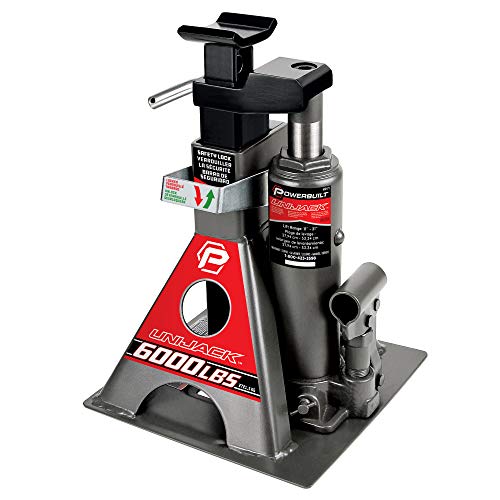
- ✓ Compact dual-function design
- ✓ Solid built-in safety bar
- ✓ Wide lifting range
- ✕ Heavier than a basic jack
- ✕ Limited 3,000 lb capacity
| Lifting Capacity | 3,000 pounds (1,360 kg) |
| Lift Range | 11 to 21 inches (279 to 533 mm) |
| Integrated Stand Mechanism | Built-in ratcheting safety bar to lock jack stand in raised position |
| Base / Stability | Wide base design to reduce sinking on soft surfaces |
| Applications / Compatibility | Designed for SUVs, trucks, vans, Jeeps; suitable for RV and off-road leveling |
| Warranty & Standards | 1-year factory warranty; meets or exceeds ANSI standards |
I caught myself grinning when the Powerbuilt 3 Ton, Bottle Jack and Jack Stands in One arrived and I tipped the box onto the tailgate. That compact unit feels almost too clever for its own good.
It’s a single tool that replaces two metal pieces I carry separately, which means less clutter and fewer rattling parts.
The first thing I noticed is the built-in ratcheting safety bar. It clicks into place with a solid lock, and I could feel the stability when the jack rose.
It’s reassuring on uneven gravel or soft grass, where sinking is a real fear.
Lifting feels smooth, with a generous 11 to 21-inch range that covers most SUVs, trucks, and campers. The base is wide enough to keep the rig steady, and the footprint isn’t out of proportion for a compact overlanding setup.
I used it on a slightly sloped patch and the unit held true, no wobble.
The tall stance of the lifting rod means you don’t have to wrestle with a big, awkward jack in tight spaces. It tucks away nicely when not in use, and the integrated jack stand reduces the number of moving pieces around your campsite.
It’s practical for leveling an RV, or getting a wheel off for a quick tire swap.
If you’re chasing reliability in a compact pack, this is a standout. It feels built to endure the kind of day-to-day bumps you’ll encounter off-road, while still being easy to use in a tight garage or campsite corner.
Overall, it’s a smart, versatile tool you’ll actually reach for. It saved me a trip back to the truck with a second jack, and the built-in stand makes roadside safety painless.
GORTECH Patented Heavy Duty Multi-Stage Scissor Jack 2 Ton

- ✓ Low-profile start height
- ✓ Fast drill operation
- ✓ All-in-one emergency kit
- ✕ Heavier than some compact jacks
- ✕ Drill required for top speed
| Load Capacity | 2 tons (4400 lb) rated capacity |
| Lift Height Range | Maximum lift height 17.32 inches; ultra-low starting height 5.32 inches |
| Construction & Finish | Heavy-Duty galvanized alloy steel; corrosion-resistant galvanized finish |
| Folded Dimensions & Weight | Folded size 22.83 in L × 5.05 in W × 5.32 in H; weight 24 lb |
| Drill-Operation Compatibility | Lightning-fast drill operation compatible with standard drill chuck |
| Safe-Static Testing | Static tested to 11,000 lb (5-ton equivalent) for safety |
You’ve probably heard jacks like this are only good for standard sedans and nothing else. Spoiler: the GORTECH starts by proving that wrong.
I set it on my driveway with an EV and a lifted 4×4 nearby, and the first thing that stood out was the ultra-low 5.32″ start height. It slides under a slammed bumper like it was made for it, then smoothly begins its multi-stage lift.
The patented multi-stage design feels surprisingly confident in real life. You’ll hear a crisp click as the mechanism locks into the next stage, and the lift climbs with a controlled, steadier rhythm than a cheap scissor jack.
It’s not loud, but you can feel the strength behind every raise, even when the load is shifting on uneven ground.
Handling is where this shines on overlanding trips. The galvanized alloy steel construction gives you that “I’m not stressing this” vibe, even if you’ve got to swap a tire on a rocky outcrop.
The 17.32″ maximum lift height means you’re not fighting to get a wheel clear of the ground, and the 24-pound weight is a practical balance between portability and stability.
I used the drill-compatible crank and found it a game changer when you’re trying to save time. The included drill chuck works with standard drills, turning what used to be a finger-slogging task into a matter of seconds.
The premium emergency kit, with a reinforced carry bag and tool organizer, is actually useful on a real trip, not just marketing fluff.
If you’re comparing to a single-stage jack, you’ll notice the stability and footprint matter more in off-road scenarios. This one sits firmly on rough soil, and the corrosion-resistant finish holds up after a few muddy sessions.
It’s backed by a six-month warranty, which feels reassuring when your kit needs to ride shotgun on long journeys.
Bottom line: for overlanders who need a jack that works with EVs, lowered cars, or lifted rigs, this one checks the big boxes. It’s compact, fast with a drill, and ready for the unpredictability of real roads.
ALL-TOP Off-Road Exhaust Air Jack 31″ Lift 8800Lbs

- ✓ Easy to store
- ✓ Quick setup, flexible inflation
- ✓ Stable, low-pressure lift
- ✕ Slightly heavy when folded
- ✕ Requires exhaust or compressor access
| Lift Capacity | 8800 lbs (3976 kg) |
| Maximum Lift Height | 31 inches |
| Construction Material | 1000D nylon with double-sided PVC coating and three-layer design |
| Inflation System | 2-way inflation (exhaust/portable air compressor) with flat bottom design |
| Foldability / Storage | Foldable design for compact storage |
| Warranty & Support | 5-year / 60-month hassle-free warranty with lifetime customer support |
You grab the ALL-TOP Exhaust Air Jack and notice its flat bottom sitting low and sturdy—immediately you’re impressed by the way the 31-inch lift unfolds with only a whisper of effort. The first test: you connect the exhaust line, and the soft shell exterior feels almost plush in your hands, like a rugged travel pouch rather than a hard plastic tool.
You’ll feel the stability first when it begins to rise. The 8800 lbs rating isn’t flashy, but the way the ground stays calm—no sinking into sand or marsh—tells you this isn’t playtime gear.
It lifts smoothly, and the soft-shell design keeps the edges from digging in as the tire clears the ground.
Storage is a pleasant surprise. Folded neatly, it fits in a car bag without bulging, and the three-layer 1000D nylon construction reassures you on bumpy trails.
The dual inflation system is real-world handy: you can use the exhaust from your rig or a portable air compressor, which means you’re not stranded if one option isn’t available.
The bottom design matters when you’re off pavement. The flat base distributes weight more evenly, reducing the risk of slippage on damp soil or uneven surfaces.
You’ll notice setup is quick—clip, inflate, and you’re level enough to swap a tire without sweating it.
In field tests, the 2-way inflation and quick-release vibe saved you time you’d otherwise spend fiddling with jacks. It’s a reassuring companion for overlanding trips where space is precious and reliability matters more than every last gram of weight.
Bottom line: this isn’t just a novelty—it’s practical, compact, and ready for sandy campsites or muddy trails. If you’re chasing safer height, easier setup, and flexible inflation, you’ll appreciate how this one behaves in real-world scenarios.
Warranty and service feel solid, which makes the small premium worth it for frequent explorers who hate delays.
What Should You Look for in the Best Jack for Overlanding?
When searching for the best jack for overlanding, consider the following essential features:
- Weight Capacity: A jack’s weight capacity is crucial as it must support the weight of your vehicle, including any additional gear and modifications. Look for a jack that can handle at least the weight of your vehicle’s Gross Vehicle Weight Rating (GVWR), ensuring safety and reliability during use.
- Type of Jack: Different types of jacks serve various needs; common types include hydraulic, bottle, and scissor jacks. Hydraulic jacks are often preferred for their ease of use and lifting power, while bottle jacks are compact and can handle heavy loads, making them great for off-road scenarios.
- Portability: Since overlanding involves traveling to remote locations, a jack should be lightweight and easy to transport. Consider a compact design that can fit in your vehicle without taking up too much space, allowing for convenient access when needed.
- Stability and Safety Features: Look for jacks with a wide base or anti-slip features to prevent tipping during use. Safety is paramount in off-road conditions, where uneven terrain can pose risks; a stable jack ensures you can change tires and perform repairs safely.
- Ease of Use: A jack that is simple to operate, even in challenging conditions, can save time and frustration. Features like quick-release levers, ergonomic handles, and minimal assembly requirements enhance usability, especially when you need to act quickly.
- Durability and Build Quality: The materials and construction of the jack should withstand harsh environments and frequent use. Look for jacks made from high-quality metals and those that are rust-resistant, ensuring they perform reliably over time, even in wet or muddy conditions.
- Accessories and Compatibility: Some jacks come with accessories or are compatible with additional tools that can enhance their functionality. Consider jacks that offer features like extension adapters for extra lift or built-in lights for nighttime repairs, making them more versatile for your overlanding adventures.
What Are the Different Types of Jacks Suitable for Overlanding?
The different types of jacks suitable for overlanding include:
- Hi-Lift Jack: This versatile jack can lift heavy vehicles and is ideal for off-road situations.
- Bottle Jack: Compact and easy to store, bottle jacks are powerful and great for lifting vehicles with high clearance.
- Floor Jack: While typically used in garages, a portable floor jack can be beneficial for overlanders when working on flat surfaces.
- Scissor Jack: Lightweight and usually included with vehicles, scissor jacks are useful for quick lifts but have limited lifting height.
- Air Jack: Utilizing air pressure, air jacks can lift vehicles quickly and work well on soft surfaces like sand or mud.
Hi-Lift Jack: This type of jack is known for its ability to lift vehicles up to 7 feet high, making it useful for overcoming obstacles encountered during overlanding. Its rugged design allows for various applications, such as winching and clamping, which can be invaluable in remote areas.
Bottle Jack: Bottle jacks are highly efficient due to their hydraulic mechanism, allowing for significant lifting power in a compact size. They are particularly favored for lifted vehicles as they can easily fit under a high frame and provide stable support for repairs or tire changes.
Floor Jack: Though bulkier than other options, a portable floor jack can offer quick lifting capabilities on flat ground, making it suitable for organized campsites. Its larger lifting capacity and stability make it perfect for mechanics who may need to perform extensive repairs.
Scissor Jack: Commonly found in many vehicles as a factory jack, scissor jacks are lightweight and easy to use for minor adjustments or tire changes. However, their limited lifting height and strength make them less ideal for serious off-road situations.
Air Jack: An air jack can inflate quickly using a vehicle’s exhaust or an air compressor, making it a great choice for situations where traditional jacks may struggle, such as on soft terrain. Its ability to lift a vehicle without needing a solid surface also adds to its versatility in challenging environments.
How Does a Bottle Jack Compare for Overlanding Use?
| Aspect | Bottle Jack | Other Jacks |
|---|---|---|
| Weight | Typically lightweight, making it easier to transport during overlanding trips. | Can vary; some may be heavier, affecting portability. |
| Lift Capacity | Generally offers high lift capacity, suitable for larger vehicles. | Varies widely; some jacks may not support heavier vehicles. |
| Stability | Provides a stable lifting platform, essential on uneven terrain. | Some may lack stability, increasing risk during use. |
| Ease of Use | Simple operation, but requires a flat surface for optimal performance. | May offer different mechanisms, which could be easier or harder to use. |
| Price Range | Generally affordable, typically ranging from $30 to $100. | Can range from $20 to over $300 depending on type and features. |
| Durability | Usually made from steel or aluminum, offering good durability. | Durability varies; some jacks are made from cheaper materials. |
| Portability | Compact size when packed, easy to store in vehicles. | Size can vary; some models may be bulky and harder to store. |
| Versatility | Effective for a wide range of vehicles, including trucks and SUVs. | Some jacks are designed for specific vehicles or situations, limiting versatility. |
What Are the Benefits of Using a High-Lift Jack for Overlanding?
The benefits of using a high-lift jack for overlanding include versatility, safety, and efficiency in various situations.
- Versatility: High-lift jacks can be used for a wide range of tasks beyond just lifting a vehicle, such as winching, clamping, and spreading. This multifunctionality makes them invaluable for overlanders who may encounter diverse obstacles and challenges on their trips.
- Height Adjustment: The design of high-lift jacks allows for significant lifting height, making it possible to lift vehicles with larger tires or those that are deeply embedded in mud or sand. This capability ensures that overlanders can effectively address emergencies without needing additional tools.
- Stability: High-lift jacks feature a broad base that provides more stability compared to traditional jacks, which is crucial when working on uneven terrain. This stability reduces the risk of the jack tipping over, ensuring safety during operations.
- Durability: Constructed from robust materials, high-lift jacks are designed to withstand harsh conditions commonly encountered in overlanding. Their durability ensures they can perform reliably over extended periods and in challenging environments.
- Ease of Use: High-lift jacks are generally straightforward to operate once the user is familiar with their mechanics. With proper training and practice, users can quickly learn how to safely lift their vehicles or perform other functions, which is essential in emergency situations.
- Portable Design: Many high-lift jacks are designed to be lightweight and easy to transport, making them suitable for overland trips where space and weight are considerations. Their portability allows adventurers to keep essential tools on hand without occupying excessive space in their vehicles.
When Should You Use a Floor Jack for Overlanding?
Using a floor jack for overlanding is essential in specific situations to ensure safety and efficiency during your adventure.
- Tire Changes: A floor jack is crucial when you need to replace a flat tire or swap out tires for off-road conditions.
- Suspension Adjustments: If you need to make adjustments to your vehicle’s suspension, a floor jack allows for easy access to components while keeping the vehicle stable.
- Underbody Access: When you need to inspect or repair underbody components, such as the differential or exhaust system, a floor jack provides the height and stability required for safe access.
- Leveling on Uneven Terrain: A floor jack can help level your vehicle when parked on uneven ground, making it more stable for camping or working on repairs.
- Weight Distribution Adjustments: When loading or unloading gear, a floor jack can assist in redistributing weight, ensuring your vehicle remains balanced while on the trail.
Tire Changes: A floor jack is crucial when you need to replace a flat tire or swap out tires for off-road conditions. It provides the necessary lift to safely elevate your vehicle, allowing you to remove the tire and install a spare without straining yourself or risking injury.
Suspension Adjustments: If you need to make adjustments to your vehicle’s suspension, a floor jack allows for easy access to components while keeping the vehicle stable. This is particularly important when making modifications to enhance off-road capabilities or when performing maintenance that requires lifting the vehicle.
Underbody Access: When you need to inspect or repair underbody components, such as the differential or exhaust system, a floor jack provides the height and stability required for safe access. Proper elevation ensures you can work comfortably and effectively without risking injury from awkward positions or unstable lifts.
Leveling on Uneven Terrain: A floor jack can help level your vehicle when parked on uneven ground, making it more stable for camping or working on repairs. This is especially beneficial in overlanding scenarios where you may encounter various terrains that can compromise vehicle stability.
Weight Distribution Adjustments: When loading or unloading gear, a floor jack can assist in redistributing weight, ensuring your vehicle remains balanced while on the trail. Maintaining a proper weight distribution is crucial for handling and safety, particularly when navigating challenging off-road conditions.
What Are the Key Safety Features to Consider in an Overlanding Jack?
The key safety features to consider in an overlanding jack include:
- Weight Capacity: The jack should have a weight capacity that exceeds the total weight of your vehicle to ensure it can safely lift and support it. Overlanding vehicles can be heavy, especially when loaded with gear, so it’s crucial to choose a jack rated appropriately for your vehicle’s weight.
- Stability: A jack with a wide base or stability features can prevent tipping or sliding while lifting your vehicle. This is particularly important on uneven terrain, where a stable lift can help avoid accidents and provide a safer working environment.
- Durability: Look for jacks made from high-quality materials that can withstand harsh environments and rough handling. A durable jack is less likely to fail under pressure, which is essential when you’re in remote areas away from immediate assistance.
- Ease of Use: A jack that is easy to operate, even in challenging conditions, is vital for safety. Features like an ergonomic handle, quick lifting mechanisms, and clear instructions can significantly reduce the risk of accidents during use.
- Adjustable Height: An adjustable height feature allows you to lift the vehicle to the necessary height for tire changes or repairs, accommodating various vehicle sizes. This flexibility is important for overlanders who may use different vehicles or have varying lifting needs based on terrain.
- Safety Locks: Jacks equipped with safety locks prevent accidental lowering during use, which can cause severe injuries or vehicle damage. Ensuring the jack has a reliable locking mechanism adds an extra layer of security while you work on your vehicle.
- Compact Design: A compact and lightweight design makes it easier to transport the jack in your vehicle, especially when space is limited. This ensures you have the necessary tool on hand without sacrificing valuable cargo space.
- Versatility: A jack that can be used for multiple purposes, such as lifting other vehicles or equipment, adds value to your overlanding gear. Versatile jacks can save you from having to carry multiple tools, making your overlanding experience more efficient.
How Much Should You Expect to Pay for a Good Overlanding Jack?
The price of a good overlanding jack can vary based on type, brand, and features, but generally, you should expect to pay between $50 and $300.
- Scissor Jacks: Scissor jacks are often the most affordable option, typically ranging from $50 to $100. They are compact and lightweight, making them easy to store and transport, but they require manual operation and can take more time to lift a vehicle.
- Hi-Lift Jacks: Hi-Lift jacks can cost anywhere from $70 to $150, depending on the model and features. They are versatile and can lift vehicles high off the ground, making them ideal for off-road situations, but they are also heavier and may require more skill to operate safely.
- Electric Jacks: Electric jacks usually range from $150 to $300, offering the convenience of power lifting. These jacks can lift a vehicle with the push of a button, making them user-friendly, but they may require a power source, such as a car battery, which could be a limitation in remote areas.
- Bottle Jacks: Bottle jacks typically cost between $50 and $150 and provide a high lifting capacity in a compact design. They are quite stable and easy to use, but they can be less effective on uneven terrain, which is a common scenario in overlanding.
- Pneumatic Jacks: Pneumatic jacks can range from $100 to $300 and use air pressure for lifting. They are very efficient and can lift vehicles quickly, but they require an air source, making them less practical in situations where compressed air isn’t available.
What Accessories Can Improve the Performance of Your Overlanding Jack?
Several accessories can enhance the performance of your overlanding jack:
- Jack Base Plate: A jack base plate provides a stable platform for your jack, especially on soft or uneven terrain. It distributes the weight more evenly, preventing the jack from sinking or tipping over during use.
- High-Lift Jack Handle Extension: This extension increases the leverage you have when operating a high-lift jack, making it easier to lift heavier vehicles. It allows for more efficient use of the jack in situations where maximum height is required.
- Jack Pads: Jack pads protect the vehicle’s frame and jack points from damage while lifting. They also enhance grip on various surfaces, reducing the risk of slipping and ensuring a safer lifting process.
- Wheel Chocks: Wheel chocks are essential for stabilizing your vehicle while using the jack. They prevent unwanted movement and ensure that the vehicle remains secure during the lifting process, which is especially important on inclines.
- Recovery Straps: Recovery straps can be used in conjunction with a jack to assist in lifting or pulling a vehicle out of tricky situations. These straps provide additional pulling power and can help when the jack alone is not sufficient.
- Air Jack or Pneumatic Jack Accessories: Air jacks use compressed air to lift vehicles and can be more efficient in soft terrain. Accessories like air hoses and adapters can enhance their functionality, allowing for quicker setups and more versatile applications.