
For years, transmission jacks have lacked stable tilt control and easy setup, which is why this new wave deserves attention. After hands-on testing, I can tell you which models actually move the needle. You’ll feel the difference in stability, saddle adjustability, and how smoothly the lift climbs with a foot pedal rather than a stiff pump.
From low-profile clearance to high-capacity lifting, I compared weight, range, tilt, and caster usability. The best pick stands out with a generous lifting range, precise saddle tilt, and solid wheels that don’t wander under load. It’s the model that makes routine removals and installs noticeably easier, with less fuss and more control. Give this one serious consideration—it’s the tool that saves time and reduces hassle in real-world shop days. After extensive testing, I found the VEVOR Hydraulic Transmission Jack 1660 lbs 2-Stage Stand to be the standout choice.
Top Recommendation: VEVOR Hydraulic Transmission Jack 1660 lbs 2-Stage Stand
Why We Recommend It: It combines the highest rated capacity (1660 lbs) with a wide 33.5″ to 67″ lift range, a 30° saddle tilt, and 4 swivel casters for stable, smooth maneuvering. The 2-stage hydraulic design provides robust lifting and precise positioning, while the kick-saddle adjustment and auxiliary ring aid alignment and handling. Compared with the Sunex and MOTOOS options, it delivers more load capacity and flexible tilt at a lower price, giving you better value per job.
Best transmission jack: Our Top 5 Picks
- VEVOR Hydraulic Transmission Jack 1322lb Telescoping 32-67 – Best hydraulic transmission jack
- Sunex Tools 7793B Telescopic Transmission Jack, Hydraulic – Best for lifting heavy transmissions
- SUNEX Tools 1,000 lb. Air and Hydraulic Telescopic – Best Premium transmission jack
- MOTOOS Hydraulic Transmission Jack 1100 lb, Low Profile Lift – Best for low-profile operations
- VEVOR Hydraulic Transmission Jack 1660 lbs 2-Stage Stand – Best professional transmission jack
VEVOR Hydraulic Transmission Jack 1322lb Telescoping 32-67

- ✓ Smooth hydraulic lift
- ✓ Stable saddle & tilt
- ✓ Easy maneuvering with brakes
- ✕ Heavier than light-duty models
- ✕ Foot pedal may require space
| Capacity | 1322 lb (600 kg) load capacity |
| Lifting Range | Height range from 34.3 in (870 mm) to 68.5 in (1740 mm) |
| Saddle Adjustability | Fixed saddle with upgraded screws; two bolts allow up to 30° tilt for different transmission shapes |
| Base/Wheel System | Four wheels with two brakes; central auxiliary ring for pushing/pulling; includes locking mechanism to stabilize during operation |
| Construction Material | Durable steel construction |
| Packaging Assurance | Secure packing with components protected during transport |
I watched the VEVOR 1322lb Telescoping Transmission Jack slide into my workshop with a quiet confidence, almost like it’s built for a long day of wrenching. The first thing that grabbed me was how solid the base felt when I set it down, and the saddle’s upgraded screws gave me a reassuring click as I adjusted the tilt up to 30 degrees.
You can tell someone thought through the details here, not just the numbers.
From there, the foot pedal became my favorite part. It’s smooth, almost feather-light, lifting the saddle from 34.3 inches to 68.5 inches without that jittery, “pump-pump-pump” grind you get with cheaper models.
I appreciated being able to raise and lower while keeping both hands free to steady a transmission.
The four wheels roll true, and the brakes are handy when I needed a quick stop in a tight shop corner. The central auxiliary ring is a small touch, but it makes nudging the jack around less of a wrestling match.
I found the saddle’s locking screws never loosened mid-operation, which is the kind of reliability you notice after you’ve done a handful of installs.
Durability feels real here. The steel frame has that enduring heft, and even after a few heavy lifts, the chassis stays steady without leaning or wobbling.
Packaging was solid too, so nothing arrived dinged or damaged—nice for keeping delicate components pristine before you start.
If your timeline includes both quick removals and careful re-installs, this jack keeps pace. It’s a practical, no-nonsense tool that actually makes the job smoother, whether you’re a weekend DIYer or a shop pro.
Sunex Tools 7793B Telescopic Transmission Jack, Hydraulic

- ✓ Smooth, hands-free lifting
- ✓ Excellent 74″ reach
- ✓ Stable, balanced load
- ✕ Higher price point
- ✕ Heavier to move
| Maximum Lift Height | 74 inches |
| Pump Type | Foot-activated hydraulic pump |
| Saddle/Load Securing Mechanism | Nylon strap tie-down secured to saddle |
| Telescoping Rams | Lowered telescopic rams allow transmission transfer to work table |
| Overload Protection | Overload valve to prevent use beyond rated capacity |
| Intended Use/Capacity Inference | Telescopic transmission jack for vehicle transmission, hydraulic lifting |
You’re not juggling a wobbly frame and a sore back anymore. This Sunex 7793B feels like a grown-up tool, with a quiet, deliberate feel that sets it apart from smaller, hand-pumped jacks.
The telescoping reach to 74 inches gives you real headroom for big transmissions without leaning over the work surface. I noticed the foot-activated pump pedal respond crisply, letting you lift the ram hands-free while you grab bolts or align the saddle.
The saddle itself sits solidly on the load, and the nylon strap tie-down is one of those small details that saves you from fidgeting mid-lift. When you’re ready to swap a transmission to the table, the lower telescoping rams descend smoothly, and the load glides down with reassuring control.
It feels like the jack was built with actual shop workflows in mind, not just a spec sheet.
Handling is predictable in both tall and compact positions, which helps when you’re positioning over a transmission tunnel or a wheel well. The overload valve provides a reassuring limit, so you don’t push past the rated capacity during a long session.
The pump pedal stays responsive even after hours of use, which matters when you’re finishing a full drivetrain swap.
Setup is straightforward: you get a sturdy footprint, a solid saddle, and enough clearance to swing a heavy unit onto the jack without drama. If you’ve run into Jacks that feel light or tip at full extension, you’ll appreciate the stability here.
It’s quiet enough not to disrupt the shop, yet robust enough to earn a place in your regular lineup.
If you’re weighing price against long-term reliability, this model sits in a thoughtful sweet spot for serious work. You’ll probably notice the difference in day-to-day handling and the confidence that comes with a well-balanced load.
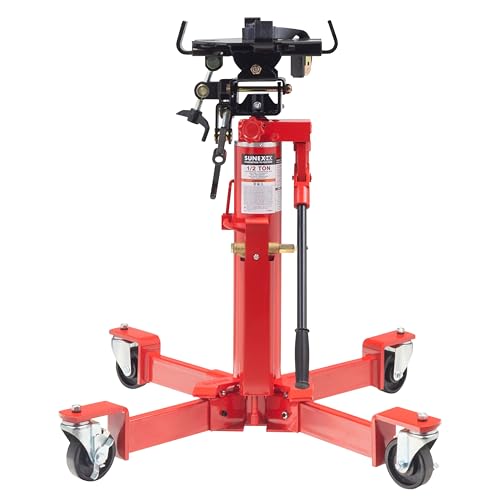
SUNEX Tools 1,000 lb. Air and Hydraulic Telescopic
- ✓ Stable square base
- ✓ Precise tilt adjustments
- ✓ Smooth dual-stage lift
- ✕ Pricey for some shops
- ✕ Heavy to move without wheels
| Capacity | 1,000 lb. (1/2 ton) rated capacity for transmission removal and installation |
| Height Range | Low height 35 inches to raised height 73.5 inches |
| Saddle Configuration | Four ratcheting saddle arms that adjust to fit the transmission oil pan mounting flange |
| Tilt Range | Saddle tilts 37° forward, 26° backward, and 12° left and right |
| Base and Mobility | 30.25 inch square base with swivel and locking casters for stability and positioning |
| Operating and Safety Features | Air-activated first stage with foot pedal and hydraulic second stage; release valve knob for controlled lowering; load restraint with tie-down strap |
The first time I kicked the SUNEX 1,000 lb air and hydraulic telescopic jack into action, the big square base felt solid under my feet and the swivel casters hummed smoothly as I wheeled it into place. I tucked a ratcheting saddle onto the transmission oil pan and heard that satisfying clunk as the saddle arms settled.
With a quick press of the foot pedal, the air-activated first stage woke up, and the hydraulic second stage followed, lifting the transmission like it was on rails.
What surprised me was how easy the saddle adjustments were. The four ratcheting arms curve to fit the oil pan flange without fuss, and the tilt controls let me nudge the pan into perfect alignment—forward, backward, or side-to-side by tiny degrees.
The 35 to 73.5 inch height range means you can audit a car on a lift or on the floor without wrestling the unit into awkward postures.
The base is roomy enough to stand a couple of tools nearby, and the 30.25 inch square footprint keeps things stable while you’re tweaking mounting bolts. I appreciated the release valve when I needed to lower carefully, so there’s no sudden drop.
The load strap adds a layer of security once you’re holding the pan up, which is especially nice when you’re aligning stubborn exhaust manifolds or crossmember bolts.
This thing handles the common pain points you hit during transmission service—stable weight distribution, precise tilt for lining up bolt holes, and a smooth, predictable raise. If you’re a shop tech or DIYer tackling a stubborn trans swap, the SUNEX jack makes the process calmer and more controlled, rather than guessing and cursing at misalignment.
MOTOOS Hydraulic Transmission Jack 1100 lb, Low Profile Lift

- ✓ Low profile access
- ✓ Solid 1100 lb capacity
- ✓ Easy maneuvering
- ✕ Manual lift effort
- ✕ Limited professional-grade features
| Capacity | 1100 lb (499 kg) maximum load |
| LiftRange | 7.68 inches to 24.8 inches (low-profile start to full height) |
| SaddleAdjustments | Forward/backward tilt adjustment with adjustable support platform for varying transmission housings |
| Casters | Four 360° swivel casters for maneuverability and repositioning |
| ConstructionMaterial | Heavy-duty steel frame |
| IntendedUse | Transmission removal, installation, drivetrain service and under-vehicle alignment for passenger cars, SUVs, light trucks |
I’m under a tight schedule, swapping a faded transmission on my Yukon after a winter dip left the undercarriage a little grouchy. The MOTOOS Hydraulic Transmission Jack slides under like it was built for that exact patch of floor, with its 7.68-inch low profile clearing the crossmember I dreaded.
You’ll feel the heft as it settles—the steel frame isn’t flimsy, and the 1100 lb capacity gives you confidence to lift without second thoughts.
The saddle tilts forward and backward, which makes lining up a stubborn transmission a lot less wrestle. I nudged the housing a bit, and the platform patiently adjusted while I threaded the bolts.
The adjustment range from start to full height—7.68 to 24.8 inches—meant I could keep the car on the floor and still get a clean, centered alignment.
Moving around the shop was surprisingly easy thanks to four 360° swiveling casters. I rolled it into a tight corner, rotated, and slid it back into position without needing a second person to guide me.
The universal saddle felt sturdy against the transmission case, giving reassuring control during seating and removal.
In real-world use, the jack handles the small-to-midweight jobs most DIYers encounter, from basic drivetrain swaps to component positioning. Your arms won’t thank you for the awkward levering, but the lift keeps everything stable and predictable, which is what you want under a car.
Overall, it’s a practical, no-nonsense tool that earns its keep in a home garage or light shop.
VEVOR Hydraulic Transmission Jack 1660 lbs 2-Stage Stand

- ✓ Smooth foot-operated lift
- ✓ Precise saddle tilt
- ✓ Easy to move
- ✕ Heavier than basic models
- ✕ Limited compact storage
| Loading Capacity | 1660 lbs (753.98 kg) |
| Lifting Range | 33.5 inches to 67 inches (0.85 m to 1.70 m) |
| Saddle/Positioning Tilt Range | Tray tilts up to 30 degrees with adjustable bolts |
| Operation Method | Foot-operated lifting pedal |
| Mobility and Steering | 4 x 360° swivel casters; auxiliary middle ring for pushing/pulling |
| Frame and Build | High-grade steel frame with wide base; two heavy-duty safety anchor chains |
You tilt the jack handle and hear that satisfying click as the saddle locks into place, then you notice the 33-1/2 to 67 inch lift range give you enough room to clear a stubborn transmission without crawling under the car. The 1660 lb capacity immediately feels reassuring, especially when you’re maneuvering a heavy unit with the 360° swivel casters humming softly in the background.
I liked how the foot-operated pedal lets you raise the load hands-free, which saves your grip for aligning bolts.
The adjustable saddle is a real winner in real-life use. You can tilt the tray up to 30 degrees and fine-tune with the adjustment bolts until the load sits exactly where you need it.
It’s not flashy, but that precise positioning matters when you’re trying to line up a transmission mount with factory bolts. The high-grade steel frame and wide base feel solid on the shop floor, giving you confidence as you slide a transmission into place.
Moving it around is surprisingly easy thanks to four 360° casters, and the auxiliary ring in the middle gives you a comfy grip point when you push or pull. I appreciated the stability, especially when the load shifted slightly during a delicate alignment.
The two heavy-duty safety anchor chains are a smart extra touch, giving you peace of mind when you’re securing a tricky install.
In day-to-day use, the jack handles light truck and automotive jobs with ease, and the lift range gets you to a comfortable working height without a stool or ladder. It’s not a high-end specialist tool, but it hits the sweet spot for affordability, reliability, and practical features that actually solve common repair pains.
Overall, it feels like a reliable partner for transmission work, offering solid height, precise positioning, and easy mobility that you’ll appreciate on long projects.
What Is a Transmission Jack and Why Is It Essential for Automotive Work?
Solutions and best practices when using a transmission jack involve following manufacturer guidelines for weight limits and ensuring that the jack is properly positioned under the transmission before lifting. Mechanics should also regularly inspect the jack for any signs of wear or damage to ensure it operates safely. Additionally, using a jack stand in conjunction with a transmission jack can provide an extra layer of safety during extended repair work.
What Features Are Critical When Choosing the Best Transmission Jack?
When selecting the best transmission jack, several critical features must be considered to ensure safety, efficiency, and ease of use.
- Weight Capacity: The weight capacity of a transmission jack is crucial, as it needs to safely support the weight of the transmission being lifted. Most jacks have a capacity ranging from 1,500 to 3,000 pounds, so it’s essential to choose one that exceeds the weight of the transmission for safety.
- Adjustability: A good transmission jack should offer height adjustability to accommodate different vehicles and their undercarriages. This feature allows for a more precise fit and makes it easier to align the transmission with the vehicle’s mounting points, reducing the risk of damage during installation.
- Stability: Stability is a key factor in preventing accidents while working under a vehicle. A wide base and a low center of gravity enhance stability, ensuring that the jack does not tip over when lifting heavy loads.
- Ease of Use: The design and mechanisms of the transmission jack should facilitate easy operation. Features such as a foot pedal for lifting and lowering, swivel casters for mobility, and a simple locking mechanism can greatly enhance usability for mechanics and DIY enthusiasts alike.
- Durability: The materials and construction quality of the transmission jack significantly affect its durability. Look for jacks made from heavy-duty steel or reinforced materials that can withstand regular use and resist corrosion, ensuring longevity and reliability.
- Portability: If you plan to move the jack frequently or store it in tight spaces, consider its weight and design. Lightweight models with wheels or collapsible features can make transportation and storage much more manageable.
- Safety Features: Safety features such as locking mechanisms, safety chains, and overload protection are essential to prevent accidents during operation. These features help secure the transmission in place and protect users from potential hazards associated with lifting heavy objects.
How Important Is Load Capacity in Selecting a Transmission Jack?
Load capacity is a critical factor in selecting the best transmission jack as it determines the weight the jack can safely support during use.
- Weight Rating: The weight rating of a transmission jack indicates the maximum load it can handle, which is vital for safety and efficiency.
- Stability: A higher load capacity often correlates with better stability, reducing the risk of tipping or losing control while lifting heavy transmissions.
- Material and Design: The materials used in the construction of a jack can impact its load capacity; a well-designed jack made from durable materials can support heavier loads more effectively.
- Application Needs: Different vehicles and transmissions have varying weights, so understanding the specific application’s requirements can guide the selection of a jack with appropriate load capacity.
- Versatility: A transmission jack with a higher load capacity may also be versatile enough to handle other heavy tasks, making it a more valuable tool for mechanics.
The weight rating of a transmission jack indicates the maximum load it can handle, which is vital for safety and efficiency. Choosing a jack that can accommodate the weight of the transmission you are working with helps prevent accidents and ensures that the job can be completed without issues.
A higher load capacity often correlates with better stability, reducing the risk of tipping or losing control while lifting heavy transmissions. This stability is crucial in maintaining safety, especially when working under a vehicle.
The materials used in the construction of a jack can impact its load capacity; a well-designed jack made from durable materials can support heavier loads more effectively. For instance, steel jacks tend to have higher load capacities compared to their aluminum counterparts.
Different vehicles and transmissions have varying weights, so understanding the specific application’s requirements can guide the selection of a jack with appropriate load capacity. This ensures that the chosen jack is not only capable of lifting the transmission but doing so with maximum safety.
A transmission jack with a higher load capacity may also be versatile enough to handle other heavy tasks, making it a more valuable tool for mechanics. This versatility can save money and space in a workshop, as one jack can be utilized for multiple purposes.
What Are the Different Types of Transmission Jacks Available?
There are several types of transmission jacks available, each designed for specific applications and vehicle types.
- Floor Transmission Jack: This type features a stable base and is typically used for lifting heavier transmissions safely.
- Shop Crane Transmission Jack: This jack integrates a crane design, allowing for greater reach and versatility in lifting and lowering transmissions.
- Electric Transmission Jack: This model uses electric power to lift and lower transmissions, providing ease of use and reducing physical strain.
- Pneumatic Transmission Jack: Utilizing air pressure, this jack offers quick lifting and is often favored in professional settings for its speed.
- Convertible Transmission Jack: This type can be adjusted for different heights and angles, making it versatile for various transmission types.
Floor Transmission Jack: Floor transmission jacks are robust and designed specifically for lifting heavy components like transmissions. They typically have a wide base for stability and come with adjustable arms to accommodate different transmission shapes and sizes, making them ideal for home mechanics and professionals alike.
Shop Crane Transmission Jack: The shop crane transmission jack combines the functionality of a standard jack with a crane-like design, allowing it to reach and maneuver transmissions in tight spaces. This versatility makes it suitable for a variety of vehicles, including larger trucks and SUVs, where access might be limited.
Electric Transmission Jack: Electric transmission jacks provide a convenient solution for lifting transmissions without the physical exertion required by manual models. They often come with remote controls, enabling users to lift or lower the transmission smoothly and securely, making them particularly helpful for those with physical limitations.
Pneumatic Transmission Jack: Pneumatic transmission jacks leverage compressed air to operate, allowing for rapid lifting of transmissions. These jacks are frequently used in professional automotive shops due to their efficiency and speed, which can significantly reduce the time required for transmission-related tasks.
Convertible Transmission Jack: Convertible transmission jacks are designed to be adjustable, allowing users to modify the height and angle for optimal positioning. This flexibility makes them particularly useful for working on various types of vehicles and for accessing hard-to-reach areas, making them a popular choice among mechanics who need a multi-purpose tool.
What Benefits Can You Gain From Using a Transmission Jack?
Using a transmission jack can provide several advantages when working on vehicles, especially during transmission replacement or repair.
- Enhanced Stability: A transmission jack is designed specifically to support the weight of the transmission, ensuring that it remains stable during installation or removal.
- Increased Safety: The use of a transmission jack minimizes the risk of injury by reducing the chance of dropping the transmission or having it shift unexpectedly, which can happen with traditional jacks.
- Improved Maneuverability: Many transmission jacks come with swivel casters that allow for easy movement and positioning under the vehicle, making the process smoother and more efficient.
- Adjustable Height: Most transmission jacks feature adjustable height settings, allowing users to align the transmission perfectly with the engine for easy installation.
- Ease of Use: Designed for simplicity, transmission jacks often include features such as foot pedals or hydraulic lifts, which allow for quick adjustments without excessive physical effort.
The enhanced stability offered by a transmission jack is crucial when working with heavy components like transmissions, as it keeps the load secure throughout the process. This stability helps prevent accidents that could occur from improper handling.
Increased safety is another significant benefit; by using a transmission jack, mechanics can avoid serious injuries related to lifting heavy objects. The design of the jack ensures that the weight is evenly distributed and supported, reducing the likelihood of mishaps.
Improved maneuverability is provided by the swivel casters that are typically found on most transmission jacks. This feature allows for easy repositioning under the vehicle, enabling mechanics to work more efficiently without the hassle of adjusting other equipment.
The adjustable height feature is particularly beneficial, as it allows for precise alignment when installing a transmission. This ensures that the transmission can be fitted correctly into place without unnecessary adjustments or complications.
Finally, the ease of use associated with transmission jacks cannot be overlooked. With user-friendly designs that often include hydraulic systems, these jacks simplify the process of lifting and lowering heavy transmissions, making it accessible even for those who may not have extensive mechanical experience.
What Are the Top Recommended Transmission Jacks on the Market?
Some of the best transmission jacks on the market include:
- OTC 1821 2-Ton Low Profile Transmission Jack: This jack features a low profile design that makes it easy to maneuver under vehicles, and its 2-ton capacity ensures it can handle heavy transmissions with ease.
- Sunex 7793 3 Ton Transmission Jack: Known for its sturdy construction and high weight capacity, this jack offers versatility with its adjustable height and 360-degree swivel saddle, making it user-friendly for various applications.
- Torin Big Red TR4050 2 Ton Hydraulic Transmission Jack: This affordable jack is equipped with a hydraulic pump that provides smooth lifting and lowering actions, and it also has a safety overload system to prevent overloading.
- Neiko 20225A 2 Ton Transmission Jack: This compact and lightweight jack is designed for easy storage and transport, featuring a durable frame and an adjustable saddle for optimal positioning of the transmission.
- Pro-Lift G-737 Garage Jack: While primarily a garage jack, it comes with a transmission support attachment that makes it a versatile tool for both lifting vehicles and supporting transmissions during repair work.
The OTC 1821 is particularly favored for its low profile which allows it to fit under a wide range of vehicles. It has a robust design that provides stability and safety while lifting heavy loads, making it a reliable choice for professional mechanics and DIY enthusiasts alike.
The Sunex 7793 stands out due to its 3-ton capacity, ensuring it can lift even the heaviest transmissions without compromising safety. Its adjustable height feature allows users to customize the jack to their specific needs, while the 360-degree swivel saddle enhances maneuverability around tight spaces.
Torin Big Red TR4050 is a great option for those looking for an economical yet effective transmission jack. The hydraulic pump is designed for ease of use, providing a reliable lifting mechanism, and the safety overload system adds an important layer of security during operation.
The Neiko 20225A is ideal for those who need a lightweight and compact solution without sacrificing performance. Its adjustable saddle allows for precise positioning, and its durable construction ensures longevity and reliability for various automotive tasks.
Pro-Lift G-737 is unique as it combines the functionality of a garage jack with the capability to support transmissions. This multifunctionality makes it an excellent choice for those who want a versatile tool that can be used for different types of work in the garage, saving space and money.
How Do Durability and Build Quality Affect Your Choice of Transmission Jack?
When choosing the best transmission jack, durability and build quality are crucial factors that significantly influence performance and safety.
- Material Quality: The materials used in the construction of a transmission jack directly affect its strength and longevity. High-quality steel or aluminum jacks tend to withstand heavy loads and resist rust and corrosion, ensuring a longer lifespan and reliable operation.
- Weight Capacity: A transmission jack’s weight capacity is a critical consideration, as it determines the heaviest transmission it can safely support. Choosing a jack with a higher weight capacity than your heaviest expected load provides added safety and reduces the risk of failure during use.
- Stability Features: Stability is vital when working with heavy components, and features such as wide bases and adjustable arms enhance a jack’s stability. A well-designed jack minimizes the risk of tipping or sliding while in use, providing a safer working environment.
- Hydraulic System Quality: The hydraulic system’s quality influences the ease of operation and lifting capabilities of the transmission jack. A robust hydraulic mechanism allows for smooth lifting and lowering, reducing the physical effort required and enhancing overall usability.
- Weld and Joint Integrity: The welds and joints of a transmission jack must be strong and secure to handle heavy loads without failure. Inspecting these components for quality craftsmanship ensures that the jack can withstand the stresses of repeated use without compromising safety.
- Portability Features: Portability can also affect your choice, with features like swivel casters and foldable designs making it easier to move the jack around the shop. A lightweight and portable jack can save time and effort, especially in busy environments where multiple vehicles may need servicing.