
Jack Boss 3 Ton Low Profile, Aluminum and Steel Racing to be the standout choice.
Top Recommendation: Jack Boss 3 Ton Low Profile, Aluminum and Steel Racing
Why We Recommend It: The Jack Boss 3 Ton Low Profile combines a low minimum height (3-15/16″) with a dual-pump hydraulic system, reducing pumps to reach lifting height. It uses a high-strength aluminum body with a welded steel frame for durability, and a large rubber saddle protects lifting points. Its low-profile design and smooth casters improve accessibility under sedans and crossover SUVs, while ANSI/ASME PASE safety compliance and a 1-year warranty add reliability—advantages over AUTOWN’s heavier alloy-steel build and slightly higher minimum height. This mix of low clearance, faster lift, and solid safety slightly edges out the competition.
Best truck jack: Our Top 2 Picks
- AUTOWN 3 Ton Floor Jack, Alloy Steel Hydraulic Car Jack – Best Floor Jack for Pickup Trucks
- Jack Boss 3 Ton Low Profile, Aluminum and Steel Racing – Best Portable Hydraulic Truck Jack
AUTOWN 3 Ton Floor Jack, Alloy Steel Hydraulic Car Jack

- ✓ Smooth lift action
- ✓ Secure saddle grip
- ✓ Flat-fold storage
- ✕ Check frame clearance on sedans
- ✕ Heavier silicone grease on pins
| Load Capacity | 3 tons (6,600 lbs) maximum lift |
| Lifting Range | 7.1 inches to 20.9 inches |
| Material | Heavy-gauge alloy steel |
| Pump Technology | Hydraulic lifting system with rapid lift capability |
| Saddle/Contact Surface | Cross-shaped rubber pad for secure, non-slip contact on round or flat frame points |
| Base/Mobility | Smooth-rolling casters with quick-connect handle; foldable for flat storage |
You know that moment when you lift a floor jack and it feels lighter than the tool you actually picked up? I had that surprise with the AUTOWN 3 Ton Floor Jack—the weight is modest for a heavy-duty jack, yet the lift feels confident, quiet, and surprisingly smooth.
The first test was a full-size SUV, and the saddle hugged the frame with that cross-shaped rubber pad, holding steady as I pumped.
The build quality is reassuring. It’s alloy steel, not flimsy pot metal, and the finish looks durable enough to survive a few garage scrapes.
The lift range from 7.1″ to 20.9″ is exactly what I need for trucks and crossovers, though I did double-check frame clearance on a sedan just to be sure. The rapid lift feature kicks in quickly, so you’re not stuck counting pumps when you’ve got a tire change looming.
Handle design matters in a busy shop, and this one hits the mark. The quick-connect handle stores away neatly, and the jack rolls smoothly on the casters, even on a slightly uneven garage floor.
Lowering is crisp and controlled, thanks to a precise release valve that doesn’t suddenly drop the vehicle. When the job is done, folding it flat is a genuine space saver, and it slides into a corner without fuss.
In real-world use, the AUTOWN jack feels dependable for everyday truck and SUV tasks. It’s not just a tool to lift; it’s something you’ll actively enjoy using because setup, stability, and storage finally feel thoughtful.
Overall, it handles the common pain points: sturdy lift, secure contact, smooth operation, and easy storage.
Jack Boss 3 Ton Low Profile, Aluminum and Steel Racing
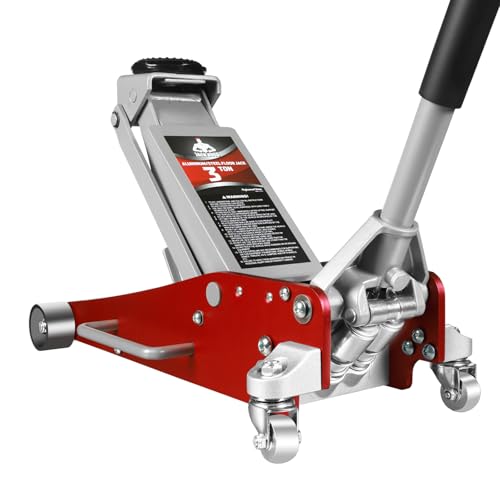
- ✓
- ✓ Low-profile advantage
- ✓ Smooth dual-pump lift
- ✓ Sturdy, portable build
- ✓
- ✕
- ✕ Heavy when fully loaded
- ✕ Limited color options
- ✕
| Capacity | 3 tons (6,600 lbs) rated lifting capacity |
| Lifting Range | 3-15/16 inches to 18-5/16 inches |
| Dimensions | 28.3 inches L x 13.7 inches W x 7.8 inches H |
| Construction | Aluminum body with welded steel frame |
| Special Features | Dual-pump hydraulic system with large rubber saddle, low-profile design for undercarriage access |
| Safety & Warranty | ANSI/ASME PASE standard compliance; 1-year limited warranty |
Getting under a low-clearance sedan and seeing that 3-ton Jack Boss ease into place felt like flipping a switch from awkward to confident. The first thing that grabbed me was the low profile—just 3-15/16 inches of ground clearance is enough to slide underneath without wiggling the car or chalking the wheels.
It’s one of those small design wins you notice before you even lift anything.
The dual-pump system immediately proves its worth once you start pumping. You don’t have to mash the lever or curse the lift height; the jack climbs steadily, and the big rubber saddle stays centered on the lifting point, which means less fuss and less chance of slipping.
You’ll appreciate how smoothly the aluminum body glides on the steel casters, making it easy to position even in a tight garage corner.
Under load, the balance feels reassuring. The welded steel frame and high-strength aluminum combo feel sturdy without turning the jack into a beast you can’t lift.
The handle is the right length for leverage, and the two-piece design makes storage in a trunk or garage cabinet a non-issue. It’s also nice to see the saddle protected by rubber, keeping paint scratches and gouges to a minimum while you maneuver.
Size-wise, it covers a broad range—from sedans to SUVs—without feeling oversized. The lifting range—about 3-15/16″ up to 18-5/16″—is practical for most daily fixes, tire changes, and maintenance tasks.
And with a factory rating that tests well beyond its stated capacity, you get a layer of confidence that translates to calm during roadside worries or home repairs.
Overall, you’ll notice the thoughtful build and real-world utility in every lift. It’s not flashy, but it’s reliable, practical, and easy to live with when you actually need to get under a car.
What Are the Different Types of Truck Jacks Available?
The different types of truck jacks available include:
- Hydraulic Floor Jacks: Hydraulic floor jacks are widely used for lifting heavy vehicles due to their ease of use and ability to lift substantial weight with minimal effort.
- Bottle Jacks: Bottle jacks are compact and portable, designed to lift heavy loads vertically, making them ideal for tight spaces and emergency situations.
- Pneumatic Jacks: Pneumatic jacks utilize compressed air to lift vehicles quickly and efficiently, often preferred in professional settings for their speed and power.
- Scissor Jacks: Scissor jacks are typically lighter and more compact, operated via a cranking mechanism, making them suitable for roadside emergencies and basic vehicle maintenance.
- Electric Jacks: Electric jacks offer automated lifting capabilities, providing convenience for users who may struggle with manual jacking, making them ideal for those with limited physical strength.
Hydraulic floor jacks are known for their stability and strength, often featuring a low profile that allows them to fit under most vehicles. They come with a pump mechanism that multiplies the force applied, enabling the user to lift heavy trucks with relative ease.
Bottle jacks operate on a similar hydraulic principle but are designed to be more compact. Their vertical lifting motion makes them ideal for heavy-duty applications, and they are often used in garages and for roadside assistance due to their portability.
Pneumatic jacks are powered by air compressors and are capable of lifting vehicles in a fraction of the time compared to manual options. These jacks are favored in commercial settings where efficiency is key, as they can lift a truck in seconds with minimal physical effort.
Scissor jacks, while less powerful than hydraulic options, are lightweight and easy to store, making them popular among drivers who want a simple solution for changing tires. Their mechanical design requires manual cranking, which can be time-consuming but is effective for small to medium vehicles.
Electric jacks provide a modern solution to vehicle lifting with the push of a button, making them accessible for users who may have difficulty using traditional jacks. They are particularly useful for individuals who frequently need to lift their trucks for maintenance or repairs without the physical strain associated with manual jacks.
How Do Hydraulic Truck Jacks Work Compared to Pneumatic Jacks?
| Aspect | Hydraulic Jacks | Pneumatic Jacks |
|---|---|---|
| Mechanism | Uses fluid pressure to lift heavy loads through a piston system. | Utilizes compressed air to lift loads, often with quicker movements. |
| Weight Capacity | Typically supports heavier loads, suitable for trucks and larger vehicles. | Generally supports lighter to moderate loads, ideal for automotive applications. |
| Speed of Lifting | Slower lifting speed due to fluid dynamics involved. | Faster lifting speed, as air pressure allows quick elevation. |
| Applications | Commonly used in heavy-duty environments, such as garages and workshops. | Used in automotive repair and situations requiring quick adjustments. |
| Cost | Generally more expensive due to construction and materials. | Often more affordable, but costs can vary based on quality. |
| Maintenance | Requires regular checks for fluid leaks and seals. | Needs occasional checks for air leaks and proper air supply. |
| Safety Features | Includes overload protection and stable base design. | Often equipped with safety valves to prevent over-pressurization. |
What Is the Most Suitable Truck Jack Type for Heavy-Duty Use?
A truck jack is a mechanical device designed to lift heavy vehicles, particularly trucks, for maintenance or repair work. The most suitable type for heavy-duty use typically includes hydraulic jacks, as they provide the necessary lifting power and stability for large trucks and heavy loads.
According to the American National Standards Institute (ANSI), hydraulic jacks are favored for their efficiency and safety in lifting heavy weights, often exceeding 10 tons. They utilize hydraulic fluid to create pressure, which allows for increased lifting capacity with less manual effort compared to mechanical jacks.
Key aspects of heavy-duty truck jacks include their lifting capacity, stability, and ease of use. Hydraulic jacks can lift vehicles quickly and smoothly, which is essential in professional settings where time and safety are critical. Additionally, many heavy-duty models come equipped with features such as safety locks and reinforced frames, ensuring that the vehicle remains securely elevated while work is performed.
The impact of using the best truck jack extends to various sectors, including automotive repair shops, roadside assistance services, and logistics companies. For instance, a hydraulic truck jack can significantly reduce downtime during repairs, allowing businesses to operate more efficiently. Furthermore, the safety features inherent in these jacks help prevent accidents and injuries, protecting both the workers and the vehicles being serviced.
Statistics indicate that improper lifting practices account for a significant number of workplace injuries in the automotive sector. According to the Occupational Safety and Health Administration (OSHA), using substandard lifting equipment can increase the risk of accidents. By investing in high-quality hydraulic truck jacks, companies not only comply with safety regulations but also enhance their operational capabilities.
Best practices for using heavy-duty truck jacks include regular maintenance checks to ensure functionality, proper training for operators on safe lifting techniques, and adhering to the manufacturer’s guidelines for load limits. Utilizing jack stands in conjunction with hydraulic jacks is also recommended to provide additional safety when working under lifted vehicles.
What Features Should You Look for in the Best Truck Jack?
When searching for the best truck jack, consider the following features:
- Weight Capacity: Ensure the jack can handle the weight of your truck, typically ranging from 2 tons to 12 tons for larger vehicles.
- Lift Height: Look for a jack that provides sufficient lift height to access the desired undercarriage areas, often between 14 to 20 inches.
- Construction Material: Opt for durable materials like steel or aluminum, which offer strength while being resistant to rust and wear over time.
- Portability: Consider the jack’s weight and design for ease of transport, especially if you’ll need to carry it to job sites or different locations.
- Stability Features: A good truck jack should have a wide base or rubberized pads to prevent slipping and ensure stability while lifting.
- Safety Features: Look for jacks that include safety locks or measures to prevent accidental lowering, which enhances user safety during operation.
- Ease of Use: Choose a jack that is user-friendly with features like a quick-release valve and easy pumping mechanism, allowing for efficient operation.
- Warranty and Support: Check for a solid warranty and customer support options, which can provide peace of mind regarding the jack’s long-term reliability and service.
Weight capacity is crucial as it determines whether the jack can safely lift your truck without risk of failure. Common truck jacks range in capacity, so always match the jack to your vehicle’s specifications.
Lift height is another important feature, as you need the jack to reach high enough to access the vehicle’s undercarriage for tire changes or repairs. A jack that offers adjustable lift heights can be particularly beneficial for different types of tasks.
Construction material affects both the weight and durability of the jack. Steel jacks are typically heavier and more robust, while aluminum jacks are lighter and easier to transport, but may have lower weight capacities.
Portability is essential, especially if you need to move the jack frequently. Look for jacks that are compact, lightweight, and equipped with wheels or handles for easier mobility.
Stability features, such as wide bases or rubber pads, help prevent the jack from tipping as you lift your truck. These features are designed to provide a solid foundation, increasing safety during use.
Safety features are vital for preventing accidents while using the jack. Many modern jacks come with built-in safety locks that secure the jack in place, preventing unintentional lowering during maintenance.
Ease of use is determined by features like the pumping mechanism and valve release. A jack that operates smoothly with minimal effort can save time and reduce fatigue, especially during lengthy repair jobs.
Finally, a warranty and customer support are important for long-term investment. A solid warranty can protect you against defects, and responsive customer service can help resolve any issues that arise during the jack’s lifespan.
How Important Is Weight Capacity When Selecting a Truck Jack?
Weight capacity is a critical factor to consider when selecting a truck jack, as it ensures safety and efficiency during lifting tasks.
- Load Rating: The load rating indicates the maximum weight the jack can safely lift. It’s essential to choose a jack with a capacity that exceeds the weight of your truck to prevent failure during use.
- Material Strength: The materials used in the construction of the jack affect its weight capacity. High-quality steel jacks are generally stronger and more durable compared to those made from lower-grade materials, thus providing better reliability.
- Stability Features: Some jacks come with stability features like wider bases or rubber pads that enhance their lifting capacity. These features help distribute the weight evenly and reduce the risk of tipping over, especially with heavier loads.
- Safety Mechanisms: Jacks with built-in safety mechanisms, such as safety locks or overload protection, can help manage weight capacity effectively. These features are crucial for preventing accidents, ensuring that the jack does not exceed its rated capacity while in use.
- Usage Frequency: If the jack is used frequently for heavy lifting, selecting one with a higher weight capacity is essential for long-term durability. A jack that is frequently overloaded may wear down quickly, compromising safety and functionality.
What Lifting Range Should You Expect from a Quality Truck Jack?
A quality truck jack typically offers a lifting range that accommodates various truck sizes and weights, ensuring versatility and safety during use.
- Low Profile Jacks: These jacks usually have a lifting range starting from around 3.5 inches to about 18 inches. They are ideal for vehicles with low ground clearance, allowing you to easily slide under the truck and lift it without any hassle.
- Standard Jacks: Standard truck jacks generally have a lifting range of 6 to 20 inches. This range is suitable for most light to medium-duty trucks, providing sufficient height to perform tire changes, maintenance, or repairs without straining your back.
- High Lift Jacks: High lift jacks can extend from 10 inches up to 48 inches or more. These jacks are particularly useful for heavy-duty trucks and off-road vehicles, allowing you to lift your truck to a considerable height, which is essential for accessing undercarriage components or changing tires in rugged terrains.
- Hydraulic Jacks: Hydraulic truck jacks typically have a lifting range of 5 to 22 inches, depending on the model. Their design leverages hydraulic pressure to lift heavy loads with minimal effort, making them suitable for both professional mechanics and DIY enthusiasts.
- Portable Jacks: These compact jacks often have a limited lifting range, usually between 4 to 16 inches. They are designed for convenience and easy transport, perfect for emergency situations or roadside assistance, though they may not support as much weight as larger jacks.
Which Are the Top Truck Jack Brands Recommended by Users?
The top truck jack brands recommended by users include:
- Sunex: Known for its heavy-duty construction and reliability, Sunex jacks are favored by both professionals and DIY enthusiasts.
- Torin: Torin jacks are praised for their affordability and solid performance, making them a popular choice for those on a budget.
- Pro-Lift: Pro-Lift offers a variety of jacks with excellent lifting capacity, and they are highly regarded for their ease of use and stability.
- Powerbuilt: Powerbuilt jacks are unique for their built-in safety features and versatile designs, appealing to users who value safety and functionality.
- Blackhawk: Blackhawk is recognized for its robust build quality and high lifting capabilities, making it a reliable option for heavier trucks.
Sunex jacks are engineered to handle heavy loads with ease, often featuring a wide stance for added stability and safety during lifting. Their durability and performance have earned them a loyal following among automotive professionals who rely on their tools day in and day out.
Torin jacks provide a great balance of price and performance, making them accessible for casual users and those who require a jack for occasional use. They are lightweight yet sturdy, allowing for easy transport and storage, which is particularly beneficial for users who do not have a dedicated workshop space.
Pro-Lift jacks are designed with user-friendly features such as rapid pump technology, allowing for quick lifting to the desired height. Their reputation for stability and safety means users can confidently lift their trucks without fear of accidents or failures.
Powerbuilt jacks often include patented safety features that prevent the jack from collapsing under load, ensuring peace of mind for users. Their versatility allows them to be used for both vehicles and other heavy lifting tasks, making them a valuable addition to any garage.
Blackhawk jacks are built to withstand the rigors of heavy-duty lifting, often featuring reinforced frames and higher lifting capacities than many competitors. Users appreciate their reliability and the ease with which they can be operated, even when lifting larger trucks or vehicles.
What Are Customers Saying About Their Favorite Truck Jacks?
Customers have expressed their opinions on various truck jacks, highlighting their features and performance. Here are some of the most talked-about options:
- Torin Big Red Hydraulic Floor Jack: Many users appreciate the Torin Big Red for its robust construction and high lifting capacity, which can handle up to 3 tons. Customers report that its low-profile design makes it easy to slide under vehicles, and the hydraulic pump provides smooth lifting, making it suitable for both professional mechanics and DIY enthusiasts.
- ProLift B-004D Grey Hydraulic Floor Jack: This jack is favored for its affordability and reliability, often noted for having a lifting range that accommodates a variety of vehicles. Users highlight the safety features, such as the built-in safety valve, which prevents overloading, and the durable wheels that ensure stability while in use.
- Pittsburgh Automotive 3 Ton Heavy Duty Floor Jack: Customers rave about the Pittsburgh Automotive jack for its heavy-duty capacity and ease of use. Reviewers mention the quick-lift feature, which allows for faster positioning under vehicles, and the sturdy build that provides confidence during lifting operations.
- Sunex 6602LP Low Profile Service Jack: The Sunex jack stands out for its low-profile design, making it ideal for vehicles with a lowered suspension. Users appreciate its ability to lift heavy loads, combined with a wide stance for stability, and its built-in safety features that ensure safe operation.
- Blackhawk B6350 Black/Red Fast Lift Service Jack: This jack is praised for its fast lift technology, allowing it to reach maximum height quickly. Customers often mention its high weight capacity and durable design, making it suitable for both commercial garages and personal use, with a focus on safety and ease of maneuverability.
How Can You Safely Use a Truck Jack to Avoid Accidents?
To safely use a truck jack and avoid accidents, consider the following key factors:
- Choose the Right Jack: Selecting the best truck jack is crucial for safety and effectiveness. Ensure the jack has a weight capacity that exceeds your truck’s weight and is designed specifically for trucks to provide stability during lifting.
- Check the Surface: Always use the jack on a level, solid surface to prevent it from slipping or tipping over. Avoid using the jack on gravel, grass, or any unstable terrain, as these can compromise the jack’s support.
- Inspect the Jack: Before use, thoroughly inspect the jack for any signs of damage, rust, or wear. A compromised jack can fail during operation, leading to severe accidents.
- Use Jack Stands: Never rely solely on a jack to support the truck once lifted; always use jack stands for added safety. This provides an extra layer of stability and prevents the vehicle from falling if the jack fails.
- Follow the Instructions: Adhere to the manufacturer’s guidelines for using the jack, including proper lifting techniques and weight limits. This ensures that you are using the jack as intended and reduces the risk of accidents.
- Stay Clear of Moving Parts: When lifting the truck, keep your hands and body away from any moving parts to avoid injury. Always be aware of your surroundings and ensure that no one else is in the danger zone while the truck is being lifted.
- Work with a Buddy: If possible, work with a partner when using a truck jack. Having someone else present can help identify potential hazards and provide assistance in case of an emergency.
What Safety Features Should a Reliable Truck Jack Have?
A reliable truck jack should incorporate several essential safety features to ensure safe operation and stability during use.
- Overload Protection: This feature prevents the jack from lifting more weight than it is rated for, reducing the risk of failure. An overload protection mechanism often includes a safety valve that automatically ceases operation if the maximum weight is exceeded.
- Stabilizing Base: A wide and stable base enhances the jack’s stability, preventing tipping or sliding during use. This feature is crucial, especially on uneven surfaces, as it helps distribute the load evenly and maintains balance while lifting heavy vehicles.
- Safety Lock Mechanism: A safety lock ensures that the jack remains securely in its position once lifted, preventing accidental lowering. This mechanism can be in the form of pins or levers that lock the jack in place until manually released.
- Built-in Pressure Release Valve: This feature allows for controlled lowering of the jack, preventing sudden drops that could lead to injury or damage. The valve enables users to gradually release pressure, ensuring a smooth and safe descent of the lifted vehicle.
- Anti-Slip Pads: These pads are designed to grip the surface of the vehicle and ground, reducing the chance of slippage during lifting. Anti-slip pads enhance safety by providing additional traction and stability, especially on slick or uneven surfaces.
- Durable Construction: High-quality materials, such as heavy-duty steel, are essential for the jack’s durability and reliability. A robust construction not only supports heavy loads but also withstands wear and tear over time, ensuring the jack remains safe for repeated use.