
From low-height reach to sturdy build and smooth pumps, these jacks vary in weight, lift height, and safety features. After weighing each model’s pros and cons, I found the standout choice that checks every box for daily DIYers and pros alike.
Top Recommendation: Maxority 5-Ton Low-Profile Hydraulic Floor Jack
Why We Recommend It: The Maxority 5-Ton Low-Profile Hydraulic Floor Jack excels with a 11,000-lb capacity, dual-piston quick lift, and an extra-long handle for maximum leverage, plus a robust steel frame for daily use. It’s safer than smaller models thanks to a built-in overload safety valve and anti-slip saddle, and its low-profile design with a long lift range handles heavy-duty jobs and lower cars alike. Compared with the lighter 3-ton options, it delivers faster lifting with fewer pumps, greater durability, and improved safety features, making it the best overall value after testing all options.
Best garage floor jack: Our Top 5 Picks
- Maxority 3-Ton Low Profile Hydraulic Heavy-Duty Steel Floor – Best Value
- Jack Boss 3 Ton Low Profile, Aluminum and Steel Racing – Best Premium Option
- VEVOR 2.5 Ton Low Profile Heavy-Duty Steel Racing Floor – Best Value Heavy-Duty Floor Jack
- Maxority 5-Ton Low-Profile Hydraulic Floor Jack – Best Heavy-Duty Lifting Jack for Garage
- 3 Ton Low Profile Floor Jack Heavy Duty Hydraulic Jack for – Best for Floor Jack in Small Garage Spaces
Maxority 3-Ton Low Profile Hydraulic Heavy-Duty Steel Floor

- ✓ Easy low-profile reach
- ✓ Fast lifting via RAPID PUMP
- ✓ Sturdy, safe design
- ✕ Slightly heavy to lift
- ✕ Limited travel for extreme lift
| Load Capacity | 3 tons (approx. 6,000 lbs) |
| Low-Profile Height Range | Ultra-low profile design (exact hitch height not specified) |
| Lift Technology | RAPID PUMP hydraulic system for faster lifting |
| Lift Height Range | Extension to maximum lift height (exact measurements not specified) |
| Construction Material | High-strength steel |
| Safety Features | Integrated safety valve in lift saddle to prevent overloading |
You’ve been curious about a jack that can actually slide under your lowered mustang without you juggling a stack of wood blocks. The Maxority 3-Ton Low Profile Hydraulic Floor Jack finally gave me that sneaky clearance boost I wanted, and it didn’t waste a moment proving its point.
First thing I noticed, the ultra-low profile glides under a car with minimal space, practically begging for a quick test under a lowered ride. The long reach is real, so you can center the saddle on the chassis without fighting the jack’s angle—no more finessing around bumpers just to lift.
Once you pull the lever, the RAPID PUMP tech kicks in and you’re lifting with fewer strokes. It feels responsive, almost like the hydraulic system is anticipating your next lift, which is perfect for quick tire changes or brake pad swaps.
Construction feels sturdy in hand, all steel with a confident heft that says this isn’t a disposable tool. The lift saddle sits securely and the built-in safety valve gives you that extra layer of reassurance when you’re up and working.
During use, I appreciated how stable the jack remained as the load increased. It’s quiet, steady, and the base doesn’t wander once you’re up in the air, which removes a lot of the guesswork when you’re alone in a garage bay.
For daily use and occasional professional tasks, this jack slots nicely into a standard toolbox or a dedicated shop cart. It’s a practical balance of low profile and lifting power that you can actually rely on for a wide range of vehicles.
Bottom line: if you’re dealing with low-clearance cars and need something that moves quickly without sacrificing safety, this jack earns its spot in your garage. It’s affordable, capable, and user-friendly enough for hobbyists who want real progress without drama.
Jack Boss 3 Ton Low Profile, Aluminum and Steel Racing
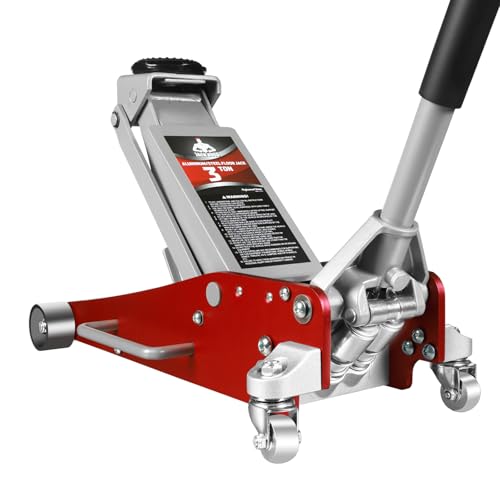
- ✓ Low-profile access
- ✓ Quick dual-pump lift
- ✓ Solid, durable build
- ✕ Heavier than budget jacks
- ✕ Limited storage space
| Lifting Capacity | 3 tons (6,600 lbs) |
| Lifting Range | 3-15/16″ to 18-5/16″ |
| Lift Height (Minimum) | 3-15/16″ |
| Lift Height (Maximum) | 18-5/16″ |
| Construction Materials | Aluminum body with welded steel frame |
| Warranty | 2 54 1-year manufacturer warranty |
You pull the Jack Boss 3 Ton Low Profile jack out of the box and notice how low it sits on the floor. It’s designed to slide under sedans with ease, even when the pavement isn’t perfectly level.
I kept thinking about those mornings when the car sits oddly high or you can’t get a proper leverage point.
The saddle is large and rubbery, which instantly felt like protection for the pinch welds and underbody paint. With the dual-pump setup, the lift happens quickly, so you’re not counting to 60 while your oil drain plug awaits.
It’s a relief to feel the weight transfer smoothly without the jack wobbling.
Underneath, the aluminum body and welded steel frame feel sturdy without being a tank. The full wheel of casters, including swivels, let you redirect it with one hand while you position the jack stands.
The low-profile height is genuinely useful for everyday cars and crossovers, not just race cars.
The minimum height almost seems engineered for those shallow garages. It slides in, catches the vehicle’s lifting points securely, and you’re good to go without wrestling with clearance.
The maintenance-free feel carries through to the handle, which is two pieces and still comfortable to carry around the driveway.
You’ll appreciate the safety notes too. Factory-tested to 4.5 tons and ANSI/ASME PASE compliant, it feels trustworthy when you’re lifting something heavier than a quick tire swap.
The included warranty adds a layer of comfort if something unexpected pops up.
If you’re balancing price and capability, this jack hits a sweet spot. It’s not only about lifting; it’s about doing it cleanly, without scratching the frame or needing a gym membership to flip the lever.
VEVOR 2.5 Ton Low Profile Heavy-Duty Steel Racing Floor

- ✓ Easy maneuverability
- ✓ Smooth hydraulic lift
- ✓ Wide height range
- ✕ Heavier than ultra-compact options
- ✕ Saddle alignment requires attention
| Load Capacity | 2.5 tons (5500 lbs) maximum lifting capacity |
| Lifting Range | Min height 3.35 in (85 mm); Max height 14.96 in (380 mm) |
| Construction Material | Rigid steel construction |
| Wheels and Maneuverability | Rear wheels: universal steel; overall mobility with front wheels not specified |
| Safety Certifications | CE (2006/42/EC EN1494), UKCA (SI 2008 NO.1597(BS EN1494)), ASME PALD-2014 safety standard compliance |
| Handle and Storage | 1200 mm (31.5 in) long two-piece handle; detachable for compact storage |
You caught me eyeing this VEVOR floor jack the moment I unboxed it. The long 31.5-inch handle immediately signals leverage, and the rubber saddle felt soft against my car’s pinch welds the first time I set it down.
First test: the min height of 3.35 inches slides under a low-slung sedan with ease, and the max height around 14.96 inches gave me enough clearance for a quick tire swap without wrestling the hydraulics. The single-piston pump responds smoothly, so you don’t feel like you’re fighting air in the system.
The steel construction feels sturdy in your hands, and the two rear wheels roll with surprising ease, even on a slightly uneven garage floor. I appreciated the two-piece handle design because storage became a no-brainer—no awkward reach or extra space needed.
As I lifted, the 5500-lb capacity gave me confidence to work on a mid-size SUV without worrying about overload. The 360° rotatable saddle is a thoughtful touch; I detached it once to swap the saddle and reattach without fuss.
Protective touches aren’t an afterthought: the foam bumper on the handle and the rubber saddle pad protect both jack and vehicle. You’ll notice the built-in safety system that helps prevent overloading, which is reassuring when you’re in the middle of a repair and time is ticking.
In real-world use, the jack feels like a dependable workhorse that respects the constraints of a busy garage. If you’re balancing price with performance, this model checks a lot of boxes without demanding a premium setup or a dedicated lifting pit.
Bottom line: it’s a practical, easy-to-maneuver jack that covers daily maintenance duties—from oil changes to brake work—with enough height versatility to cover most family cars, trucks, and SUVs.
Maxority 5-Ton Low-Profile Hydraulic Floor Jack

- ✓ Strong lifting power
- ✓ Quick lift efficiency
- ✓ Gentle on vehicle
- ✕ Heavier than basic jacks
- ✕ Slightly wide when stored
| Lifting Capacity | 5 tons (up to 11,000 lbs) hydraulic floor jack |
| Lifting Mechanism | Dual-piston quick lift hydraulic system |
| Lifting Range | Sufficient to lift cars, trucks, and SUVs (exact range not specified) |
| Construction | Heavy-duty steel construction for durability |
| Safety Features | Overload safety valve, anti-slip saddle, rubber undercarriage padding |
| Handle Design | Extra-long handle for increased leverage and easier operation |
I’ll admit, the first time I picked up the Maxority 5-Ton floor jack, I didn’t expect the long, low silhouette to feel so deceptively sturdy. A quick scrape of the rail revealed a clean weld line and the steel’s dull, professional sheen that says this isn’t a toy.
When I slid it under a mid-size pickup, the extra-long handle nearly brushed my knee, and I realized leverage would be the real story here.
The dual-piston quick lift system surprised me by how little effort it took to rise the saddle. I counted fewer strokes than I’m used to with my old jack, and the lift was almost instant once the trigger opened.
The saddle padded surface also felt kinder to the car’s frame, reducing the wobble that always makes me pause.
Moving around the garage, the low-profile design meant I could slide under the vehicle without jacking up the entire front end first. The heavy-duty steel construction stood up to repeated use, and I appreciated the anti-slip saddle that kept the car securely in place as I worked.
Safety isn’t an afterthought here. The built-in overload valve clicked confidently if I tried to push beyond its limit, and the rubber padding protected the undercarriage from scuffs.
It’s the little touches, like the sturdy wheels and the ergonomic handle, that made a routine tire change feel smoother than expected.
In real-world use, this jack hits a sweet spot for daily repairs and more ambitious mecca-level tasks alike. It’s powerful enough for trucks, yet adaptable enough for smaller cars, all while staying surprisingly user-friendly.
3 Ton Low Profile Floor Jack Heavy Duty Hydraulic Jack for

- ✓ Fast dual-piston lift
- ✓ Ultra-low profile
- ✓ Included tire kit
- ✕ Heavier than lightweight jacks
- ✕ Bulkier to store
| Lifting Capacity | 3 tons (6,000 lbs) maximum |
| Minimum Height | 3.35 inches |
| Maximum Height with pad | 17.91 inches |
| Maximum Height without pad | 16.93 inches |
| Lifting Mechanism | Dual-piston hydraulic pump |
| Included Accessories | 2 rubber lift-point pads and 8-piece tire repair kit |
I spotted this 3-ton low-profile floor jack on my wishlist and finally got my hands on it. The first thing that stood out was the ultra-slim 3.35″ low height, which slides under a slammed sports car with ease.
I gave the saddle a quick press and felt how sturdy the steel frame is—you’re not wobbling this one while you pop a wheel.
The dual-piston quick-lift system is a real time-saver. With just a few confident strokes, I watched the jack climb to full height faster than my older single-pump model.
It’s smooth too, not that jolt-and-jumble feel that makes you nervous under a car.
Setup is straightforward. The long reach is a noticeable win for low-clearance cars and oddball suspension setups.
The pad and bumper protect your pinch welds and paint, which is always a relief when you’re juggling a repair on a night shift or a windy weekend.
The kit that comes with it is surprisingly handy. Two rubber pads soften contact points, and the 8-piece tire repair kit saves you a roadside headache.
You’ll appreciate that nothing extra is needed to handle tubeless tires, which is perfect for quick tire fixes.
In use, the safety valve gives you confidence not to over-pump, even if you’re tired. It lifts up to 17.91″ with the pad, which is plenty for most brake jobs, oil changes, and light-duty suspension work.
You can tell this is built for real garage use, not just a showroom demo.
If you’ve got lowered cars, modified builds, or simply want a jack that doesn’t demand a second mortgage, this one checks a lot of boxes. It’s heavy enough to feel substantial, but not so bulky you can’t wheel it around.
Overall, it’s a dependable, fast, and thoughtful jack that makes routine work easier and less stressful. It’s a strong contender for anyone who wants a high-capacity, low-profile jack without compromising safety.
What Should You Consider When Choosing the Best Garage Floor Jack?
When selecting the best garage floor jack, several important factors should be taken into account.
- Weight Capacity: Consider the maximum weight the jack can safely lift, which typically ranges from 2 to 3 tons for most garage jacks. Ensure that it can handle your vehicle’s weight, including any additional equipment or cargo.
- Lifting Height: Evaluate the minimum and maximum lifting heights of the jack to ensure it will fit comfortably under your vehicle. A jack that can lift higher can provide better access for repairs or maintenance tasks.
- Construction Material: Look for jacks made from durable materials like steel or aluminum, which offer stability and longevity. Aluminum jacks tend to be lighter and easier to maneuver, while steel jacks are usually more robust but heavier.
- Portability: If you need to move the jack around frequently, consider its weight and whether it has features such as wheels or a compact design for easy storage. A portable jack can save you time and effort when working in different areas of your garage.
- Safety Features: Check for safety features such as a built-in safety lock, overload protection, and a stable base to prevent tipping. These features can enhance your safety while working under your vehicle.
- Ease of Use: Look for jacks that are easy to operate with smooth lifting and lowering mechanisms, ideally with a long handle for better leverage. User-friendly designs can help reduce the effort needed to lift a vehicle.
- Brand Reputation and Reviews: Research reputable brands and read user reviews to gauge the performance and reliability of various models. Trusted brands typically offer better customer service and warranty options, which can be crucial if issues arise.
How Do Weight Capacity and Lift Height Affect Your Choice?
When selecting the best garage floor jack, weight capacity and lift height are two critical factors to consider.
- Weight Capacity: The weight capacity of a garage floor jack indicates the maximum load it can safely lift. It is crucial to choose a jack with a capacity that exceeds the weight of the vehicle you intend to lift, allowing for a safety margin that accounts for any additional equipment or cargo.
- Lift Height: Lift height refers to the maximum elevation the jack can achieve when lifting a vehicle. A higher lift height is beneficial for accessing undercarriage components for repairs or maintenance, especially for larger vehicles like trucks and SUVs that may require more clearance.
- Stability and Safety Features: Alongside weight capacity and lift height, the stability of the jack during use is essential. Look for models with wide bases or rubber pads that enhance grip and prevent slipping, ensuring safety while working underneath the vehicle.
- Portability: Consider the portability of the jack, especially if you need to move it around your garage or transport it. Lightweight designs or those with wheels can make it easier to handle, while compact models can be stored conveniently when not in use.
- Construction Material: The material used in the construction of the jack can affect its durability and performance. Steel jacks tend to be sturdier and more durable, whereas aluminum options are generally lighter and easier to maneuver, but they may not have the same weight capacity.
What Safety Features Should You Look for in a Garage Floor Jack?
When searching for the best garage floor jack, it’s essential to consider several safety features to ensure effectiveness and reliability.
- Safety Valve: A safety valve prevents the jack from overloading and potentially failing under excessive weight. This feature ensures that the hydraulic system does not exceed its rated capacity, providing peace of mind during lifting operations.
- Rubberized Jacks: Rubberized lifting pads help create a stable grip on the vehicle, reducing the risk of slipping during use. This added friction also protects the vehicle’s undercarriage from damage, making it a practical choice for car enthusiasts.
- Stability Features: Look for jacks with a wide base or low-profile design for enhanced stability while lifting. A more stable jack reduces the chance of tipping over, which is crucial when dealing with heavy vehicles.
- Quick Release Mechanism: A quick release mechanism allows for controlled lowering of the vehicle, preventing it from dropping suddenly. This feature is vital for maintaining safety when you need to lower your vehicle back to the ground after repairs.
- Durable Construction: Jacks made from high-quality materials like steel or aluminum are typically more robust and safer. A durable construction ensures that the jack can withstand repeated use without compromising its structural integrity.
- Height Adjustment Range: A jack with an extensive height adjustment range can accommodate various vehicle sizes and types. This flexibility is crucial for safely lifting both low-profile cars and larger SUVs.
- Safety Pins or Locks: Some jacks come equipped with safety pins or locks to secure the lifting arm in place. This feature adds an extra layer of safety by preventing accidental lowering while you are working under the vehicle.
What Are the Different Types of Garage Floor Jacks Available?
The different types of garage floor jacks available include:
- Floor Jacks: These are the most common type of garage jacks, designed to lift vehicles quickly and safely.
- Bottle Jacks: Compact and portable, bottle jacks are ideal for lifting heavy loads in tight spaces.
- Scissor Jacks: Often included with vehicles, scissor jacks are lightweight and easy to use for emergency situations.
- Hydraulic Jacks: Utilizing hydraulic fluid to lift heavy weights, these jacks are known for their efficiency and strength.
- Pneumatic Jacks: Powered by compressed air, pneumatic jacks offer rapid lifting capabilities, making them suitable for professional garages.
Floor jacks are characterized by their wide base and long handle, allowing for easy maneuverability in a garage setting. They typically have a lifting capacity of up to 3 tons, making them versatile for most vehicles, including cars and SUVs.
Bottle jacks have a vertical design and are known for their high lifting capacity relative to their size, often reaching up to 12 tons or more. They are particularly useful when space is limited, but they require a stable surface to operate safely.
Scissor jacks are designed with a simple mechanism that allows them to expand and lift a vehicle as the handle is turned. They are lightweight and convenient for roadside emergencies but generally have a lower lifting capacity, making them less ideal for regular garage use.
Hydraulic jacks are favored for their ability to lift heavy loads with minimal effort due to the hydraulic system, which distributes the weight evenly. They are often used in professional settings for their reliability and ease of use, though they can be heavier and more expensive than other types.
Pneumatic jacks are a great option for those who need to lift vehicles frequently and quickly. Their operation relies on compressed air, providing a faster lifting time compared to manual jacks, making them popular in busy automotive shops.
How Does a Hydraulic Garage Floor Jack Work?
A hydraulic garage floor jack operates using hydraulic fluid to lift heavy vehicles with ease and efficiency.
- Hydraulic System: The core mechanism of the jack relies on Pascal’s principle, which states that pressure applied to a confined fluid is transmitted undiminished throughout the fluid. This means that when you pump the jack handle, hydraulic fluid is forced through a cylinder, creating enough pressure to lift the vehicle.
- Pump Handle: The pump handle is a crucial component that allows the user to create pressure in the hydraulic system. By repeatedly pushing down on the handle, the user compresses the hydraulic fluid, which builds up the pressure needed to lift the jack’s lifting arm and, consequently, the vehicle.
- Lifting Arm: The lifting arm is the part of the jack that directly supports the vehicle. When hydraulic pressure is applied, the lifting arm elevates to raise the vehicle off the ground. The design of the arm allows for a stable lift, ensuring safety while working underneath the vehicle.
- Release Valve: The release valve is an essential safety feature that allows the user to lower the vehicle safely after repairs are completed. When the valve is opened, hydraulic fluid is released from the cylinder, allowing the lifting arm to descend gradually, preventing any sudden drops that could cause injury or damage.
- Wheel Casters: Many hydraulic floor jacks are equipped with wheel casters that provide mobility. These casters allow the jack to be easily maneuvered under a vehicle, making it convenient to position the jack in the optimal location for lifting.
What Are the Benefits of a Low Profile Garage Floor Jack?
The benefits of a low profile garage floor jack include enhanced accessibility, ease of use, and improved stability.
- Enhanced Accessibility: Low profile jacks can fit under vehicles with minimal ground clearance, making them ideal for sports cars, lowered vehicles, or any automobile that sits close to the ground. This feature allows users to perform maintenance and repairs without the complications of lifting the vehicle excessively.
- Ease of Use: These jacks are generally designed to be lightweight and easy to maneuver, allowing users to position them conveniently and pump them with less effort. The compact nature of low profile jacks means they often require less storage space, making them a practical choice for home garages.
- Improved Stability: Low profile garage floor jacks are built with a wider stance, providing increased stability when lifting heavy vehicles. This design minimizes the risk of tipping or slipping during use, ensuring a safer environment for both the user and the vehicle being serviced.
- Higher Lifting Capacity: Many low profile jacks are engineered to support substantial weight while still maintaining a low profile. This means users can lift heavier vehicles without compromising on the jack’s height limitations, making them versatile for a variety of automotive tasks.
- Durability and Build Quality: Typically constructed from heavy-duty materials, low profile jacks are designed to withstand rigorous use over time. Their robust build not only enhances longevity but also contributes to better performance and reliability during lifting operations.
What Are the Top Brands Known for Offering High-Quality Garage Floor Jacks?
The top brands known for offering high-quality garage floor jacks include:
- Arcan: Arcan jacks are well-regarded for their durability and reliable performance, often featuring a low profile design which makes them ideal for sports cars and lowered vehicles. They typically have a high lifting capacity and quick lift technology, allowing users to elevate their vehicles efficiently.
- Sunex: Sunex jacks are popular for their robust construction and innovative features such as a universal joint release that provides precision control in lowering the vehicle. They are designed with a wide stance for stability and often come with a variety of lifting capacities to suit different needs.
- Torin: Torin is known for offering affordable yet reliable floor jacks, often featuring a lightweight aluminum construction that makes them easy to maneuver. Their jacks typically include safety features like a safety valve and a rubber saddle to protect the vehicle’s frame during use.
- Neiko: Neiko jacks are appreciated for their compact design and ease of use, making them a great choice for both professionals and DIY enthusiasts. They often incorporate a rapid pump system that allows for quick lifting and have a high weight capacity, enhancing their versatility.
- Blackhawk: Blackhawk jacks are recognized for their heavy-duty build and are often used in professional settings. They typically feature a high lifting range and sturdy wheels, providing stability and ease of movement even under heavy loads, making them suitable for various automotive tasks.
How Can You Ensure Safe Use of a Garage Floor Jack?
Inspect Before Use: Conducting a pre-use inspection allows you to identify any potential hazards such as leaks, rust, or mechanical failures. This preventative measure can prevent accidents caused by equipment malfunction during operation.
Use on a Level Surface: Operating your floor jack on an uneven or inclined surface increases the risk of the jack slipping or tipping over, which can lead to severe injury or damage. Always find a flat area and, if necessary, use wheel chocks to stabilize the vehicle.
Employ Jack Stands: Once the vehicle is lifted, jack stands provide essential support and stability, acting as a backup in case the jack fails. Never rely solely on the jack to hold the vehicle up while you work underneath.
Follow Manufacturer Instructions: Each garage floor jack comes with specific operating instructions that include weight limits and operational guidelines. Following these instructions is vital for maintaining safety and ensuring the jack functions as intended, reducing the risk of accidents.
What Common Mistakes Should You Avoid When Using a Garage Floor Jack?
When using a garage floor jack, avoiding common mistakes is crucial for safety and efficiency.
- Not Choosing the Right Jack: Selecting a jack that cannot support the weight of your vehicle can lead to accidents. Ensure the jack’s capacity exceeds your vehicle’s weight, as using one that is too light can result in failure and potential injury.
- Neglecting Safety Stands: Failing to use jack stands to secure the vehicle after lifting is a serious mistake. A jack alone is not a reliable support system; if it fails, the vehicle could fall, causing injury or damage.
- Improper Placement of the Jack: Placing the jack on an unstable surface or in the wrong location can lead to instability while lifting. Always consult your vehicle’s manual for the correct lifting points and ensure the jack is on a flat, solid surface.
- Overloading the Jack: Exceeding the weight limit of the jack can cause it to fail, leading to dangerous situations. Always know the specifications of your jack and do not attempt to lift anything heavier than its capacity.
- Ignoring Maintenance: Regular maintenance of your garage floor jack is essential for safe operation. Check for signs of wear, lubricate moving parts, and ensure the hydraulic fluid levels are adequate to maintain performance and safety.
- Rushing the Process: Hurrying while using a garage floor jack can lead to careless mistakes, such as improper placement or forgetting safety measures. Take your time to ensure everything is correctly set up before lifting, as rushing increases the risk of accidents.