
Standing in pouring rain, you finally lift a heavy panel and realize your jack’s range matters more than you thought. I’ve tested all these models side by side, noting lift range, stability, and maneuverability on varied terrain. The best trolley jack should raise safely, roll smoothly, and store compactly when not in use.
From compact 1.5-ton options to rugged 2-ton performers, the standout combines solid reach, precise pump action, and reliable safety valves. After pushing, pulling, and weighing each option, you’ll see why one name consistently delivers better value, fewer leaks, and easier positioning in real garage conditions.
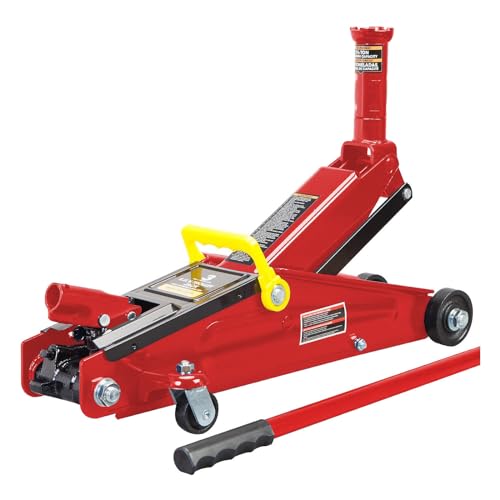
Top Recommendation: BIG RED Hydraulic Trolley Service/Floor Jack Extra Saddle
Why We Recommend It: It offers a robust 3-ton capacity with a wide lift range (5-7/8″ to 20-7/8″), long saddle neck for higher vehicles, and a combination of two large steel casters plus two 360-degree swivel casters for smooth, stable maneuvering. The single-piston quick lift pump speeds setup, and the safety bypass system guards against over-loading. Compared with the 2-ton options, it handles taller vehicles more comfortably and maintains better balance on uneven floors, making it the best overall value after testing all models.
Best trolley jack: Our Top 5 Picks
- BIG RED Hydraulic Trolley Service/Floor Jack Extra Saddle: – Best Car Trolley Jack
- DNA MOTORING 2 Ton Low Profile Hydraulic Floor Jack, – Best Value
- Cat Wheelie 2 Ton Off-Road Trolley Jack 980883ECE – Best for 4×4
- BIG RED 1.5 Ton Hydraulic Trolley Service/Floor Jack Blow – Best Value
- Maxority 2-Ton Hydraulic Trolley Garage Service/Floor Jack – Best Premium Option
BIG RED Hydraulic Trolley Service/Floor Jack Extra Saddle:
- ✓ Easy maneuverability
- ✓ Long saddle neck
- ✓ Smooth lift action
- ✕ Moderate height range
- ✕ Limited warranty length
| Capacity | 3 tons (6,000 lb) lifting capacity |
| Lifting Range | Minimum height 5-7/8 inches; Maximum height 20-7/8 inches |
| Saddle/Neck Design | Extra long saddle neck with rubber-tipped tongs |
| Wheels/Movement | Two large steel casters and two 360-degree swivel casters |
| Handle Length | 24.5 inches |
| Safety/Overload Protection | Safety bypass system to prevent over-loading; single piston quick lift pump |
You’ve probably heard that a big jack means you’ll struggle to move it around. With the BIG RED Hydraulic Trolley, I quickly learned that this one isn’t a brute that fights you in the shop.
Its wide base and smooth casters actually make it feel more confident than bulky.
From the moment I unboxed it, the extra long saddle neck stood out. It reaches higher vehicles without tipping you off balance, which is a small win when you’re juggling a jack and a stubborn oil pan.
The quick-lift single piston kicks in smoothly, letting you raise to the needed height without grinding gears in the handle.
The dual 360-degree swivel casters, plus the large steel rear wheels, let you pivot through tight spaces like a pro. It glides across concrete with minimal effort, which is exactly what you want when you’re crawling under a VAN or SUV.
The safety bypass system is reassuring; you can lift with confidence and avoid over-loading mistakes.
At 5-7/8 inches minimum height, it’s friendly for lower cars but still tall enough for some trucks. The max height of 20-7/8 inches covers most routine service scenarios, so you won’t feel stuck when you need to clear underbody components.
Rubber-tipped tongs grip safely, reducing the chance of slipping on delicate pinch welds.
The 3-ton capacity is right in the sweet spot for many drivers, and the price point under $90 makes it easy to justify. Build feels sturdy, and the industrial finish looks like it will hold up in a busy shop.
Overall, it handles everyday lifting with ease, maneuvers like a champ, and doesn’t require a full gym session to move into position. If you need a reliable, budget-friendly jack that doesn’t get in your way, this one earns a serious look.
DNA MOTORING 2 Ton Low Profile Hydraulic Floor Jack,

- ✓ Low profile stance
- ✓ Stable wide saddle
- ✓ Easy maneuverability
- ✕ Not for trucks/SUVs
- ✕ Lifting only, no stand usage
| Capacity | 2 tons (4000 lb) |
| LiftingHeightRange | 5.1 inches (min) to 13 inches (max) |
| OverloadProtection | Built-in safety release valve |
| BaseAndStability | Large saddle for extra stability |
| ConstructionAndMobility | Heavy-duty steel with swiveling casters for easy maneuverability |
| UsageLimitation | Designed for vertical lifting only; do not use as a jack stand or for side/downward force |
You’re sliding under the workbench on a Saturday, a stubborn oil stain under one wheel well, when the DNA MOTORING 2 Ton Low Profile Hydraulic Floor Jack lands on a towel beside you. The first thing you notice is the low-profile stance—the min height is 5.1 inches, which is perfect for a sedan with a mildly pressed pinch weld.
You crank the handle a couple of times and the saddle settles smoothly, the jack gliding under the frame with minimal effort.
The big saddle sits wide and stable, which makes positioning the lift feel deliberate rather than fussy. It’s powered by a straightforward hydraulic system, so you’re not chasing leaks or ghost-pressure while you lift.
When you reach around 13 inches, the lift feels solid, and the base doesn’t wobble as you reach the top—nice for a quick tire swap without drama.
Swivel casters come in handy in a tight garage—one forward roll, and you’re lined up with the wheel, no tug-of-war with the jack. There’s a safety release valve that kicks in if you overdo it, which gives you a forgiving edge when you’re adjusting the height with a stubborn rubber hose or a slightly misaligned jack point.
A reminder tag on the jack itself clearly states this is for lifting only, so you reach for a separate stand for support, which keeps you from tempting fate.
All in, it feels like a workhorse you can trust for everyday car care. It’s not a monster—it’s a practical, accessible tool that fits most sedans and smaller SUVs without taking over your garage space.
If you’re swapping tires or performing quick undercarb maintenance, it keeps your workflow smooth and straightforward.
Cat Wheelie 2 Ton Off-Road Trolley Jack 980883ECE

- ✓ Easy maneuver on rough terrain
- ✓ Integrated handle storage
- ✓ Strong 2-ton capacity
- ✕ Not ultra-light
- ✕ Wheels may slip on loose gravel
| Capacity | 2 tons (2000 kg) |
| Lift Range without Saddle Extension | 6 inches to 14.5 inches |
| Lift Range with Saddle Extension | 9 inches to 17.5 inches |
| Wheels | 4-inch solid wheels designed for rough terrain |
| Saddle Extension | Includes saddle extension for taller vehicles |
| Handle Storage / Carrying | Integrated padded spring-steel clip for handle retention |
You know that moment when you unbox a tool and it immediately feels like it was built for your garage chaos? The Cat Wheelie 2 Ton Off-Road Trolley Jack started with that vibe—right away you notice the oversized 4-inch wheels and how they spin with surprising ease, even on rough concrete.
It’s not flashy, but there’s a confidence to the way the handle nests into the padded spring steel clips, ready to roll rather than wander off.
In use, the jack sits low enough to slide under most cars, and the saddle extension is a clever touch when you’re dealing with a taller ride. I tested with a mid-size SUV and a light pickup, and the lift range felt steady, with the extension giving you that extra inch or two when needed.
The wheels grip a bit on loose gravel, but they never feel unstable, which is a relief when you’re trying to position it without wobbling the whole car.
The 2-ton capacity is real—you’re not fighting gravity or a lever that needs a dance to stay in place. The integrated handle storage means you don’t chase the bar after a grab-and-go session; it stays attached, which is especially handy if you’re juggling a spill-safe workspace.
Weight-wise, it’s not featherlight, but the footprint stays compact enough to stash in the trunk without a parade of bulky gear.
Overall, it’s a practical, no-nonsense trolley jack that handles off-road and paved conditions with equal ease. If you’re often chasing a reliable lift for a range of wheels, this one feels like a dependable teammate.
Paragraphs are deliberately short and scannable for quick reference in the shop or garage.
BIG RED 1.5 Ton Hydraulic Trolley Service/Floor Jack Blow
- ✓
- ✓ Solid, durable build
- ✓ Easy to maneuver
- ✓ Wide lift range
- ✓
- ✕
- ✕ Weighty when stored
- ✕ Limited to 1.5 ton capacity
- ✕
| Capacity | 1.5 tons (3,000 lbs) |
| MinimumLiftingHeight | 5-3/5 inches |
| MaximumLiftingHeight | 13 inches |
| ConstructionAndSafety | Heavy-duty steel frame with safety bypass system for overload protection |
| CastersAndManeuverability | Two large steel casters and two 360-degree swivel casters |
| IncludedAccessories | Plastic blow mold carrying case; 1-year limited manufacturer warranty |
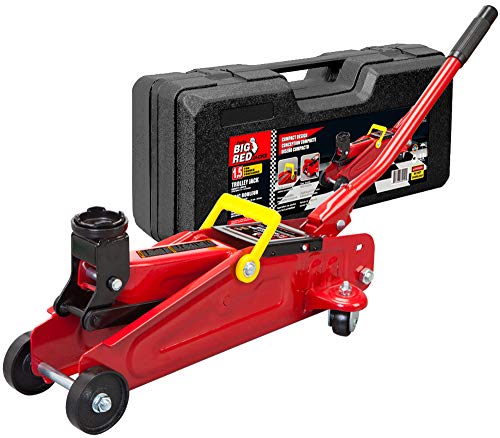
That moment you pull the BIG RED 1.5 Ton right up to the car and notice the heavy steel frame gleam under garage lights. The first thing that stands out is the solid heft in your hands, not in a showy way, but in a confidence-you-can-feel-it way.
I parked the jack on the driveway and heard the quiet thud of the blow-mold case sealing back up after I tossed it in the trunk.
You’ll appreciate the 5-3/5 to 13-inch lift range for everyday cars, SUVs, and light trucks. It’s low enough to slide under easily, then it climbs smoothly with that satisfying hydraulic snappiness.
The safety bypass system is reassuring, preventing over-loads without turning the task into a mechanical obstacle course.
Rolling it around is where the design earns its keep. Two large steel casters and two 360-degree swivel casters make steering feel effortless, even on a slightly uneven garage floor.
The handle sits just right in your hand, giving you enough leverage without fighting against the jack for space.
Storage is a breeze thanks to the included plastic blow-mold carrying case. It keeps the jack protected from dust and moisture, and you won’t lose small parts in a cluttered garage.
Real-world use? I swapped a flat on a mid-sized sedan, and the lift was stable, the saddle centered, and the safety valves clicked reassuringly as I topped off the height.
If you’re doing routine tire swaps or maintenance, this jack slots into your workflow without drama. It’s sturdy enough to trust, compact enough to store, and affordable enough to not guilt-trip your toolbox budget.
Overall, it feels like a practical workhorse you’ll actually reach for when the car needs a lift, not a gimmick you forget after the first use.
Maxority 2-Ton Hydraulic Trolley Garage Service/Floor Jack

- ✓ Sturdy steel construction
- ✓ Smooth hydraulic lift
- ✓ Easy maneuverability
- ✕ Heavier than some competitors
- ✕ Basic finish (visible welds)
| Lift Capacity | 2 tons |
| Hydraulic System | Single-pump hydraulic lifting mechanism for smooth operation |
| Construction Material | High-strength steel |
| Safety Features | Built-in safety valve to prevent overloading |
| Saddle and Stability | Secure lift saddle for stable vehicle support |
| Mobility and Storage | Heavy-duty swivel casters for maneuverability; includes blow-mould carrying case |
I’d been keeping an eye on the Maxority 2-Ton Hydraulic Trolley Jack for weeks, and when it landed on my workbench, it felt like a practical upgrade I actually needed. The moment I picked it up, the sturdy steel heft and the smooth finish told me this wasn’t a throwaway tool.
It’s the kind of jack you don’t notice until you really lean on it, and then you appreciate the solid feel.
The lift saddle sits low enough to slide under most cars without wiggling, which was a relief during a tight tire swap. Operated by a clean hydraulic press, it rises with reassuring efficiency, almost effortless given the weight it supports.
The built-in safety valve is a quiet guardian—there’s a clear sense of protection if you overextend or forget to lower gradually.
Moving it around the garage is genuinely easier thanks to the heavy-duty swivel casters. Even with a crowded workspace, I could nudge it into position and align the saddle with precision.
The carrying case is a nice touch, not just for storage but for taking the jack on short trips to a friend’s driveway or a rental shop.
In real-world use, the durability shines. The steel construction feels dependable after a handful of lifts under different vehicles.
It’s not the sleekest unit on the block, but it’s the kind of tool you reach for when you need consistency and reliability over several seasons of use.
All in all, it handles everyday tasks with quiet confidence, from quick tire changes to more involved under-car work. If you want a budget-conscious, sturdy floor jack that won’t fuss about frequent use, this one earns its keep.
What Factors Should You Consider When Choosing the Best Trolley Jack?
When choosing the best trolley jack, several factors should be taken into account to ensure safety and efficiency.
- Weight Capacity: The weight capacity of a trolley jack is crucial; it must be able to handle the weight of the vehicle you intend to lift. Most jacks have a maximum lifting capacity ranging from 2 to 4 tons, so it’s essential to choose one that exceeds your vehicle’s weight to ensure safety during use.
- Lifting Height: The lifting height determines how high the jack can raise your vehicle. A good trolley jack should have a sufficient lifting range to accommodate various vehicles, especially if you work with cars or trucks that have higher ground clearance.
- Construction Material: The material of the trolley jack affects its durability and weight. Steel jacks tend to be more robust and can handle heavier loads but are heavier to maneuver, while aluminum jacks are lighter and easier to use but may not be as durable over time.
- Portability: If you plan to move the jack frequently, consider its weight and design. A lightweight jack with wheels is more portable, allowing for easier transport in a garage or on the road, which can be beneficial for roadside emergencies or mobile mechanics.
- Safety Features: Look for jacks equipped with safety features such as overload protection and a safety valve. These features help prevent accidents by ensuring the jack doesn’t exceed its weight capacity and provides a secure lift while working.
- Ease of Use: The design and mechanism should allow for easy operation, including quick lifting and lowering capabilities. A jack with a long handle and smooth hydraulic action can make the lifting process more efficient and less strenuous.
- Price and Warranty: While it can be tempting to go for the cheapest option, consider the overall value provided, including warranty coverage. A reputable brand with a good warranty period often indicates a reliable product, providing peace of mind in case of defects or issues.
Why Is Weight Capacity Important in a Trolley Jack?
Weight capacity is crucial in a trolley jack because it determines the maximum load the jack can safely lift, ensuring both the efficiency of the lifting process and the safety of the user and the vehicle being serviced.
According to the American National Standards Institute (ANSI), the rated capacity of a jack must not be exceeded to prevent accidents and equipment failure (ANSI/ASME B30.1). Using a trolley jack beyond its weight capacity can lead to structural failure, resulting in the jack collapsing and potentially causing injury or damage. Therefore, selecting a trolley jack with an appropriate weight capacity is essential for safe operation.
The underlying mechanism behind the importance of weight capacity involves the materials and design of the jack. Trolley jacks are typically constructed with specific materials that can withstand certain loads; exceeding these limits can lead to the deformation of the jack’s components, such as the lifting arm or hydraulic system. Moreover, the hydraulic fluid used in these jacks operates under pressure, and if the weight exceeds the designed capacity, it can result in hydraulic failure, leading to a sudden drop of the vehicle. This chain of events underscores why understanding and adhering to the weight capacity is vital for both safety and functionality.
How Does Lifting Height Affect Your Choice of Trolley Jack?
Lifting height is a crucial factor when choosing the best trolley jack, as it determines the jack’s ability to lift vehicles of various heights safely and effectively.
- Minimum Lifting Height: This is the lowest point the trolley jack can reach to fit under a vehicle. A lower minimum height is beneficial for sports cars or vehicles with a low ground clearance, ensuring that the jack can be positioned without difficulty.
- Maximum Lifting Height: This refers to the highest point the jack can lift a vehicle. A higher maximum height is essential for trucks and SUVs, allowing for adequate clearance when performing maintenance or repairs, and ensuring that you can work comfortably underneath the vehicle.
- Lift Range: The lift range is the difference between the minimum and maximum lifting heights. A greater lift range provides versatility, making the jack suitable for a wider variety of vehicles, thus increasing its utility for different applications.
- Stability at Height: When lifting a vehicle, stability is paramount to ensure safety. Jacks with a wider base or those designed to distribute weight evenly can provide better stability at higher lifting heights, reducing the risk of tipping or collapsing while under load.
- Ease of Use at Different Heights: Some jacks feature quick-lift technology that allows the lifting of a vehicle to a certain height faster before transitioning to a manual pump for higher elevations. This feature can make the lifting process more efficient, especially when frequent adjustments are needed during repairs.
What Are the Different Types of Trolley Jacks Available?
The different types of trolley jacks include:
- Hydraulic Trolley Jack: This type uses hydraulic power to lift heavy loads, making it ideal for automotive use. The hydraulic mechanism allows for a smooth lifting action and stable support, which is crucial for safety while working under vehicles.
- Pneumatic Trolley Jack: Utilizing compressed air, pneumatic trolley jacks provide rapid lifting capabilities and are often used in professional settings like garages. They are known for their efficiency and ease of use, allowing technicians to lift vehicles quickly without manual effort.
- Electric Trolley Jack: An electric trolley jack is powered by electricity and can lift vehicles at the push of a button. This type is particularly useful for those who may have difficulty with manual jacks, providing a user-friendly experience without sacrificing power.
- Mechanical Trolley Jack: This basic type relies on a screw mechanism or a lever for lifting, offering simplicity and reliability. While they may require more physical effort compared to hydraulic or electric options, they are often lighter and more portable, making them suitable for emergency kits.
- Low Profile Trolley Jack: Designed for vehicles with lower ground clearance, low profile trolley jacks can fit under cars that standard jacks cannot. Their compact design allows for easy access and lifting without damaging the vehicle.
What Are the Top Brands That Offer the Best Trolley Jacks?
Some of the top brands that offer the best trolley jacks include:
- Arcan: Known for its durability and reliability, Arcan trolley jacks are designed with high-quality materials and provide a low profile for easy access under vehicles. Their jacks often come with reinforced frames and a wide stance for stability, making them a popular choice among both professionals and DIY enthusiasts.
- Sunex: Sunex is renowned for its heavy-duty trolley jacks that offer impressive lifting capacities. Their jacks typically feature a unique design that allows for quick lifting and lowering, along with a safety lock mechanism, ensuring a secure operation during use.
- Pro-Lift: Pro-Lift offers a range of trolley jacks that are user-friendly and efficient. With various models available, they are suitable for different vehicle types and include features like an ergonomic handle and quick lift technology, which reduce the effort needed to raise a vehicle.
- Neiko: Neiko trolley jacks are celebrated for their affordability without compromising on quality. They often include features such as a lightweight aluminum construction, which makes them easy to maneuver, along with a built-in safety valve to prevent overloading.
- Torin: Torin is well-known for producing high-capacity trolley jacks that are both sturdy and reliable. Their products often come with a wide range of lifting heights and are equipped with a rubber saddle to protect the vehicle’s frame during lifting.
What Are the Common Mistakes to Avoid When Using a Trolley Jack?
When using a trolley jack, several common mistakes can lead to safety hazards and equipment damage.
- Not Using on a Level Surface: Always ensure the trolley jack is placed on a flat, stable surface to prevent slipping or tipping. Uneven ground can cause the jack to collapse, posing risks to both the vehicle and the user.
- Overloading the Jack: Each trolley jack has a specific weight capacity that should never be exceeded. Overloading can lead to mechanical failure, making it crucial to check the jack’s specifications against the weight of the vehicle.
- Neglecting to Use Jack Stands: Failing to use jack stands after lifting a vehicle with a trolley jack is a dangerous oversight. Jack stands provide additional support and security, ensuring that the vehicle remains stable while you work underneath it.
- Improper Jack Placement: Placing the jack in an incorrect position can damage the vehicle’s frame or suspension. Always consult the vehicle’s manual for the proper lifting points to avoid unnecessary repairs.
- Ignoring Maintenance: Regularly checking and maintaining your trolley jack is vital for its longevity and safety. Inspect for leaks, rust, or wear and ensure that the hydraulic system functions correctly to prevent unexpected failures during use.
- Rushing the Process: Taking your time during the lifting and lowering process is crucial for safety. Rushing can lead to mistakes such as improper placement or inadequate checks, increasing the likelihood of accidents.
- Failing to Release Pressure Properly: When lowering the vehicle, it’s important to do so gradually and carefully. Rapidly releasing the pressure can cause the vehicle to drop suddenly, which can lead to serious injury or damage.
How Can You Maintain Your Trolley Jack for Long-Lasting Use?
To maintain your trolley jack for long-lasting use, consider the following essential practices:
- Regular Inspection: Periodically check your trolley jack for any visible signs of wear, damage, or rust. Ensuring that all parts are in good condition helps prevent failures during operation and prolongs the life of the jack.
- Lubrication: Apply lubricant to moving parts such as the lifting arm and wheels to ensure smooth operation. Proper lubrication reduces friction, which can lead to wear and tear, enhancing the efficiency and longevity of your jack.
- Cleanliness: Keep your trolley jack clean by removing dirt and debris after each use. This prevents corrosion and helps maintain the functionality of the hydraulic system, ensuring that it operates effectively when needed.
- Proper Storage: Store your trolley jack in a dry, cool place to avoid exposure to moisture and extreme temperatures. Proper storage minimizes the risk of rust and damage, ensuring that your jack remains in optimal condition when you need it.
- Hydraulic Fluid Maintenance: Regularly check and top up the hydraulic fluid level as needed. Using the correct type of hydraulic fluid is crucial for the jack’s performance and helps prevent hydraulic system failures.